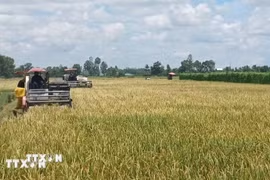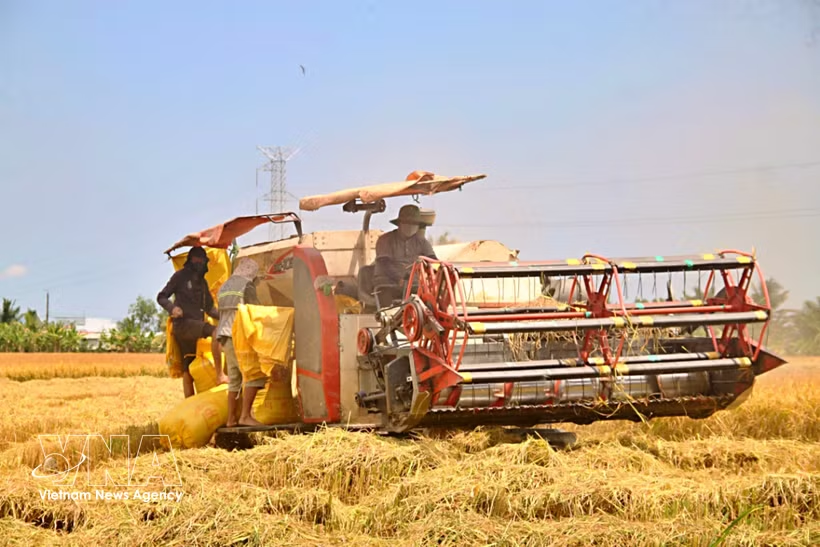
Hanoi (VNA) – Vietnam is accelerating efforts to cut greenhouse gas emissions from crop production as part of its strategy to build a greener, more sustainable agricultural sector while maintaining the competitiveness of its farm exports.
Vietnam is among the world's leading producers and exporters of agricultural products, including rice, coffee and a wide range of fruits. However, key export markets such as the US, the European Union (EU) and Japan are tightening sustainability requirements for agricultural products, making the transition to low-emission farming increasingly important.
Experts say reducing emissions is not only essential for tackling climate change but also brings tangible benefits to farmers and businesses. Farming practices such as alternate wetting and drying (AWD) irrigation for rice, integrated nutrient management, organic farming, precision agriculture and climate-smart agriculture have helped reduce the use of chemical fertilisers, pesticides and irrigation water. This lowers production costs, improves farmers' incomes and enhances the quality of agricultural products.
The reduced use of agricultural inputs also helps restore soil health, protect biodiversity and reduce environmental pollution, contributing to the long-term sustainability of the sector.
Developing low-emission crop production is also expected to strengthen Vietnam's reputation as a responsible agricultural producer while creating opportunities to participate in both voluntary and compliance carbon markets. Carbon credit projects could provide new sources of income for farmers, cooperatives and agribusinesses, supporting the sector's green transition.
To advance these goals, the Ministry of Agriculture and Environment has approved the Low-emission Crop Production Scheme for 2025–2035, with a vision to 2050, and established a steering committee to oversee its implementation.
So far, 22 provinces and cities have issued action plans under the scheme, while international organisations, businesses and local authorities have joined pilot programmes promoting low-emission farming.
Several localities have already launched large-scale initiatives. Quang Tri province has introduced low-emission rice cultivation across 13 communes, covering more than 6,000 hectares. Hung Yen province plans to apply AWD irrigation on 3,000 hectares of rice fields in 2026, supported by equipment to measure emission reductions.
However, experts stress that achieving the scheme's targets will require coordinated efforts across all levels of government and the active participation of farmers, cooperatives and businesses.
They say success depends on a comprehensive, long-term programme that combines technical solutions with supportive policies, financing mechanisms, scientific research, technology transfer, training, communications and international cooperation.
Deputy Minister of Agriculture and Environment Hoang Trung said the scheme aims to build a sustainable crop production sector that is resilient to climate change, reduces greenhouse gas emissions, lowers production costs, raises farmers' incomes and enhances the international standing of Vietnamese agricultural products.
In the coming years, the ministry will continue refining technical processes for key crops, including rice, maize, coffee and durian, while expanding pilot low-emission production models and developing a nationwide measurement, reporting and verification (MRV) system for emissions.
For rice cultivation, AWD irrigation will be promoted on a wider scale. Coffee production will focus on circular farming models, water-saving irrigation, greater use of organic fertilisers, reuse of agricultural by-products and soil restoration.
Fruit-growing areas producing durian, dragon fruit, mangoes and passion fruit will focus on managing agricultural by-products to meet the green production standards of export markets./.
See more
European business confidence in Vietnam climbs to near seven-year high
EuroCham's latest survey shows European business confidence rebounding to its highest level in nearly seven years, driven by stronger demand despite global uncertainty.
Vietnam, Japan enhance experience sharing in stock market development
Deputy Minister of Finance Nguyen Duc Chi and representatives of Japan's Financial Services Agency (JFSA) and Securities and Exchange Surveillance Commission (SESC) have exchanged experience in securities market development, financial regulation and innovation.
"Live data" paves way for Vietnamese farm exports
Achieving Vietnam's target of more than 74 billion USD in agricultural, forestry and fishery exports in 2026 will require stronger traceability systems, initially focusing on key export commodities, high-value products and major markets such as the EU, the US and China.
Broadening financing channels key to unlocking SME growth
As the private sector takes on a more central role under the Politburo's Resolution No. 68-NQ/TW, experts and business representatives say Vietnam needs a more comprehensive approach to supporting SMEs. This includes improving institutions, making financial support tools more effective and reshaping the financial system to better suit the characteristics of SMEs.
Reference exchange rate continues upward trend on July 15
With the current trading band of +/- 5%, the ceiling rate applicable for commercial banks during the day is 26,495 VND/USD, and the floor rate 23,971 VND/USD.
Finance ministry outlines priorities to keep economy on track for growth target
The ministry said the Government would focus on implementing eight key priorities to achieve its full-year growth target and keep average inflation at around 4.5%, despite mounting external risks from the Middle East conflict and increasingly unpredictable natural disasters.
Vietnam, Cambodia extend road transport pact to Tan Nam–Meun Chey
Applying the agreement to the international border gate pair is key to lowering logistics costs, boosting competitiveness, expanding market access, attracting investment and fostering socio-economic development in both countries.
Government urges vigilance as inflation pressures mount in H2
The Government's inflation target remains within reach despite mounting headwinds. Several forecasts suggest inflation can stay below 4.5% this year if international oil prices continue to retreat. Extending domestic fuel tax incentives through year-end, along with stable electricity prices, healthcare fees and exchange rates, would offer additional relief.
Public investment drives Hanoi’s growth momentum
In the first half of 2026, Hanoi disbursed 64 trillion VND (2.4 billion USD) in public investment, equivalent to more than 53% of the annual plan assigned by the Prime Minister – the highest mid-year disbursement rate recorded in many years.
Green-certified Vietnamese farm produce gains premium in global markets
Vietnamese coffee already compliant with EUDR requirements is being sold at a premium of around 50 USD per tonne. Once the regulation is fully enforced, opportunities for Vietnam's coffee industry will become even greater, an insider said.
Businesses continue to drive Vietnam's economic growth: census
The 2025 business landscape indicates that the enterprise sector continued to demonstrate resilience amid fluctuations in both domestic and international business environments.
Reference exchange rate goes up on July 14
With the current trading band of +/- 5%, the ceiling rate applicable for commercial banks during the day is 26,486 VND/USD, and the floor rate 23,964 VND/USD.
Cai Mep Ha Free Trade Zone – New growth engine for Ho Chi Minh City
The Cai Mep Ha Free Trade Zone (FTZ) is emerging as a strategic project of special importance, expected to become the city's gateway to global markets and a new growth engine in a new era of development.
Vietjet, Vikki Digital Bank named official partners of ASEAN United FC events
As the Official Airline Partner of the ASEAN United FC events, Vietjet connects fans and destinations across Southeast Asia through the region's leading football competitions, kicking off with the ASEAN Hyundai Cup™ 2026, the jewel in the crown of ASEAN football and the region's biggest sporting event.
Lao Cai steps up anti-smuggling crackdown, handles more than 1,220 cases
Among the cases were 367 involving the illegal trade and transport of prohibited or smuggled goods, 692 related to commercial and tax fraud, and 162 concerning counterfeit products, imitation goods and intellectual property infringements. Criminal proceedings were launched in 231 cases, with 406 suspects facing criminal proceedings, while 957 cases were settled through administrative penalties.
Technology, digitalisation boost competitiveness of Vietnamese farm produce
Digital transformation, artificial intelligence (AI), product traceability and e-commerce are increasingly reshaping Vietnam's agricultural sector, helping farmers and businesses improve product quality, meet stricter market requirements and enhance competitiveness.
Footwear industry accelerates green transition, strengthens supply chains
Lefaso has called for faster development of the domestic supporting industry to reduce reliance on imported materials. It also proposed establishing strategic raw material reserves and trading platforms to improve supply security.
Ho Chi Minh City counts on trade, services to drive double-digit GRDP growth in 2026
With domestic demand recovering, tourism expanding and new consumption spaces emerging, the trade and service sector is expected to become not only the outlet for production but also a catalyst for broader economic growth, helping Ho Chi Minh City achieve its ambitious double-digit GRDP target in 2026.
Vietnam, RoK step up financial cooperation, expand capital flows into VIFC-HCMC
Describing the RoK as a strategic partner of VIFC-HCMC, a leader of the centre said cooperation potential is significant given the country’s developed capital market, modern banking system, technological strengths and experience in building financial centres in Seoul, Busan and Incheon.
High-quality FDI expected to drive new growth model
The resolution calls for a shift in development mindset, positioning FDI as a key driver of growth model transformation, with a focus on quality, value addition and continuous improvement of intrinsic capacity and self-reliance of the economy. Many experts and businesses believe the policy provides a timely strategic boost, helping Vietnam to capitalise on the ongoing global supply chain realignment.