Institutional reforms, sustainable development key to Vietnam’s 2045 vision: experts

The country’s GDP now surpasses 514 billion USD, with per capita GDP exceeding 5,026 USD a year. Alongside economic gains, Vietnam has also made strides in infrastructure development, poverty reduction, human development and global integration.

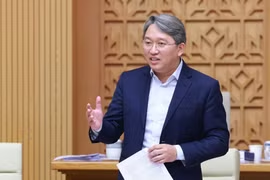
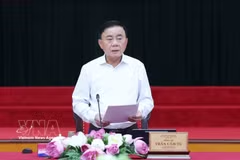
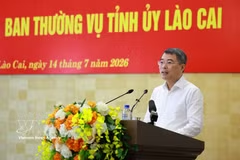
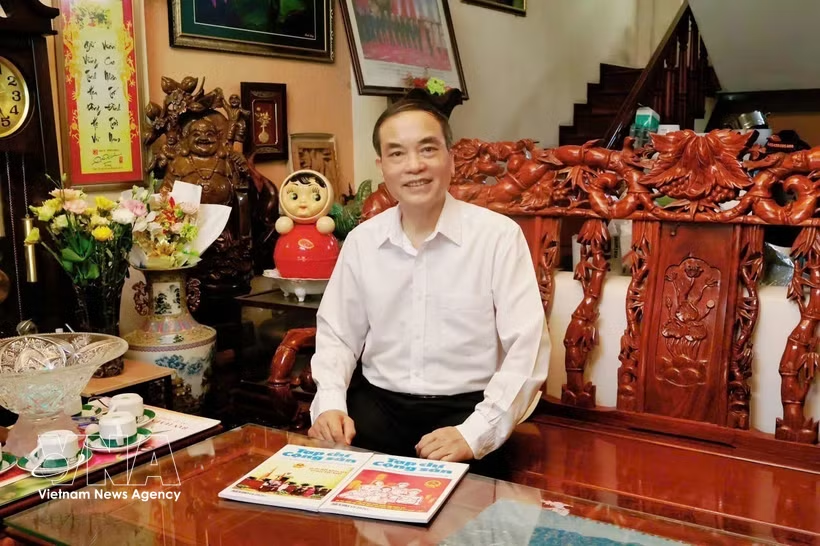
Assoc. Prof. Dr. Vu Van Phuc, Chairman of the Scientific Council of the Institute of Economics and International Law under the VUSTA. (Photo: VNA)

Hanoi (VNA) - Vietnam’s next stage of development will depend on breakthrough institutional reforms, innovation-driven growth and a transition to a green and sustainable economy, experts have said, describing these as essential pillars for achieving the country’s goal of becoming a developed, high-income nation by 2045.

Speaking on the strategic direction set out at the 14th National Party Congress, experts from the Vietnam Union of Science and Technology Associations (VUSTA) highlighted the need to unlock new motivations for growth while balancing economic expansion with environmental protection and governance reform.

Breakthrough shift in environmental development mindset

Reviewing the country’s prominent achievements over four decades of the Doi moi (renewal) process, Dr. Tran Van Mieu, Vice President of the VUSTA's Vietnam Association for Conservation of Nature and Environment (VACNE), said Vietnam has successfully transitioned to a socialist-oriented market economy, broken through embargoes and isolation, and steadily emerged as a regional growth bright spots while integrating more deeply into the regional and global economy, laying a solid foundation for a new stage of development.

The country’s GDP now surpasses 514 billion USD, with per capita GDP exceeding 5,026 USD a year. Alongside economic gains, Vietnam has also made strides in infrastructure development, poverty reduction, human development and global integration.

According to Mieu, Vietnam has undergone a fundamental shift in its development philosophy, moving from exploiting natural resources for growth to pursuing sustainable development. Environmental protection, climate action and green transition have become central to national development strategies, reflected in the commitment to achieve net-zero emissions by 2050 and promote biodiversity conservation alongside benefit sharing.

The expert said despite its economic achievements, Vietnam's rapid industrialisation has created growing environmental challenges. He noted that balancing growth with nature conservation requires stronger institutions and clearer responsibilities for authorities, businesses and citizens, wider adoption of green and circular economy models, greater public awareness, more sustainable business practices, science-based planning that respects environmental carrying capacity, and transparent environmental impact assessments.

Science, technology and digital transformation should play a greater role in environmental management, biodiversity conservation and early-risk forecasting through big data systems, he added.

To fulfil Vietnam’s climate commitments, Mieu proposed accelerating the transition to a circular economy, green infrastructure and digital transformation with ecosystems at the centre of development. Priorities include advancing a low-carbon economy through eco-design and renewable energy, while strengthening ecosystem-based biodiversity conservation, particularly by restoring mangrove forests to enhance carbon absorption and improve resilience to natural disasters.

He stressed that people must remain at the centre of sustainable development, with communities, businesses, schools and social organisations all sharing responsibility for the green transition.

Vietnam should introduce green finance mechanisms to attract sustainable FDI, issue green bonds and develop the carbon credit market, he said, noting that lasting environmental protection depends on putting people at the centre of sustainable development by engaging individuals, communities, schools, religious organisations and businesses in the country's green transition process.

Institutional and economic reforms


Sharing Mieu’s opinion, Assoc. Prof. Dr. Vu Van Phuc, Chairman of the Scientific Council of the Institute of Economics and International Law under VUSTA and former Editor-in-Chief of the Communist Review, said Vietnam's national strength, international standing and development potential have reached unprecedented levels after nearly four decades of reform.

From a poor and isolated economy, Vietnam has become one of the world's fastest-growing exporters while making notable progress in social welfare, with the multidimensional poverty rate falling to 1.93%.

Vietnam has signed 17 free trade agreements (FTAs), established diplomatic relations with 194 countries, and set up comprehensive partnerships or higher with 42 countries, and comprehensive strategic partnerships with all five permanent members of the UN Security Council.

However, reaching the upper-middle-income status is only an initial step, Phuc said.

To achieve the goal of becoming a developed, high-income country, he proposed a comprehensive set of measures, calling for accelerating the transition to a new growth model driven by digital, data and green economy, with science, technology and innovation as the main engines of growth.

Vietnam should seize opportunities presented by the Fourth Industrial Revolution, particularly artificial intelligence (AI) and semiconductor technology, to boost total factor productivity (TFP), while further improving the socialist-oriented market economy to unlock resources, strengthen development of domestic enterprises and safeguard national interests, he said.

Phuc added that institutional reform should go hand in hand with modern governance, including streamlining the state apparatus and improving the effectiveness of the rule-of-law state.

The expert called for a people-centred governance model, further streamlining the state apparatus, ensuring that all laws and policies prioritise the people's safety, well-being and happiness, and promoting public participation in governance while aligning the Party's vision with the people's aspirations to achieve the country’s long-term development ambitions by 2045./.

VNA
See more

Australian Governor-General Sam Mostyn hosts a welcome ceremony for General Secretary of the Communist Party of Vietnam Central Committee and President To Lam in Canberra on August 11 morning (Photo: VNA)

Australian Governor-General hosts welcome ceremony for top Vietnamese leader

Following the welcome ceremony, General Secretary and President Lam held a meeting with Governor-General Mostyn, and talks with Prime Minister Anthony Albanese. He witnessed the exchange of cooperation documents and met the press. He also had meetings with the President of the Australian Senate and the Speaker of the House of Representatives.

Politburo member and Secretary of the Ho Chi Minh City Party Committee Tran Luu Quang leads a delegation from the city's leadership in paying tribute to President of the National Assembly of Laos Xaysomphone Phonvihane at the Lao Consulate General on August 10, 2026. (Photo: VNA)

Ho Chi Minh City leaders pay tribute to late Lao National Assembly President

The municipal Party Committee, administration, and people has lost a close comrade who paid special attention to preserving the great friendship, special solidarity, comprehensive cooperation, and strategic cohesion between Vietnam and Laos, including the friendship and cooperation between Ho Chi Minh City and Lao localities.

General Secretary of the Central Committee of the Communist Party of Vietnam (CPV) and President To Lam (R) receives Nicholas Moore, Australia’s Special Envoy for Southeast Asia, in Sydney on August 10. (Photo: VNA)

Top leader receives Australian Special Envoy for Southeast Asia

General Secretary of the Central Committee of the Communist Party of Vietnam (CPV) and President To Lam said Vietnam considers Australia one of its leading important partners in the Indo-Pacific region, noting that bilateral relations are facing many new opportunities and the Australia-Vietnam Comprehensive Strategic Partnership should continue to be advanced in an increasingly substantive and effective manner.

Ambassador Nguyen Minh Tam leads the delegation from the Vietnamese Embassy, and other Vietnamese representative agencies, as well as the Vietnamese community in Laos, to pay their respects to President of the Lao National Assembly Xaysomphone Phomvihane (Photo: VNA)

Vietnamese Embassy, community pay tribute to Lao National Assembly President

Writing in the condolence book at the memorial service, Ambassador Nguyen Minh Tam, on behalf of the Vietnamese Embassy, representative agencies, and community in Laos, expressed profound sorrow and conveyed his deepest condolences to the Lao Party, State, National Assembly and people, and the bereaved family.

Vietnamese Ambassador to the Czech Republic Duong Hoai Nam speaks on Resolution No. 23. Photo: VNA

Resolution 23: Four networks connecting OV intellectuals, experts to be established

Overseas Vietnamese are regarded not only as an integral part of the Vietnamese nation but also as an important strategic resource contributing to national strength. They serve as a bridge between Vietnam and the world and participate directly in the cause of national construction, development and defence, according to newly-issued Politburo Resolution No. 23.

General Secretary of the Central Committee of the Communist Party of Vietnam (CPV) and President To Lam (left) and Governor of New South Wales Margaret Beazley at their meeting on August 10. (Photo: VNA)

Top Vietnamese leader meets with Governor of New South Wales

Suggesting that Australia could explore growing Vietnamese coffee varieties, General Secretary and President Lam said the two sides should step up cooperation across a wide range of areas, particularly high-tech agriculture, biotechnology, agricultural processing, trade and investment.

General Secretary of the Communist Party of Vietnam Central Committee and President To Lam (right) receives prominent Vietnamese intellectuals and scientists who are members of the Vietnam-Australia Scholars & Experts Association (VASEA) in Sydney on August 10. (Photo: VNA)

Top leader receives Vietnamese intellectuals, scientists in Australia

General Secretary of the Communist Party of Vietnam Central Committee and President To Lam urged Vietnamese intellectuals and scientists in Australia to further strengthen great national unity, promote Vietnamese cultural values, mentor younger generations and Vietnamese students studying in Australia, and help foster closer community ties.

Politburo member and Standing member of the Communist Party of Vietnam (CPV) Central Committee’s Secretariat Tran Cam Tu signs the condolence book in commemoration of Politburo member of the Lao People's Revolutionary Party (LPRP) and President of the Lao NA Xaysomphone Phomvihane. (Photo: VNA)

Vietnamese Party, State leaders pay tribute to Lao National Assembly President

Writing in the book of condolences, the Vietnamese leaders expressed profound sorrow over the passing of comrade Xaysomphone Phomvihane, describing him as an outstanding and dedicated leader of the Lao Party, State, NA and people, as well as a close and loyal friend of the Vietnamese Party, State, NA, Government and people.

British researcher Kyril Whittaker (Photo published by VNA)

Vietnam’s four strategic shifts strengthen int'l partners’ confidence: British researcher

The four strategic shifts that General Secretary of the Communist Party of Vietnam and State President To Lam laid out at the recent third plenum of the 14th Party Central Committee suggest that Vietnam is seriously abiding by its commitments to the environment, economic growth and investment opportunities, the researcher said, adding they are creating new impetus for trade through large infrastructure programmes and showcasing Vietnamese talent and wealth to other countries.

Canadian friends highlight Vietnam’s values of independence, self-reliance

Canadian friends highlight Vietnam’s values of independence, self-reliance

CPC (M-L) member Margaret Villamizar noted that Vietnam’s long history of defending its independence and sovereignty has demonstrated the Vietnamese people’s organisational capacity, creativity and resilience. These qualities continue to be reflected in the country’s development and international relations today.

Vietnamese Ambassador to New Zealand Phan Minh Giang (Photo: VNA)

Top leader’s visit to inject fresh momentum into Vietnam-New Zealand Comprehensive Strategic Partnership: diplomat

The upcoming state visit to New Zealand by General Secretary of the Communist Party of Vietnam (CPV) Central Committee and State President To Lam is expected to provide further momentum for the Vietnam-New Zealand Comprehensive Strategic Partnership to reach a new height, commensurate with the potential and stature of the two countries, bringing more practical benefits to their people and businesses, as well as contributing to the development goals of each country and to peace, stability and sustainable development in the region and the world.