Hanoi (VNA) – Waste is not confined to the loss of money, public assets or land. In the country's new phase of development, waste is also reflected in every day of delay, every cumbersome administrative procedure, every protracted project and every missed opportunity. As Vietnam accelerates towards its goal of becoming a developed nation by 2045, preventing the waste of time and development opportunities is no longer merely a matter of public administration; it has become an urgent national imperative.
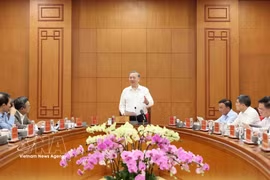
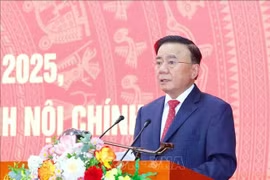
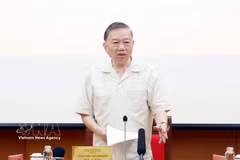
It was therefore no coincidence that at the conference reviewing the six-month performance of the Party's internal affairs sector and the provincial-level steering committee on prevention and control of corruption, wastefulness and negative phenomena, Politburo member, Secretary of the Party Central Committee and Chairman of the Party Central Committee's Commission for Internal Affairs Le Minh Tri stressed that efforts to combat waste "must not focus solely on money and assets, but also pay due attention to preventing the waste of time and opportunities for development". He called on state management agencies to develop measurable criteria for preventing the waste of time and development opportunities, thereby clearly defining the responsibilities of every agency, organisation and individual.
That position is consistent with the directives of Party General Secretary and State President To Lam to address the situation in which citizens and businesses are forced to expend unnecessary time and effort because of cumbersome administrative procedures, and to tackle inertia, buck-passing, avoidance of responsibility and a reluctance to accept accountability that continue to impede the country's development. The Party and State leader has made it clear that the most pressing forms of waste today are no longer confined to the loss of public assets, but are also found in projects that drag on and bottlenecks that remain unresolved, resulting in the depletion of resources, rising costs, declining public confidence, the creation of invisible barriers, and the loss of development opportunities for the nation.
Vietnam is entering a new stage of development, one that demands sustained high growth as it works towards its strategic milestones for 2035 and 2045. In that context, every delayed policy decision and every resource left idle has the potential to cost the country valuable opportunities for progress. Money lost can be earned again, but time once gone and opportunities once missed cannot be recovered. Combating waste today must therefore begin with tackling the waste of time and development opportunities.
The urgency of the issue is underscored by figures presented at the 30th meeting of the Central Steering Committee on Prevention and Control of Corruption, Wastefulness and Negative Phenomena. Following a nationwide review, authorities identified 4,492 stalled or long-delayed projects, of which only 1,531 have so far been resolved. Meanwhile, of the 30,595 surplus public buildings and land assets resulting from the reorganisation of the state apparatus, only 14,992 have been put back into use.
Every delayed project not only drives up investment costs, and every vacant plot of land not only represents wasted public assets; more importantly, these are resources that have yet to be channelled into production and business activity, have yet to create additional employment and have yet to contribute to the current goal of achieving double-digit economic growth.
Accordingly, the central steering committee has directed that all outstanding projects, along with surplus public buildings and land assets, must be comprehensively dealt with during 2026. If the waste of physical assets can be measured in figures, however, the waste of time is far harder to quantify. It is less visible, yet its consequences are no less severe. A prolonged administrative procedure may cause a business to miss an investment opportunity. A delayed project may erode a locality's competitive advantage. A policy decision issued too late may cause an entire sector to lose its window for development. Preventing the waste of time is therefore essential to safeguarding the country's growth momentum.
President Ho Chi Minh once advised: "What should be done today should be finished today; do not put it off until tomorrow. Remember that the people pay our wages with the sweat of their brow during those working hours."
More than half a century has passed, yet those words remain as relevant as ever, particularly at a time when the country demands greater speed and efficiency than at any point in its history. Preventing the waste of time and development opportunities requires not only dealing with individual cases, but, more fundamentally, improving institutions, strengthening control of power and clearly defining the responsibilities of every agency, organisation and individual. It also requires developing concrete criteria to measure efforts to prevent the waste of time and development opportunities, providing a sound basis for evaluating accountability and the effectiveness of public administration.
At the same time, digital transformation must be accelerated to shorten processing times, enhance openness and transparency, and strengthen oversight through data. During the first half of 2026, the Party Central Committee's Commission for Internal Affairs digitised 4,846 outgoing documents and 20,615 incoming documents, while continuing to classify and digitise a further 304,888 pages of records. These figures represent not merely technological progress, but an important foundation for reducing processing times, lowering social costs and limiting opportunities for misconduct.
The guiding principle now set by the Party Central Committee is to shift decisively from dealing with consequences to preventing problems at an early stage and from a distance; from merely reviewing and compiling statistics to resolving outstanding issues once and for all; and from detecting violations after they occur to preventing waste before it takes root. Achieving this requires leaders at every level to demonstrate the courage to think boldly, act decisively and take responsibility. Every act of avoidance, buck-passing or waiting for further instruction merely means more time is wasted and more opportunities are allowed to slip away.
Vietnam stands before significant opportunities for development. To realise its strategic goals for 2035 and 2045, every resource must be used effectively. Not only money, land and public assets, but also time and opportunities for development must be recognised as among the nation's most valuable resources. Combating waste today is therefore not simply about preventing losses, but about preserving and making full use of opportunities for growth, generating new resources and fresh momentum to enable the country to develop more rapidly and sustainably./.
📝 OP-ED: Streamlining state apparatus: From restructuring to better governance
As institutions continue to improve, resources are allocated more effectively, officials are placed where their abilities can be best used, and digital transformation advances further, Vietnam's two-tier local administration model is expected to deliver increasingly better results for both the State and its people.