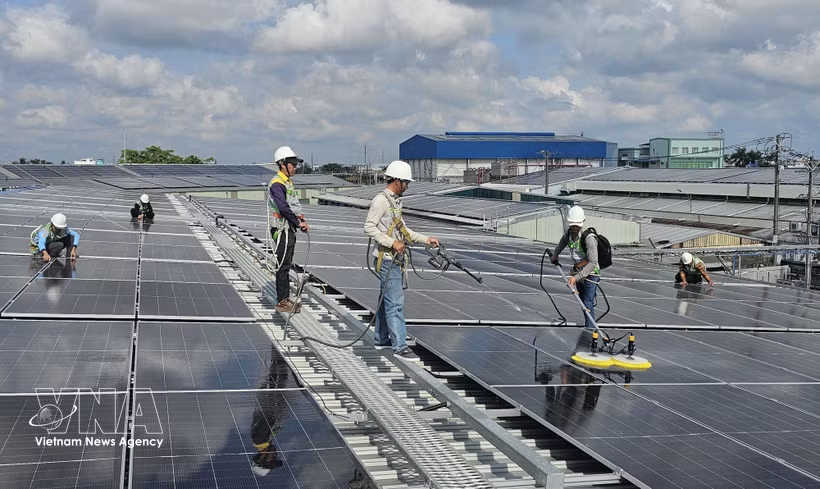
Hanoi (VNA) - New Government policies and mechanisms are set to broaden investment channels for households and businesses, accelerate distributed power generation, shore up energy security and realise Vietnam's green growth targets.
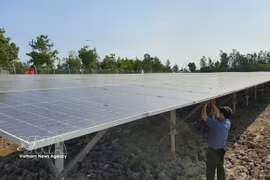
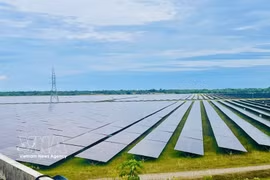
A key driver is the Government’s Decree 243/2026/ND-CP, which amends Decree 57/2025/NĐ-CP on the Direct Power Purchase Agreement (DPPA) mechanism and Decree 58/2025/ND-CP on renewable and new energy development. It clears bottlenecks by broadening DPPA eligibility, refining regulations governing self-produced and self-consumed rooftop solar systems, and revising the mechanism for surplus electricity trading.
The headline change lifts the cap on surplus rooftop solar power sold through negotiated contracts from 20% to 50% of total generation. Through late 2030, stakeholders can agree on a higher ratio provided the regional grid meets safety standards. The move is set to bolster investment returns and make rooftop solar projects more attractive.
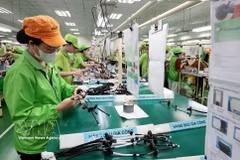
Pham Le Phu, Deputy General Director of the Vietnam Electricity (EVN), said Decree 243 creates a clearer legal framework for households, businesses and investors to access green electricity. Together with the broader DPPA mechanism, it enables market-based price negotiations to meet accelerating clean-power demand from factories, data centres, EV charging stations and other emerging consumers.
Nguyen Minh Anh, Chief of Office of the Asia Clean Energy Coalition, said the new regulations will enable firms to take a more proactive approach to investment planning, better manage energy costs, and meet growing demand for green electricity across global supply chains.
Nguyen Quoc Trung, Deputy General Director of the National Power System and Market Operator (NSMO), said power demand will continue to surge as global energy markets stay volatile.
Rooftop solar coupled with battery energy storage will play an increasingly vital role in renewable integration, grid flexibility and peak supply, he added.
The Northern Power Corporation (EVNNPC), a distribution grid operator for 17 northern cities and provinces outside Hanoi, has been moving aggressively to enforce the Government’s rooftop solar policy.
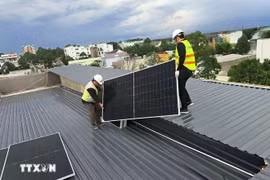
In the first half of 2026, EVNNPC added about 8,500 self-produced and self-consumed rooftop solar customers with a combined capacity of nearly 394.5 MW. By end-June, it had more than 10,000 such customers totaling some 718 MW.
Do Nguyet Anh, Chairwoman of the EVNNPC Members' Council, said her company is investing in battery energy storage at its 110-kV substations, with the first phase deploying 305 MW/610 MWh across 47 substations to sharpen load management and renewable integration.
The northern province of Bac Ninh ranks among the strongest performers under the new policy. According to Director of Bac Ninh Power Company Do Quoc Long, the province recorded 957 registered rooftop solar investors with a combined planned capacity of 272 MW by late June. Of these, 742 projects totalling 189 MG had been connected to the grid and put into operation. Its total operational rooftop solar capacity neared 224 MW, easing strain on the power grid as electricity demand continues to rise.
From the completion of mechanisms and policies to the proactiveness of the power sector and local authorities, rooftop solar power is entering a new phase of development with a more solid foundation. When integrated with energy storage systems and direct power purchase mechanisms, it not only contributes to supplementing distributed energy sources and reducing pressure on the national power system, but also serves as a driving force for green growth, enhances the competitiveness of the economy, and ensures energy security./.