Vietnam's economy needs to shift from quantity to quality: ADB experts

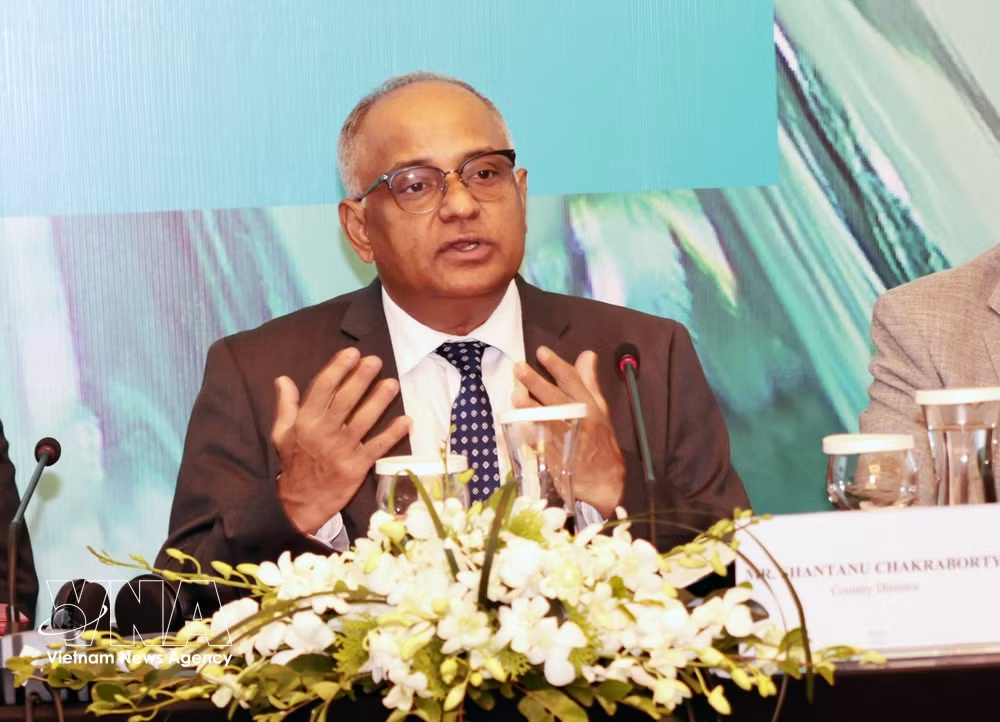
Shantanu Chakraborty, ADB Country Director for Vietnam, noted that while achieving strong growth in a single year is encouraging, maintaining both the pace and quality of growth over many years will be essential if Vietnam is to achieve its goal of becoming a high-income country by 2045.
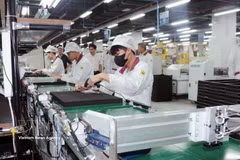
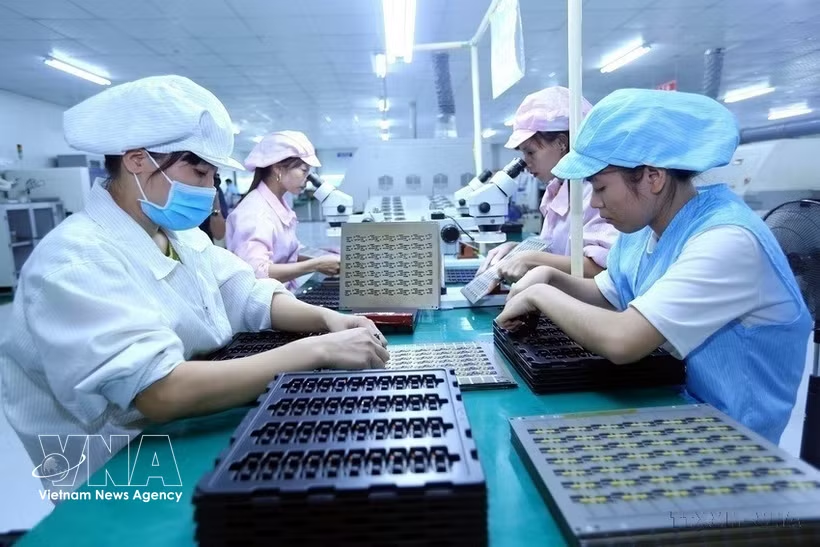
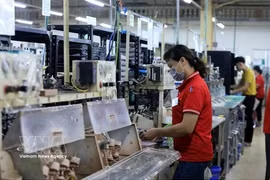
Workers assembles electronic components on the production line at the Bao Sen Co., Ltd. in Bac Ninh province. (Photo: VNA)

Hanoi (VNA) – Vietnam's economy posted robust growth in the first half, with gross domestic product (GDP) expanding by 8.18%, prompting leading economists at the Asian Development Bank (ADB) to stress that sustaining such momentum over the medium and long term will require a growth model driven by productivity and efficiency rather than traditional input-intensive factors.

The latest data released by the National Statistics Office (NSO) under the Ministry of Finance show that GDP grew by 8.18% in the period, including 8.39% growth in the second quarter.

Shantanu Chakraborty, ADB Country Director for Vietnam, described the figures as highly encouraging, saying they reflect the economy's resilience in the face of global headwinds. He noted that the results exceeded the bank's earlier forecasts.

Echoing that view, Bui Minh Giap, ADB's principal economist for Vietnam, said the country's growth has been broad-based, supported by strong performance in industry, construction, services, exports, foreign direct investment (FDI), public investment and a recovery in domestic demand.

Despite the strong headline figures, however, the expert cautioned that external uncertainties and domestic macroeconomic pressures remain significant.

Giap pointed out that with total foreign trade around 170% of GDP, Vietnam is a highly open economy. As a result, fluctuations in global trade, tariff policies and weakening demand in key export markets have a substantial impact on growth through trade, logistics, investment flows, and business reactions.

He also highlighted that imports have been rising faster than exports, resulting in a sizeable trade deficit during the first half of the year. Although the deficit is not entirely a negative indicator as it reflects expanding production activities, with enterprises ramping up imports of machinery, equipment, raw materials, and components to meet manufacturing needs. However, he emphasised the downside of this trend, noting that it highlights the domestic economy’s heavy reliance on imported inputs.

Inflationary pressures, he added, also warrant close monitoring. With both core inflation and the consumer price index (CPI) exceeding 4% in the first half of the year, room for monetary policy maneuvering during the remaining months has tightened, demanding continued flexibility and caution in monetary governance.

Against this backdrop, Giap said the key challenge is no longer how to achieve rapid growth, but how to sustain high-quality, long-term growth while maintaining macroeconomic stability.

Chakraborty agreed, noting that while achieving strong growth in a single year is encouraging, maintaining both the pace and quality of growth over many years will be essential if Vietnam is to achieve its goal of becoming a high-income country by 2045.

vnanet-shantanu-chakraborty.jpg
ADB Country Director for Vietnam Shantanu Chakraborty (Photo: VNA)

To realise that ambition, he said, the economy must move decisively away from a model reliant on capital, low-cost labour and the FDI sector towards one driven by productivity, skills, innovation and a stronger domestic private sector.

The ADB Country Director underlined the need to enhance the capacity of Vietnamese private enterprises to absorb the benefits of foreign investment and participate more deeply in value chains.

Giap added that strong GDP growth must ultimately translate into higher incomes for the population while enabling domestic businesses – particularly small- and medium-sized enterprises (SMEs), which account for more than 95% of firms operating in Vietnam – to integrate into global supply chains.

He also welcomed the Politburo’s Resolution No. 10-NQ/TW on the development of the foreign-invested economic sector, noting that its emphasis on linking domestic enterprises with global value chains demonstrates Vietnam's determination to make the domestic private sector a key driver of economic growth.

Regarding foreign investment, Giap said the country’s priority should no longer be attracting greater volumes of FDI, but rather securing higher-quality investment and increasing the share of value added retained within the domestic economy.

He described the inclusion of this objective in Resolution No. 10-NQ/TW as a well-founded policy direction.

Looking ahead, the ADB economist said Vietnam's economic outlook remains highly positive. The bank's Asian Development Outlook (ADO), released in July, continues to project the country as the fastest-growing economy in Southeast Asia./.

VNA

See more

Production at an FDI enterprise in Tay Ninh province. (Photo: VNA)

FTA Index 2025 to be unveiled later this month

The index is designed to provide valuable information not only for State management agencies but also as an important reference for businesses, foreign investors, and industry associations in planning investment and business activities in Vietnam.

Air Premia, a carrier of the Republic of Korea, will resume flights between Incheon and Ho Chi Minh City from November 5. (Photo: The Courtesy of Air Premia)

Air Premia to resume Incheon–Ho Chi Minh City route from November

Flights will depart Incheon International Airport at 6:40 pm (RoK time) and arrive at Tan Son Nhat International Airport in Ho Chi Minh City at 11 pm (Vietnam time). Return flights will leave Ho Chi Minh City at 12:30 am on Mondays, Tuesdays, Thursdays, Fridays and Sundays, landing in Incheon at 7:40 am.

Production at Viet Hai High-Tech Structure Production Company Limited in Vung Ang Economic Zone. Ha Tinh province aims to develop Vung Ang Economic Zone into a regional centre for industry, energy, seaports and logistics (Photo: VNA)

Revised master plan of Vung Ang EZ approved

The adjustment aims to create a more rational development framework to maximise the zone’s potential and advantages while providing a legal foundation for construction management and ensuring sustainable development.

Illustrative image (Photo: VNA)

Vietnam looks to domestic market to sustain wood industry growth

Vietnam’s wood sector has long been a top foreign-currency earner. Exports of wood and wooden products neared 17.3 billion USD in 2025, reaching more than 160 countries and territories and clearing the high bars set by the US, the European Union and Japan.

Delegates at the event (Photo: VNA)

Vietnam remains key market for Polish food producers

The campaign promotes selected European Union agricultural and food products, including fresh, chilled and frozen beef and pork, fresh apples, apple juice and dried apples, targeting consumers, importers, distributors, retailers and the hospitality sector.

Wei Xiaoli, a representative of Shandong Jindafeng Machinery Co., Ltd., in an interview granted to the Vietnam News Agency. (Photo: VNA)

Chinese firms see strong potential for agricultural mechanisation cooperation with Vietnam

Business representatives said mechanisation not only helps reduce reliance on manual labour but also improves production efficiency, shortens planting and harvesting times, reduces post-harvest losses and enhances the quality of agricultural products. For rice-producing countries like Vietnam, they noted, accelerating mechanisation is an inevitable trend to strengthen the competitiveness of the agricultural sector.

Community-led fisheries groups have become frontline defenders of coastal fisheries. (Photo: VNA)

Community-led fisheries groups strengthen IUU fight in Ha Tinh

With a long coastline and abundant inshore fishing grounds, Ha Tinh has long identified the marine economy as a key growth driver. However, growing fishing pressure and destructive practices have posed major management challenges. Community-led self-management initiatives are now providing an effective solution.

At the VIFC-HCMC (Photo: VNA)

700 bln USD for net zero: Vietnam bets on VIFC

Assoc. Prof. Dr. Nguyen Huu Huan, Vice Chairman of the Executive Board of VIFC-HCMC, said the VIFC will focus on building market infrastructure needed to bridge the gap between big investment pledges and bankable projects.

A view of the launch ceremony for the expanded Vietnam–China cross-border QR payment service. (Photo: NAPAS)

Over 1 billion Weixin Pay users can make QR code payments in Vietnam

NAPAS, Weixin Pay, and BIDV will study the rollout of the reverse payment service, enabling users of Vietnamese banking applications and e-wallets to make QR code payments in China, with the aim of completing a comprehensive cross-border payment ecosystem between the two countries.

Vietnam cuts retail fuel prices on August 6. (Photo: VNA)

Vietnam cuts retail fuel prices on August 6

The maximum retail price of E5RON92 biofuel was reduced by 1,160 VND to 21,728 VND (0.83 USD) per litre, while that of E10RON95-III fell by 1,035 VND to 22,324 VND per litre.

Production of electronic components at Star Engineers Vietnam Co. Ltd. in Binh Xuyen I Industrial Park in Phu Tho province. (Photo: VNA)

Vietnam targets higher-quality FDI under Resolution 10

During the first seven months of 2026, Vietnam attracted more than 38 billion USD in registered FDI, up nearly 58% year-on-year. More importantly, the increase was driven by large-scale, high-tech projects rather than a surge in the number of new investments, signalling a significant improvement in the quality of capital inflows.

A woodchip production line at a plant in Vinh Thuy commune, Quang Tri province (Photo: VNA)

Tackling timber supply bottlenecks needed for value-added processing: experts

Vietnam's wood industry has grown rapidly in recent years, with exports reaching 17.2 billion USD in 2025. Wood and wood products are now shipped to more than 140 countries and territories, making Vietnam an important processing hub in the global supply chain, with key markets such as the US, Japan, China, the European Union and the Republic of Korea.