Vietnam-EFTA deal set to further boost bilateral trade growth

The Vietnam-EFTA FTA is one of the longest-negotiated trade agreements in Vietnam's history, reflecting its broad scope of commitments covering trade in goods and services, investment, intellectual property, government procurement, environmental protection, sustainable development, small and medium-sized enterprises (SMEs), and other areas of cooperation.

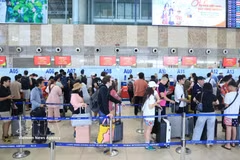
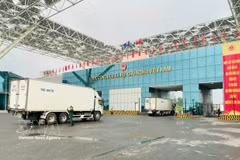
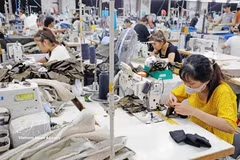
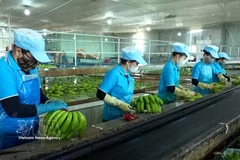
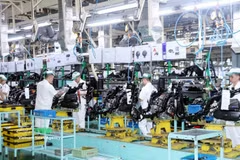
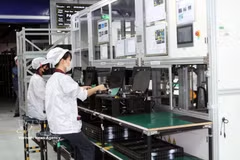
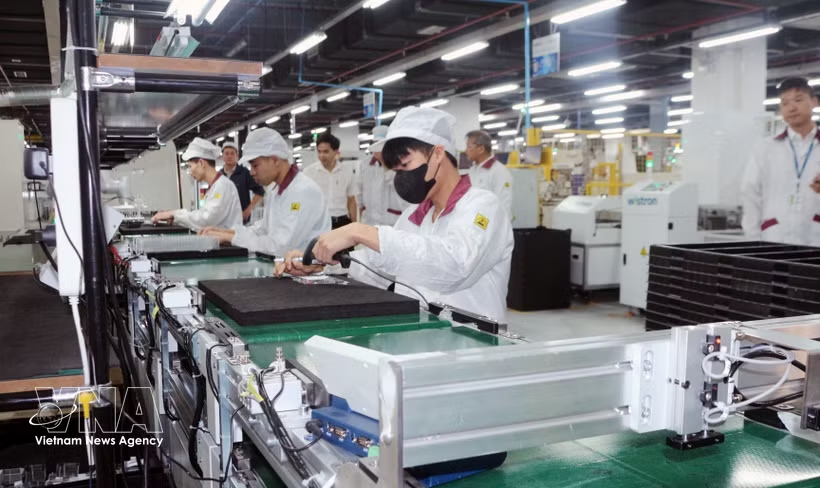
The Vietnam-EFTA FTA is one of the longest-negotiated trade agreements in Vietnam's history. (Illustrative Photo: VNA)

​Hanoi (VNA) - After more than 14 years of negotiations, Vietnam and the European Free Trade Association (EFTA) have officially concluded talks on a Free Trade Agreement (FTA), paving the way for its signing in the fourth quarter of 2026 and opening a new chapter in economic cooperation with some of Europe's most advanced economies while reaffirming Vietnam's commitment to deep and comprehensive international integration.

The Vietnam-EFTA FTA is one of the longest-negotiated trade agreements in Vietnam's history, reflecting its broad scope of commitments covering trade in goods and services, investment, intellectual property, government procurement, environmental protection, sustainable development, small and medium-sized enterprises (SMEs), and other areas of cooperation.

The conclusion of negotiations comes at a time when global trade is facing mounting challenges from protectionism, strategic competition among major economies, supply chain disruptions and climate change. Beyond expanding opportunities for economic cooperation, the agreement reaffirms the commitment to promoting free trade based on transparency and fairness, creating new momentum for growth while strengthening Vietnam's position in global value chains.

According to Deputy Minister of Industry and Trade Nguyen Sinh Nhat Tan, the Vietnam-EFTA FTA is highly complementary in nature. The EFTA members comprise Norway, Switzerland, Iceland and Liechtenstein – the economies recognised for their strengths in technology, finance, innovation, green industry, clean energy and modern governance. Vietnam, meanwhile, continues to strengthen its role as a dynamic manufacturing and export hub within global supply chains.

Espen Barth Eide, Minister of Foreign Affairs of Norway, said that, amid growing global uncertainties, concluding an ambitious and forward-looking FTA would significantly improve market access for goods and services while deepening cooperation in areas such as sustainable development and intellectual property, creating new business opportunities for enterprises on both sides.

The complementary strengths of the two economies provide a solid foundation for cooperation. Vietnamese businesses will gain greater access to high-income markets with strong purchasing power, while EFTA companies will have more opportunities to invest in Vietnam and leverage the country's network of 17 free trade agreements with major economies worldwide.

Trade between Vietnam and the EFTA states has expanded steadily over the past decade, reaching 4.8 billion EUR (5.5 billion USD) in 2025. Vietnam recorded a trade surplus of 2.5 billion EUR, up sharply from 0.5 billion EUR a decade earlier, excluding Switzerland's gold trade. EFTA's key exports to Vietnam include electrical machinery, pharmaceutical products and mechanical equipment, while its main imports from Vietnam are electrical machinery, footwear and apparel.

Experts noted that although EFTA's combined population is only around 15 million, it represents a high-income market with stringent standards and global leadership in technology, finance and innovation. The agreement is expected to diversify Vietnam's export markets and create new growth opportunities for agricultural and aquatic products, textiles and garments, footwear, wood products, electronics and processed goods. Meeting EFTA's demanding standards is also expected to encourage Vietnamese businesses to improve product quality, strengthen branding and enhance international competitiveness.

The Vietnam-EFTA FTA is also expected to attract high-quality foreign investment into Vietnam's priority sectors, including high technology, renewable energy, green industry, circular economy, healthcare, pharmaceuticals, finance and digital transformation.

Opportunities, however, come with challenges. The EFTA countries maintain some of the world's strictest requirements on product quality, food safety, environmental protection, labour standards, traceability and sustainable development. To fully benefit from the agreement, Vietnamese businesses will need to upgrade technologies, improve corporate governance and adopt internationally recognised quality management systems, ensuring tariff preferences translate into genuine competitive advantages.

The Ministry of Industry and Trade stressed that concluding negotiations marks only the beginning. The agreement's success will ultimately depend on how effectively businesses take advantage of its commitments.

In the lead-up to the signing, the ministry will step up efforts to disseminate information about the agreement, provide guidance on rules of origin, technical standards, environmental requirements, sustainable development commitments and trade remedy measures. It will also strengthen trade promotion, business matchmaking and support for Vietnamese enterprises to join EFTA supply chains, helping them maximise the opportunities created by the agreement./.


VNA

See more

Vietnamese Ambassador to Laos Nguyen Minh Tam and Lao Deputy Minister of Industry and Commerce Phouthavanh Nanthavong visit the Vietnamese pavilion at VIETLAO EXPO 2026 (Photo: VNA)

VIETLAO EXPO 2026 helps boost Vietnam-Laos strategic cohesion

The Vietnam-Laos Trade Fair 2026 (VIETLAO EXPO 2026) opened on July 16 in Vientiane, serving as a key platform for businesses from both countries to showcase products, seek partnerships, transfer technologies and expand investment cooperation.

Passengers and visitors check in at Terminal 1 of Noi Bai International Airport. (Photo: VNA)

Hanoi-Ho Chi Minh City route among world’s busiest

According to IATA’s ranking of global air passenger markets, the US remained the world’s largest market in 2025, with 890.1 million passengers, up 1.6% from 2024. China, the world’s second-largest market, recorded stronger growth of 4.8%, reaching 776.1 million passengers. China is widely forecast to overtake the US and become the world’s largest air passenger market in the 2030s.

An overview of the working session between the Kazakh delegation and the Can Tho City People's Committee on July 16. (Photo: VNA)

Kazakhstan explores agricultural by-product recycling project in Can Tho city

The proposed project would use rice husks as its primary feedstock, with an estimated one million tonnes processed annually using advanced technology developed in Kazakhstan. At present, the top priority is to secure a stable supply of raw materials from rice-producing provinces across the Mekong Delta.

Consumers buy fruit at a supermarket in Vietnam. (Photo: VNA)

US highlights potential in Vietnam’s fruit market

The US was Vietnam's second-largest supplier of agricultural products, with export turnover reaching 4.7 billion USD in 2025, a remarkable increase from less than 3.5 billion USD in 2024, Fruitnet said, citing a new report by the US Department of Agriculture (USDA).

Vietnamese Ambassador to Thailand Pham Viet Hung (thitd, left) attends the opening ceremony of Grand Halal Bangkok 2026 (Photo: VNA)

Vietnamese firms seek global Halal opportunities at Bangkok exhibition

Ambassador Pham Viet Hung described Grand Halal Bangkok 2026 as an important opportunity for Vietnamese businesses to connect not only with Thailand's Halal industry but also with Halal food producers worldwide, while learning from experience of Thailand and international partners.

Marnufacturing garments for export at Hung Yen Jute and Garment Joint Stock Company. (Photo: VNA)

GDP expands 8.18%, with new growth drivers taking shape

According to the National Statistics Office under the Ministry of Finance, GDP expanded by 8.39% in the second quarter, up from 8.14% a year earlier. Growth for the first six months reached 8.18%, exceeding the 7.63% recorded in the same period of 2025. The performance reflected broad-based contributions from both the supply and demand sides of the economy.

Production line at Honda Vietnam's manufacturing facility in Dong Van II Industrial Park, Ninh Binh province. (Photo: VNA)

Vietnamese economy sustains momentum on strong industrial production

The National Statistics Office (NSO) under the Ministry of Finance reported that the manufacturing and processing sector remained the principal driver of economic growth, accounting for 33.07% of the economy's total value-added growth during the first six months of the year.

Investors conduct transactions at Bao Viet Securities' headquarters in Hanoi. (Photo: VNA)

Vietnam eyes 205.6 billion USD in stock market funding for 2026–2030

Addressing a seminar on restructuring capital mobilisation channels hosted by the Finance and Investment newspaper on July 15, Bui Hoang Hai, Vice Chairman of the State Securities Commission of Vietnam (SSC), said the domestic economy continues to face considerable external challenges in 2026, including the effects from the Middle East conflict.

Workers process farm produce at the Coastal Fisheries Development Company (Cofidec) in Ho Chi Minh City. (Photo: VNA)

Vietnam remains ASEAN’s fastest-growing economy in first half of 2026: experts

Economists at United Overseas Bank (UOB), a Singapore-based multinational bank, said Vietnam’s gross domestic product (GDP) expanded by 8.39% in the second quarter of 2026, from 7.94% in the first quarter. As a result, economic growth for the first half of the year reached 8.18%, keeping Vietnam at the top among ASEAN economies.