Hanoi (VNA) - Vietnam's economy maintained strong momentum in the second quarter and first half of 2026, posting GDP growth above expectations despite persistent global uncertainties, underscoring the economy's resilience and the Government's flexible policy management.
According to the National Statistics Office under the Ministry of Finance, GDP expanded by 8.39% in the second quarter, up from 8.14% a year earlier. Growth for the first six months reached 8.18%, exceeding the 7.63% recorded in the same period of 2025.
The performance reflected broad-based contributions from both the supply and demand sides of the economy.
On the supply side, all three major economic sectors recorded balanced growth.
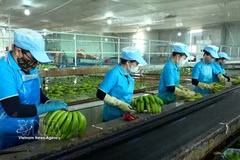
Agriculture, forestry and fisheries remained a key pillar, sustaining steady expansion through structural reforms, wider application of advanced technologies, improved planting-area code management, stronger disease control in livestock and enhanced forest protection.
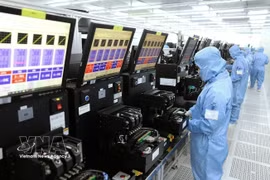
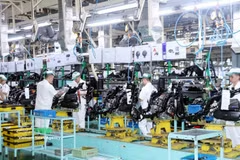
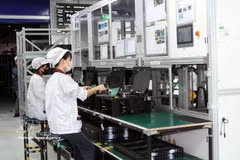
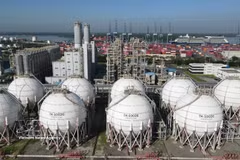
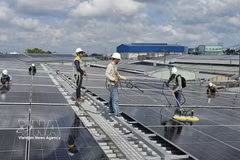
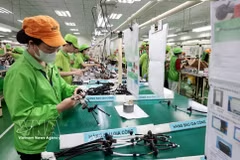
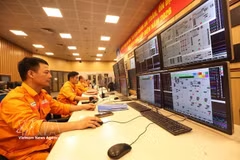
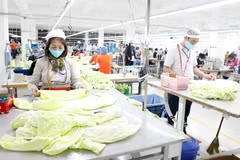
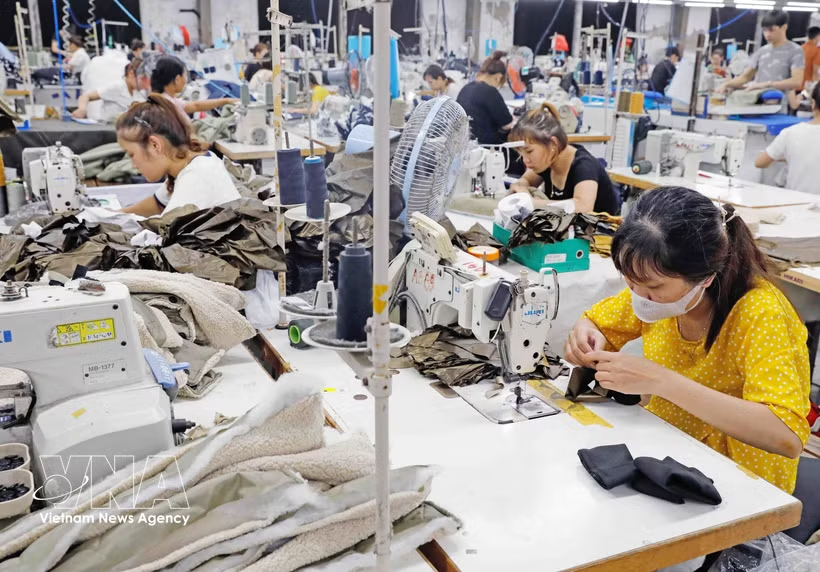
Industry and construction continued to serve as the main growth engine. Processing and manufacturing led the expansion, rising 10.56% in the second quarter and 10.23% in the first half, supported by a strong recovery in export orders for electronics, computers, metals and automobiles. Electricity and gas production grew 12.19%, ensuring stable energy supplies, while construction rose 10.28% and mining increased 7.59%, driven by higher crude oil and natural gas output.
The services sector also recorded positive growth despite higher input costs.
On the demand side, final consumption rose 7.02% in the second quarter and 8.15% in the first six months. Household spending increased 9.94% in the second quarter and 9.48% in the first half, reflecting stronger domestic demand supported by seasonal spending and the recovery of tourism, accommodation and entertainment services.
Consumption patterns also shifted towards higher-quality and more sustainable products, with spending on environmentally friendly goods and experience-based services such as tourism and leisure increasing.
Asset accumulation remained a major growth driver, surging 20.4% in the second quarter and 15.2% in the first half, reflecting stronger public investment disbursement and a recovery in production. Inventories also rose sharply as businesses increased imports of raw materials and components for future production.
Merchandise trade expanded 27.1% year-on-year in the first six months. Exports increased 21%, while imports climbed 33.4%, driven by higher purchases of fuel, electronic components and production materials, as well as investment in data centres and AI infrastructure. The resulting trade deficit may weigh on the external sector's net contribution to GDP growth.
The statistics office said traditional growth drivers – investment, manufacturing, exports, and consumption - continued to underpin the economy. Faster public investment disbursement, particularly for major infrastructure projects, boosted construction activity while encouraging private investment. Manufacturing and exports remained resilient despite a slow global recovery, and stronger household consumption helped support domestic demand and economic stability.
At the same time, new growth drivers such as science and technology, innovation and the digital economy are gaining momentum and gradually expanding into high-tech industries and services. However, they remain supportive rather than leading drivers of growth, with their full potential dependent on continued institutional reforms, human resource development and a stronger innovation ecosystem./.
See more
EU deforestation rules put Vietnamese exporters on the clock
Only shipments that fully satisfy the EUDR's data requirements will qualify for export to the EU, and exporters will no longer be able to source products with unclear compliance records for the European market.
Vietnamese economy sustains momentum on strong industrial production
The National Statistics Office (NSO) under the Ministry of Finance reported that the manufacturing and processing sector remained the principal driver of economic growth, accounting for 33.07% of the economy's total value-added growth during the first six months of the year.
Vietnam eyes 205.6 billion USD in stock market funding for 2026–2030
Addressing a seminar on restructuring capital mobilisation channels hosted by the Finance and Investment newspaper on July 15, Bui Hoang Hai, Vice Chairman of the State Securities Commission of Vietnam (SSC), said the domestic economy continues to face considerable external challenges in 2026, including the effects from the Middle East conflict.
Vietnam remains ASEAN’s fastest-growing economy in first half of 2026: experts
Economists at United Overseas Bank (UOB), a Singapore-based multinational bank, said Vietnam’s gross domestic product (GDP) expanded by 8.39% in the second quarter of 2026, from 7.94% in the first quarter. As a result, economic growth for the first half of the year reached 8.18%, keeping Vietnam at the top among ASEAN economies.
Domestic consumption hits new record, but consumer spending remains cautious
Despite the positive headline figures, analysts caution that actual purchasing power has yet to recover fully.
Manufacturing sector faces defining race for survival through dual transformation
As one of Vietnam’s key economic growth drivers, the manufacturing and processing industry now faces mounting pressure to move beyond a development model based on inexpensive labour, intensive energy consumption and high emissions.
Reference exchange rate up 10 VND on July 16
The State Bank of Vietnam set the daily reference exchange rate at 25,243 VND/USD on July 16, up 10 VND from the previous day.
Foreign digital service providers pay nearly 480 million USD in taxes
According to the Department of Taxation, 259 overseas suppliers have registered, declared and paid taxes through the portal. Tax revenue from the group reached 78.1% of the full-year target, surging 119% from a year earlier and making foreign suppliers the fastest-growing source of tax revenue in Vietnam's digital economy.
Ho Chi Minh City targets high-quality FDI to drive green growth, sustainable development
With 21,351 valid FDI projects worth a combined 146.8 billion USD, Ho Chi Minh City remains Vietnam's leading recipient of foreign investment. The southern largest economic hub recorded nearly 7.5 billion USD in registered FDI in the first half of 2026, fulfilling over 68% of the annual target.
EFTA deal provides fresh opportunities for seafood exports
The FTA would widen access to markets with strong demand for premium food products in line with the country’s strategy of shifting exports towards increasing added value.
Vietnam raises rooftop solar sales cap to 50%, widens direct power deals
Rooftop solar power is entering a new phase of development with a more solid foundation. When integrated with energy storage systems and direct power purchase mechanisms, it not only contributes to supplementing distributed energy sources and reducing pressure on the national power system, but also serves as a driving force for green growth, enhances the competitiveness of the economy, and ensures energy security.
Record FDI Inflows signal strong investor confidence, but absorptive capacity remains key
Vietnam's competitive advantages are evolving. Rather than relying primarily on low labour costs and tax incentives, the country's future competitiveness will increasingly depend on structural and long-term factors, including transparent institutions, policy predictability and an investment environment capable of supporting long-term strategic investors.
Vietnam, Cambodia promote cross-border e-commerce to bolster exports
An official expressed confidence that stronger cooperation in cross-border e-commerce will become a new growth channel, contributing to the realisation of the bilateral trade target while supporting the digital economies of both countries.
Vietnam, RoK strengthen investment links at Seoul conference
Vietnamese Ambassador to the RoK Vu Ho said bilateral relations are currently enjoying the best conditions, underpinned by what he described as the three key factors of “favourable timing, geographical advantages, and strong public support”.
Energy security “shield” must be built in layers: Expert
In an interview recently granted to the Vietnam News Agency, Dr Nguyen Van Tu, General Director of the Vietnam Petroleum Institute (VPI), said petroleum reserves are a critical line of defence, but a genuine energy security “shield” must be built in layers.
Vietnam steps up low-emission farming to support green growth
Vietnam is among the world's leading producers and exporters of agricultural products, including rice, coffee and a wide range of fruits. However, key export markets such as the US, the European Union (EU) and Japan are tightening sustainability requirements for agricultural products, making the transition to low-emission farming increasingly important.
European business confidence in Vietnam climbs to near seven-year high
EuroCham's latest survey shows European business confidence rebounding to its highest level in nearly seven years, driven by stronger demand despite global uncertainty.
Vietnam, Japan enhance experience sharing in stock market development
Deputy Minister of Finance Nguyen Duc Chi and representatives of Japan's Financial Services Agency (JFSA) and Securities and Exchange Surveillance Commission (SESC) have exchanged experience in securities market development, financial regulation and innovation.
"Live data" paves way for Vietnamese farm exports
Achieving Vietnam's target of more than 74 billion USD in agricultural, forestry and fishery exports in 2026 will require stronger traceability systems, initially focusing on key export commodities, high-value products and major markets such as the EU, the US and China.
Broadening financing channels key to unlocking SME growth
As the private sector takes on a more central role under the Politburo's Resolution No. 68-NQ/TW, experts and business representatives say Vietnam needs a more comprehensive approach to supporting SMEs. This includes improving institutions, making financial support tools more effective and reshaping the financial system to better suit the characteristics of SMEs.