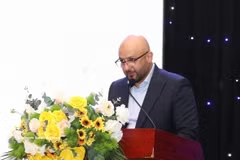
Hanoi (VNA) - Digital transformation in the heritage sector should adopt a people-centred approach, ensuring the meaningful participation of communities at every stage-from documentation and preservation to the management, use and dissemination of cultural data. Jonathan Baker, Representative of the United Nations Educational, Scientific and Cultural Organization (UNESCO) to Vietnam told the Vietnam News Agency during an interview on July 8.
Reporter: In the context of global digital transformation, how does UNESCO assess the role of digital technologies in safeguarding and promoting religious and belief-related heritage, particularly in preserving knowledge, rituals and sacred spaces for future generations?
Jonathan Baker: In the context of global digital transformation, UNESCO recognizes digital technologies as an important tool for safeguarding, transmitting and promoting cultural expressions, knowledge systems and traditions associated with religion, beliefs and the spiritual life of communities. Technology creates unprecedented opportunities to document, preserve and share forms of cultural heritage and cultural expression that are particularly vulnerable to loss over time, including traditional knowledge, languages, community memory, rituals, festivals, cultural spaces and belief-related practices.
For many forms of intangible cultural heritage, especially those transmitted primarily through oral traditions or direct intergenerational learning, digital technologies can support the creation of valuable archives of audiovisual materials, digital inventories and virtual documentation of cultural spaces. These efforts not only contribute to safeguarding heritage but also enhance public access to cultural knowledge, particularly for young people, researchers and communities in remote areas.
At the same time, UNESCO emphasizes that digitization is not an end in itself and cannot replace the role of communities as the bearers, practitioners and transmitters of heritage. A ritual, a belief-related practice or a cultural space remains truly alive only when it continues to be practiced, maintained and transmitted within contemporary community life.
Furthermore, as intangible cultural heritage is not static but continuously evolves in response to its environment, UNESCO emphasizes the need for robust monitoring mechanisms. These mechanisms ensure that digital archives are regularly updated to reflect the living and evolving nature of heritage, preventing digital records from becoming obsolete versions of a dynamic reality. Therefore, digital transformation in the heritage sector should adopt a people-centred approach, ensuring the meaningful participation of communities at every stage-from documentation and preservation to the management, use and dissemination of cultural data.
UNESCO also believes that digitization initiatives should pay particular attention to the principles of authenticity, ethics, cultural rights and community ownership reflected in the UNESCO 2003 Convention for the Safeguarding of the Intangible Cultural Heritage. While technology can expand access to heritage, it also raises important questions regarding the interpretation, use and sharing of cultural knowledge in digital environments. Striking a balance between innovation and respect for cultural diversity and traditional values is therefore essential.

Reporter: What recommendations does UNESCO have for countries advancing digital transformation, particularly regarding the development of digital databases, the protection of cultural data, and ensuring equitable access for communities in the field of religious and belief-related heritage?
Jonathan Baker: UNESCO believes that countries should approach digital transformation as a comprehensive process in which technology, culture and community rights are considered in a balanced and integrated manner.
First, it is necessary to invest in the development of integrated and interoperable digital heritage databases based on shared standards. Such databases should not only serve as repositories of information but also function as platforms that support research, education, heritage management and the dissemination of cultural knowledge. Ensuring the accuracy, authenticity and long-term sustainability of data is essential, as is avoiding fragmentation and insufficient coordination among institutions and local authorities.
In addition to digitizing intangible cultural heritage practices, UNESCO highlights the importance of digitally documenting cultural and ritual spaces, architectural heritage, cultural landscapes and related elements such as artefacts, soundscapes, images, rituals and performance contexts. This holistic approach helps capture the full cultural ecosystem, preventing cultural practices from being separated from their original settings and meanings, while enabling more meaningful, authentic and context-sensitive representation, research and educational use in digital environments.
Second, the protection of cultural data should be considered a priority within digital transformation processes. Not all heritage-related data can or should be accessed, shared or reused in the same way. Many religious practices, belief systems and forms of traditional knowledge require appropriate safeguards to protect the rights and interests of the communities concerned, respect cultural values and ethical considerations, and prevent misrepresentation, inappropriate commercialization or the departure from original meanings. UNESCO particularly emphasizes the importance of responsible and ethical data governance, ensuring that communities are actively involved in decisions related to the documentation, storage, management and use of cultural data.
Third, UNESCO believes that digital transformation can only be truly successful when everyone has the opportunity to access and benefit from its outcomes. This requires policies that promote equitable access to digital cultural resources, particularly for young people, women, persons with disabilities, ethnic minority communities, local communities and other groups in vulnerable situations.
Finally, UNESCO stresses that digital transformation in the heritage sector is not solely a technological issue; it is equally a matter of human capacity, governance and cross-sectoral collaboration. Investing in skills development and fostering cooperation among cultural institutions, heritage professionals, communities, researchers and technology stakeholders will be critical to building sustainable, secure and inclusive digital heritage ecosystems.
UNESCO looks forward to continuing our collaboration with Vietnam and other Member States to ensure that digital transformation not only helps safeguard cultural heritage but also contributes to building knowledge-based, innovative and sustainable societies for the future./.