Hanoi aims to raise tourists' night-time spending to 30%

Hanoi will establish and operate flagship night-time economy zones supported by preferential policies, including heritage and cultural districts in Hoan Kiem, Cua Nam, Ba Dinh, Son Tay and Soc Son; modern entertainment hubs in Tay Ho-West Lake West, My Dinh and Dong Anh; creative economy zones linked to cultural industries such as theatres, cinemas and museums; and cultural tourism and resort destinations in suburban craft villages including Bat Trang, Ba Vi and Huong Son.

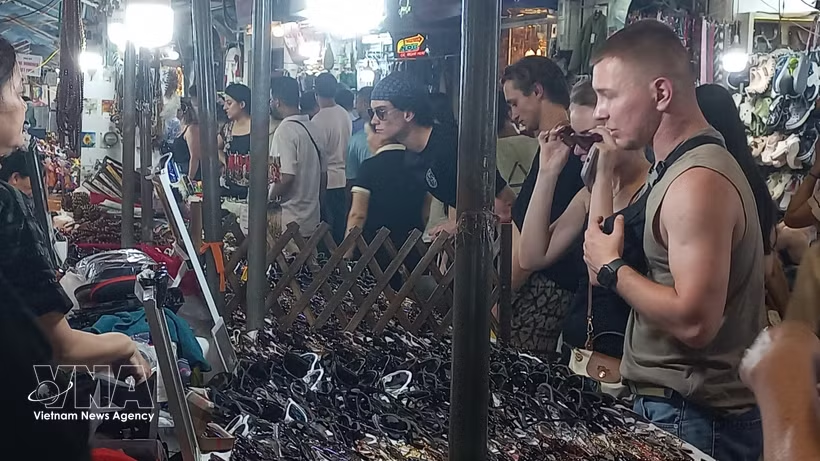
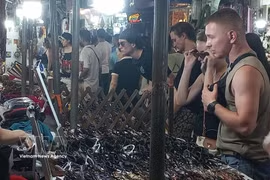
International tourists love shopping for souvenirs at Hanoi's Old Quarter night market (Photo: VNA)

Hanoi (VNA) - Hanoi plans to develop night-time economy zones, corridors and public spaces centred on heritage, culture, creativity and visitor experiences to increase the value of its tourism industry, with an aim to raise the proportion of tourist spending at night to 25-30% of total travel expenditure.

According to a plan of the municipal People’s Committee dated July 15, 2026 to implement the municipal People's Council's resolution on developing the capital's night-time economy, by 2030 the city aims to make the night-time economy a major driver of its service sector, contributing around 5% of Hanoi's GRDP while gradually increasing its share of budget revenue. The city also aims to extend the average visitor stay to 2.5-3.5 days.

Hanoi will establish and operate flagship night-time economy zones supported by preferential policies, including heritage and cultural districts in Hoan Kiem, Cua Nam, Ba Dinh, Son Tay and Soc Son; modern entertainment hubs in Tay Ho-West Lake West, My Dinh and Dong Anh; creative economy zones linked to cultural industries such as theatres, cinemas and museums; and cultural tourism and resort destinations in suburban craft villages including Bat Trang, Ba Vi and Huong Son.

The city also plans to develop themed night-time economy corridors featuring iconic attractions rooted in Hanoi's heritage, arts, cuisine and urban identity, including the Thang Long-Tu Tran heritage route and food streets such as Tong Duy Tan and Ta Hien.

Cultural industry centres and creative spaces will be expanded in areas including Dong Xuan-Bac Qua, Cua Nam, Tay Ho, Dong Anh, the Bat Trang Ancient Village Ecological Museum, and the Vietnam National Village for Ethnic Culture and Tourism.
vnanet-potal-ha-noi-ky-vong-danh-thuc-tiem-nang-du-lich-tu-kinh-te-dem-8837886.jpg
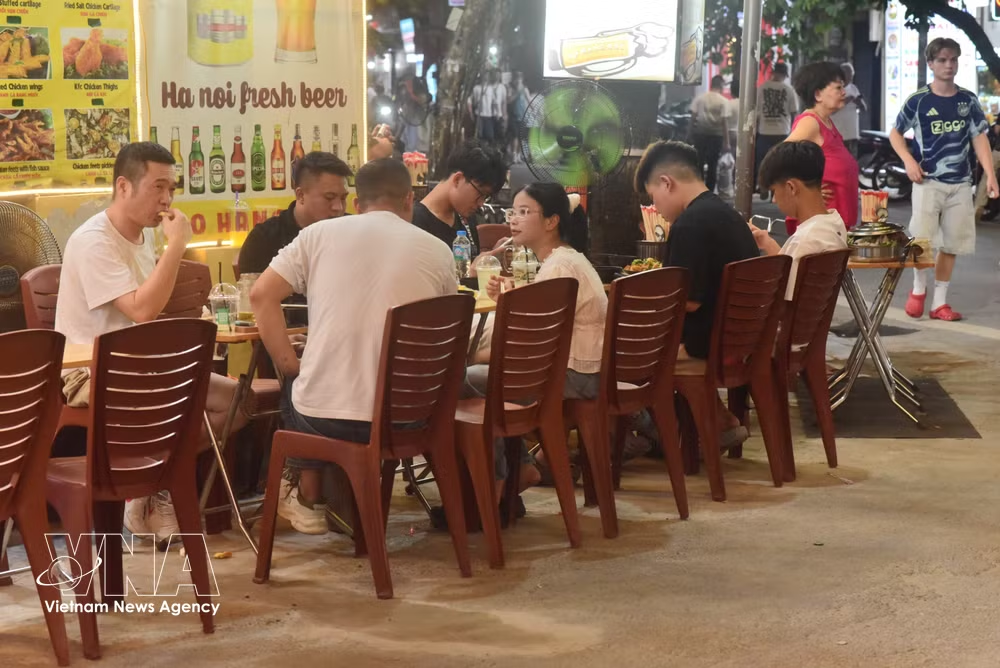
Tourists enjoy dinner on Ta Hien street, Hanoi (Photo: VNA)

Suburban areas will develop night-time tourism linked to traditional craft villages, cultural and historical sites, agricultural tourism and experiential travel, alongside night markets specialising in agricultural products, local specialties and OCOP products.

Hanoi will manage these night-time economy zones through the city's Intelligent Operations Centre (IOC) integrated with the iHanoi digital ecosystem, while encouraging all businesses operating in these areas to adopt cashless payments and share data to support smart urban management.

To achieve these goals, the city will launch a broad communication campaign to raise public awareness of the role of the night-time economy in economic, cultural and tourism development.

The plan also seeks to position Hanoi as "the region's leading distinctive night-time economy destination", capitalising on its unique strengths in heritage, culture and creativity. A unified branding system and dedicated digital communications ecosystem will be developed to promote the capital's night-time identity.

Authorities will standardise administrative procedures for establishing and managing night-time economy zones, while building digital databases and interactive maps to support planning, supervision, promotion and connectivity.

Licensing procedures will also be overhauled through a pilot one-stop integrated licensing mechanism, replacing fragmented sector-based approvals. The city aims to cut administrative procedures by 50%, clearly categorising activities that require standard licensing, additional conditions or pilot-only approval, while ensuring greater transparency and making investment more attractive.

Other measures include improving infrastructure for the night-time economy, introduction of late-night bus services connecting major night-time economy hubs, expanding urban artistic lighting system, and increasing open-air night-time arts spaces in major parks.

A comprehensive digital database and interactive map of Hanoi's night-time economy will underpin planning, management, marketing and operations. The platform will provide information on venues, opening hours, available services, visitor density, parking, transport links, live events, safety conditions and other visitor services.

The city also plans to establish an integrated monitoring system aligned with its Smart Hanoi initiative, combining 3D GIS, urban databases and real-time sensor data from AI-powered cameras and noise, lighting and activity-density sensors to ensure the safe operation of the night-time economy./.
VNA

See more

The Long Son Petrochemical Complex, an investment project of Thailand's SCG Group, is located in Long Son commune, Ho Chi Minh City. (Photo: VNA)

Vietnam reshapes FDI strategy with focus on technology, innovation

Politburo Resolution No. 10-NQ/TW, issued on June 8, 2026, recognises the foreign-invested sector as an important component of the national economy, signalling a major shift in the country's investment attraction strategy. Rather than prioritising labour-intensive projects, Vietnam is now seeking high-quality investments capable of driving technological progress, innovation, sustainable development and stronger participation in global value chains.

Vietnamese Ambassador to Laos Nguyen Minh Tam and Lao Deputy Minister of Industry and Commerce Phouthavanh Nanthavong visit the Vietnamese pavilion at VIETLAO EXPO 2026 (Photo: VNA)

VIETLAO EXPO 2026 helps boost Vietnam-Laos strategic cohesion

The Vietnam-Laos Trade Fair 2026 (VIETLAO EXPO 2026) opened on July 16 in Vientiane, serving as a key platform for businesses from both countries to showcase products, seek partnerships, transfer technologies and expand investment cooperation.

The Vietnam-EFTA FTA is one of the longest-negotiated trade agreements in Vietnam's history. (Illustrative Photo: VNA)

Vietnam-EFTA deal set to further boost bilateral trade growth

The Vietnam-EFTA FTA is one of the longest-negotiated trade agreements in Vietnam's history, reflecting its broad scope of commitments covering trade in goods and services, investment, intellectual property, government procurement, environmental protection, sustainable development, small and medium-sized enterprises (SMEs), and other areas of cooperation.

Passengers and visitors check in at Terminal 1 of Noi Bai International Airport. (Photo: VNA)

Hanoi-Ho Chi Minh City route among world’s busiest

According to IATA’s ranking of global air passenger markets, the US remained the world’s largest market in 2025, with 890.1 million passengers, up 1.6% from 2024. China, the world’s second-largest market, recorded stronger growth of 4.8%, reaching 776.1 million passengers. China is widely forecast to overtake the US and become the world’s largest air passenger market in the 2030s.

An overview of the working session between the Kazakh delegation and the Can Tho City People's Committee on July 16. (Photo: VNA)

Kazakhstan explores agricultural by-product recycling project in Can Tho city

The proposed project would use rice husks as its primary feedstock, with an estimated one million tonnes processed annually using advanced technology developed in Kazakhstan. At present, the top priority is to secure a stable supply of raw materials from rice-producing provinces across the Mekong Delta.

Consumers buy fruit at a supermarket in Vietnam. (Photo: VNA)

US highlights potential in Vietnam’s fruit market

The US was Vietnam's second-largest supplier of agricultural products, with export turnover reaching 4.7 billion USD in 2025, a remarkable increase from less than 3.5 billion USD in 2024, Fruitnet said, citing a new report by the US Department of Agriculture (USDA).

Vietnamese Ambassador to Thailand Pham Viet Hung (thitd, left) attends the opening ceremony of Grand Halal Bangkok 2026 (Photo: VNA)

Vietnamese firms seek global Halal opportunities at Bangkok exhibition

Ambassador Pham Viet Hung described Grand Halal Bangkok 2026 as an important opportunity for Vietnamese businesses to connect not only with Thailand's Halal industry but also with Halal food producers worldwide, while learning from experience of Thailand and international partners.

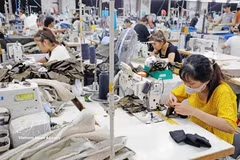
Marnufacturing garments for export at Hung Yen Jute and Garment Joint Stock Company. (Photo: VNA)

GDP expands 8.18%, with new growth drivers taking shape

According to the National Statistics Office under the Ministry of Finance, GDP expanded by 8.39% in the second quarter, up from 8.14% a year earlier. Growth for the first six months reached 8.18%, exceeding the 7.63% recorded in the same period of 2025. The performance reflected broad-based contributions from both the supply and demand sides of the economy.

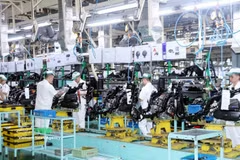
Production line at Honda Vietnam's manufacturing facility in Dong Van II Industrial Park, Ninh Binh province. (Photo: VNA)

Vietnamese economy sustains momentum on strong industrial production

The National Statistics Office (NSO) under the Ministry of Finance reported that the manufacturing and processing sector remained the principal driver of economic growth, accounting for 33.07% of the economy's total value-added growth during the first six months of the year.

Investors conduct transactions at Bao Viet Securities' headquarters in Hanoi. (Photo: VNA)

Vietnam eyes 205.6 billion USD in stock market funding for 2026–2030

Addressing a seminar on restructuring capital mobilisation channels hosted by the Finance and Investment newspaper on July 15, Bui Hoang Hai, Vice Chairman of the State Securities Commission of Vietnam (SSC), said the domestic economy continues to face considerable external challenges in 2026, including the effects from the Middle East conflict.

Workers process farm produce at the Coastal Fisheries Development Company (Cofidec) in Ho Chi Minh City. (Photo: VNA)

Vietnam remains ASEAN’s fastest-growing economy in first half of 2026: experts

Economists at United Overseas Bank (UOB), a Singapore-based multinational bank, said Vietnam’s gross domestic product (GDP) expanded by 8.39% in the second quarter of 2026, from 7.94% in the first quarter. As a result, economic growth for the first half of the year reached 8.18%, keeping Vietnam at the top among ASEAN economies.