Vietnam reshapes FDI strategy with focus on technology, innovation

Politburo Resolution No. 10-NQ/TW, issued on June 8, 2026, recognises the foreign-invested sector as an important component of the national economy, signalling a major shift in the country's investment attraction strategy. Rather than prioritising labour-intensive projects, Vietnam is now seeking high-quality investments capable of driving technological progress, innovation, sustainable development and stronger participation in global value chains.

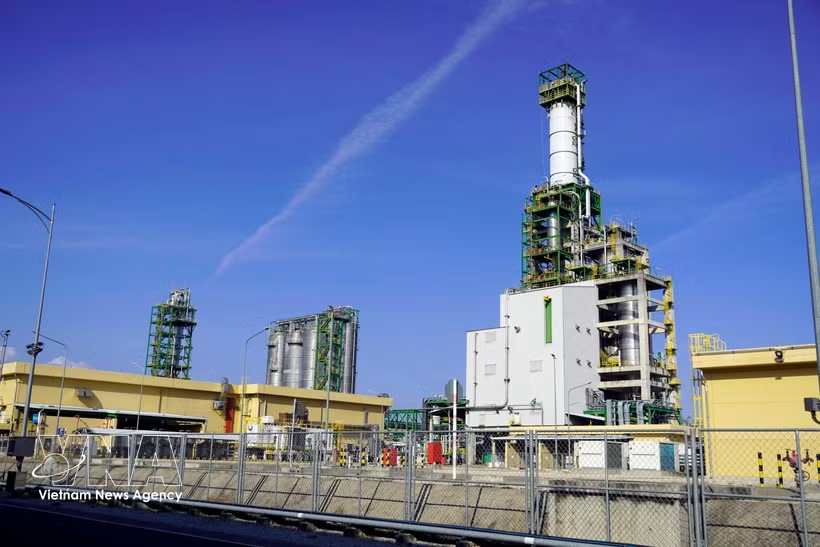
The Long Son Petrochemical Complex, an investment project of Thailand's SCG Group, is located in Long Son commune, Ho Chi Minh City. (Photo: VNA)

Hanoi (VNA) – Vietnam is entering a new phase in attracting foreign direct investment (FDI), with the emphasis shifting from the volume of capital inflows to technology, innovation and added value creation, following the issuance of Politburo Resolution No. 10-NQ/TW on developing the foreign-invested sector.

The resolution, issued on June 8, 2026, recognises the foreign-invested sector as an important component of the national economy, signalling a major shift in the country's investment attraction strategy. Rather than prioritising labour-intensive projects, Vietnam is now seeking high-quality investments capable of driving technological progress, innovation, sustainable development and stronger participation in global value chains.​

Experts told the Hanoi Press and Radio–Television Agency that the resolution provides an important political foundation for repositioning FDI as an integral part of Vietnam's economic ecosystem rather than simply a source of foreign capital.

Bruno Jaspaert, Chairman of the European Chamber of Commerce in Vietnam (EuroCham), said the recognition of FDI as a key part of the national economy sends a strong message to international investors.

He said European businesses, which typically make investment decisions based on long-term strategies rather than short-term returns, view the policy as reducing uncertainty and strengthening confidence in Vietnam as a long-term investment destination.

Bianca Wong, Vice President of FedEx Southeast Asia, said the resolution reinforces Vietnam's commitment to building a transparent and predictable investment environment.

She welcomed its focus on high-quality investment, innovation and deeper integration into global value chains, saying these priorities align closely with FedEx's long-term commitment to Vietnam. She added that Vietnam is increasingly becoming an important link in high-tech supply chains that demand speed and reliability.
vnanet-fdi-1419.jpg
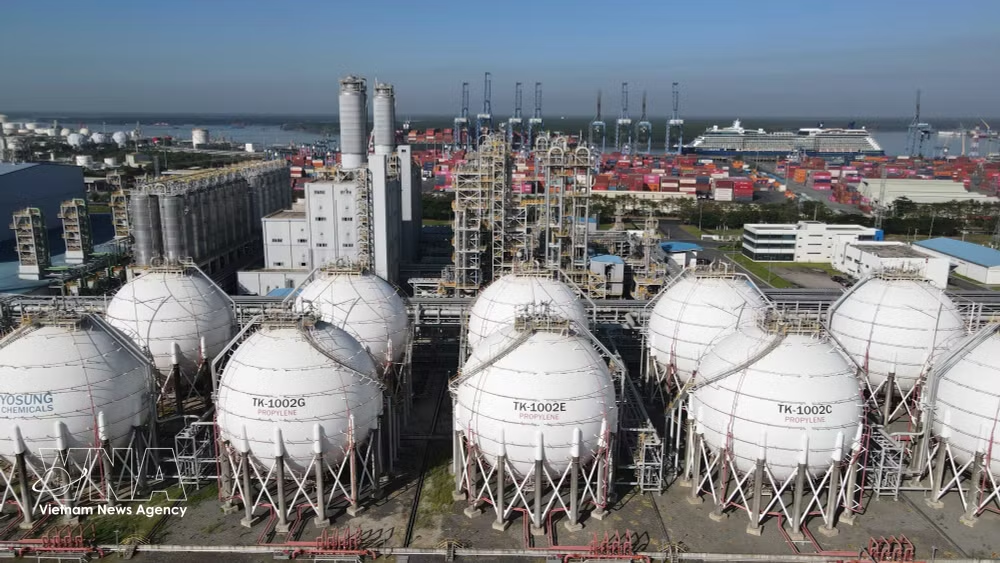
A view of Hyosung Chemical Plant, an investment project by the Republic of Korea's Hyosung Group, in Tan Phuoc Ward, Ho Chi Minh City. (Photo: VNA)

Nguyen Ba Luan, Country Representative of Cargill Vietnam, said the new policy reflects a broader change in how Vietnam measures the value of FDI.

According to him, investment quality is no longer determined solely by capital size but also by technology transfer, knowledge sharing, governance capacity and value chain connectivity. At Cargill, this approach has been translated into helping Vietnamese farmers adopt international biosecurity standards, enabling them to meet export market requirements while improving production capacity and management skills.​

Changes in the investment attraction mindset are also reflected in the structure of capital flows.

Vietnam attracted 34.6 billion USD in newly registered FDI in the first six months of 2026, up 61% year-on-year. Of the total, more than 18.4 billion USD, or 53.3%, flowed into manufacturing and processing, underscoring the country's continued appeal as a production and technology hub.

At the same time, newly licensed projects are increasingly expected to meet environmental, social and governance (ESG) standards, supporting Vietnam's commitment to achieving net-zero emissions.

Despite the positive outlook, experts said further reforms are needed to fully realise the resolution's objectives.

Jaspaert stressed that Vietnam should continue simplifying administrative procedures so businesses can devote more resources to innovation, green transition and workforce development rather than dealing with overlapped regulations.

He also identified human resources as the country's biggest challenge over the next five years. According to EuroCham's Business Confidence Index, the proportion of businesses concerned about talent shortages rose from 23% in the fourth quarter of 2025 to 38% in the second quarter of 2026.

Joel Hassan, a lecturer in International Business at RMIT Vietnam, said stronger links between the Government, universities and businesses are essential to improve Vietnam's ability to absorb advanced technologies.

He said universities should focus on research and talent development, the Government should provide supportive policies and reduce risks, while businesses should lead technology application and industrial upgrading.

Experts agreed that Resolution No. 10 has laid out a clear roadmap for upgrading the role of FDI in Vietnam. However, its success will ultimately depend on the country's ability to translate policy commitments into stronger domestic capabilities through better infrastructure, skilled human resources, innovation and closer cooperation among the State, academia and enterprises./.

VNA

See more

Vietnamese Ambassador to Laos Nguyen Minh Tam and Lao Deputy Minister of Industry and Commerce Phouthavanh Nanthavong visit the Vietnamese pavilion at VIETLAO EXPO 2026 (Photo: VNA)

VIETLAO EXPO 2026 helps boost Vietnam-Laos strategic cohesion

The Vietnam-Laos Trade Fair 2026 (VIETLAO EXPO 2026) opened on July 16 in Vientiane, serving as a key platform for businesses from both countries to showcase products, seek partnerships, transfer technologies and expand investment cooperation.

The Vietnam-EFTA FTA is one of the longest-negotiated trade agreements in Vietnam's history. (Illustrative Photo: VNA)

Vietnam-EFTA deal set to further boost bilateral trade growth

The Vietnam-EFTA FTA is one of the longest-negotiated trade agreements in Vietnam's history, reflecting its broad scope of commitments covering trade in goods and services, investment, intellectual property, government procurement, environmental protection, sustainable development, small and medium-sized enterprises (SMEs), and other areas of cooperation.

Passengers and visitors check in at Terminal 1 of Noi Bai International Airport. (Photo: VNA)

Hanoi-Ho Chi Minh City route among world’s busiest

According to IATA’s ranking of global air passenger markets, the US remained the world’s largest market in 2025, with 890.1 million passengers, up 1.6% from 2024. China, the world’s second-largest market, recorded stronger growth of 4.8%, reaching 776.1 million passengers. China is widely forecast to overtake the US and become the world’s largest air passenger market in the 2030s.

An overview of the working session between the Kazakh delegation and the Can Tho City People's Committee on July 16. (Photo: VNA)

Kazakhstan explores agricultural by-product recycling project in Can Tho city

The proposed project would use rice husks as its primary feedstock, with an estimated one million tonnes processed annually using advanced technology developed in Kazakhstan. At present, the top priority is to secure a stable supply of raw materials from rice-producing provinces across the Mekong Delta.

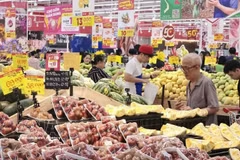
Consumers buy fruit at a supermarket in Vietnam. (Photo: VNA)

US highlights potential in Vietnam’s fruit market

The US was Vietnam's second-largest supplier of agricultural products, with export turnover reaching 4.7 billion USD in 2025, a remarkable increase from less than 3.5 billion USD in 2024, Fruitnet said, citing a new report by the US Department of Agriculture (USDA).

Vietnamese Ambassador to Thailand Pham Viet Hung (thitd, left) attends the opening ceremony of Grand Halal Bangkok 2026 (Photo: VNA)

Vietnamese firms seek global Halal opportunities at Bangkok exhibition

Ambassador Pham Viet Hung described Grand Halal Bangkok 2026 as an important opportunity for Vietnamese businesses to connect not only with Thailand's Halal industry but also with Halal food producers worldwide, while learning from experience of Thailand and international partners.

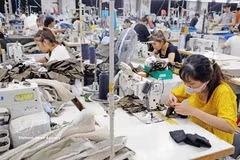
Marnufacturing garments for export at Hung Yen Jute and Garment Joint Stock Company. (Photo: VNA)

GDP expands 8.18%, with new growth drivers taking shape

According to the National Statistics Office under the Ministry of Finance, GDP expanded by 8.39% in the second quarter, up from 8.14% a year earlier. Growth for the first six months reached 8.18%, exceeding the 7.63% recorded in the same period of 2025. The performance reflected broad-based contributions from both the supply and demand sides of the economy.

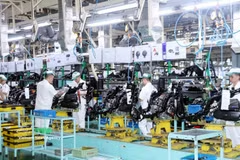
Production line at Honda Vietnam's manufacturing facility in Dong Van II Industrial Park, Ninh Binh province. (Photo: VNA)

Vietnamese economy sustains momentum on strong industrial production

The National Statistics Office (NSO) under the Ministry of Finance reported that the manufacturing and processing sector remained the principal driver of economic growth, accounting for 33.07% of the economy's total value-added growth during the first six months of the year.

Investors conduct transactions at Bao Viet Securities' headquarters in Hanoi. (Photo: VNA)

Vietnam eyes 205.6 billion USD in stock market funding for 2026–2030

Addressing a seminar on restructuring capital mobilisation channels hosted by the Finance and Investment newspaper on July 15, Bui Hoang Hai, Vice Chairman of the State Securities Commission of Vietnam (SSC), said the domestic economy continues to face considerable external challenges in 2026, including the effects from the Middle East conflict.

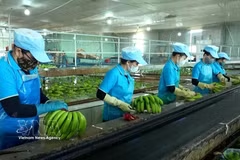
Workers process farm produce at the Coastal Fisheries Development Company (Cofidec) in Ho Chi Minh City. (Photo: VNA)

Vietnam remains ASEAN’s fastest-growing economy in first half of 2026: experts

Economists at United Overseas Bank (UOB), a Singapore-based multinational bank, said Vietnam’s gross domestic product (GDP) expanded by 8.39% in the second quarter of 2026, from 7.94% in the first quarter. As a result, economic growth for the first half of the year reached 8.18%, keeping Vietnam at the top among ASEAN economies.