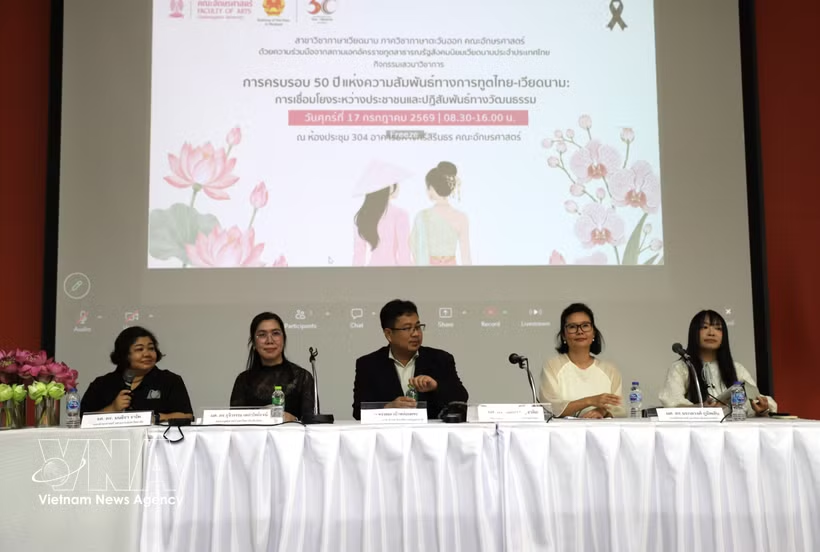
Bangkok (VNA) – A seminar highlighting the role of people-to-people connectivity and cultural exchanges in strengthening Vietnam-Thailand relations was held at Chulalongkorn University in Bangkok on July 17 as part of activities marking the 50th anniversary of diplomatic ties between the two countries.
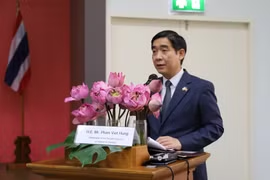
The event brought together Vietnamese Ambassador to Thailand Pham Viet Hung, scholars and lecturers from Thai universities, and a large number of students from Chulalongkorn University’s Faculty of Arts.
Delivering a keynote speech on the future of Thailand-Vietnam relations after five decades of diplomatic ties, Ambassador Hung underscored the important role of universities not only in preserving shared history but also in shaping the future of the bilateral partnership through education, research and people-to-people connections.
The diplomat noted that Thailand holds a unique place in Vietnam’s modern history as the only Southeast Asian country where President Ho Chi Minh lived and carried out revolutionary activities. During his stay in Thailand in 1928-1929, under the name Thau Chin, the late Vietnamese leader earned the respect and affection of both the Vietnamese community and many Thai people.
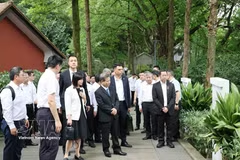
Today, memorial sites dedicated to President Ho Chi Minh in Nakhon Phanom, Udon Thani and Phichit remain enduring symbols of the historic friendship and deep mutual respect between the two peoples.
These historical and cultural bonds continue to resonate today. Thai culture has become increasingly familiar to the Vietnamese public, while Vietnam’s traditional culture and tourist destinations are drawing growing interest from Thai people. In 2025 alone, more than 1.1 million Vietnamese and Thai tourists visited each other’s countries, reflecting increasingly close connections between the two societies.
The Vietnamese community in Thailand, numbering more than 100,000, has long served as an important bridge of friendship, preserving Vietnamese culture while actively contributing to Thailand’s socio-economic development. Meanwhile, around 20 pairs of sister cities and provinces have expanded cooperation and exchanges in education, culture, tourism and business, bringing the benefits of bilateral ties closer to local communities.
Ambassador Hung affirmed that the strong bonds between the two peoples give vitality, resilience and meaning to Vietnam-Thailand relations.
He proposed further expanding student and lecturer exchanges, joint research and partnerships between universities of the two countries. He also called for stronger language and cultural exchanges through teaching of Thai in Vietnam and Vietnamese in Thailand, as well as greater support for Thai and Vietnamese studies programmes.
Other priorities include promoting tourism, youth exchanges and cooperation between local communities, along with preserving the shared historical heritage connecting the two countries, particularly President Ho Chi Minh memorial sites in Thailand.
“Last but not least, we must preserve the shared historical heritage that binds our two countries, including the President Ho Chi Minh memorial sites in Thailand, so that future generations can continue to cherish the enduring friendship between our peoples,” the ambassador stressed.
The seminar also featured presentations on Vietnam’s socio-economic development trends and orientations and the country’s “era of national rise,” reflecting Thai scholars’ growing interest in and understanding of Vietnam.
A highlight of the event was a panel discussion on the teaching and learning of Vietnamese in Thailand, attended by scholars and Vietnamese-language lecturers from leading Thai universities, including Chulalongkorn, Chiang Mai, Thammasat, Ramkhamhaeng and Udon Thani Rajabhat.
Assistant Prof. Dr. Morragotwong Phumplab of Thammasat University said people-to-people relations are at the heart of ties between the two countries, with the Vietnamese language serving as a gateway to greater mutual understanding and closer connections.
Naresuan University lecturer Thanattha Jantem, meanwhile, noted that an increasing number of Thai universities are offering Vietnamese-language programmes. She described the seminar as a valuable opportunity for lecturers to exchange experience and expertise in teaching the language.
Having taught Thai in Vietnam and Vietnamese in Thailand, Thanattha said understanding each other’s languages could help the two peoples work together more effectively toward economic and social development.
Vietnamese language is currently taught at universities across Thailand, helping foster cultural exchanges and deepen mutual understanding between the two peoples./.