Ho Chi Minh City, GTEL partner on technology transfer for metro network

The two sides will study and localise key technologies covering signalling, communications, power supply, electromechanical systems (E&M), SCADA, operations control centres (OCC), automatic fare collection (AFC) and platform screen doors (PSD), while advancing technology transfer, workforce development and the capabilities of domestic enterprises.

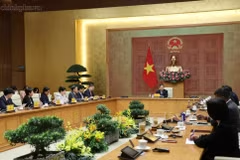
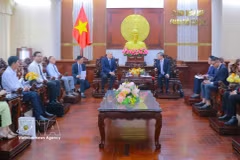
Ho Chi Minh City (VNA) - Ho Chi Minh City's Management Authority for Urban Railways (MAUR) and the Global Technology and Telecommunications Corporation (GTEL) on July 17 signed a memorandum of understanding to cooperate on system integration research and technology transfer for Ho Chi Minh City's metro network, aiming to gradually master core urban railway technologies.

The partnership will initially focus on Metro Line 2 (Ben Thanh – Tham Luong) and metro projects scheduled for 2026–2030.

The two sides will study and localise key technologies covering signalling, communications, power supply, electromechanical systems (E&M), SCADA, operations control centres (OCC), automatic fare collection (AFC) and platform screen doors (PSD), while advancing technology transfer, workforce development and the capabilities of domestic enterprises.

The agreement also includes collaboration on applying advanced technologies such as artificial intelligence (AI), digital twins, building information modelling (BIM), geographic information systems (GIS), the Internet of Things (IoT), big data, electronic identification (eID) and other digital solutions to improve metro operations, maintenance and management. The partners aim to develop an integrated operations control centre for Ho Chi Minh City's future metro network and build a pool of Vietnamese engineers and companies capable of designing, integrating, operating and maintaining metro systems.

GTEL Chairman Senior Colonel Luong Duc Minh said the company would leverage its expertise in digital technology, digital transformation and cybersecurity to support the MAUR in system integration and technology transfer, helping strengthen domestic technological capabilities.

Ho Chi Minh City is accelerating metro development with a target of building around 200 km of urban rail by 2030 under the Politburo's Resolution No. 09-NQ/TW on the city's development in the new era.

MAUR Director Phan Cong Bang said metro investment must go beyond infrastructure construction to include technological self-reliance, data ownership and the development of Vietnam's domestic capabilities in urban rail.

He expressed confidence that the partnership will help establish a locally driven urban rail technology ecosystem and support the sustainable expansion of the city's metro network.

Vice Chairman of the Ho Chi Minh City People's Committee Hoang Nguyen Dinh called for standardised technology architecture and shared data systems, stronger technology transfer, workforce training, enhanced domestic industrial capacity and safeguards to ensure Vietnam's control over transport data.

He reaffirmed the city's commitment to supporting research, technology transfer and the development of the railway industry to build a modern, smart and sustainable public transport system.

The agreement marks the start of a long-term partnership on system integration and technology transfer, laying the groundwork for stronger domestic technological capabilities, a highly skilled workforce and greater participation by Vietnamese companies in the urban railway value chain./.

VNA
See more

Production at Viet Hai High-Tech Structure Production Company Limited in Vung Ang Economic Zone. Ha Tinh province aims to develop Vung Ang Economic Zone into a regional centre for industry, energy, seaports and logistics (Photo: VNA)

Revised master plan of Vung Ang EZ approved

The adjustment aims to create a more rational development framework to maximise the zone’s potential and advantages while providing a legal foundation for construction management and ensuring sustainable development.

Illustrative image (Photo: VNA)

Vietnam looks to domestic market to sustain wood industry growth

Vietnam’s wood sector has long been a top foreign-currency earner. Exports of wood and wooden products neared 17.3 billion USD in 2025, reaching more than 160 countries and territories and clearing the high bars set by the US, the European Union and Japan.

Delegates at the event (Photo: VNA)

Vietnam remains key market for Polish food producers

The campaign promotes selected European Union agricultural and food products, including fresh, chilled and frozen beef and pork, fresh apples, apple juice and dried apples, targeting consumers, importers, distributors, retailers and the hospitality sector.

Wei Xiaoli, a representative of Shandong Jindafeng Machinery Co., Ltd., in an interview granted to the Vietnam News Agency. (Photo: VNA)

Chinese firms see strong potential for agricultural mechanisation cooperation with Vietnam

Business representatives said mechanisation not only helps reduce reliance on manual labour but also improves production efficiency, shortens planting and harvesting times, reduces post-harvest losses and enhances the quality of agricultural products. For rice-producing countries like Vietnam, they noted, accelerating mechanisation is an inevitable trend to strengthen the competitiveness of the agricultural sector.

Community-led fisheries groups have become frontline defenders of coastal fisheries. (Photo: VNA)

Community-led fisheries groups strengthen IUU fight in Ha Tinh

With a long coastline and abundant inshore fishing grounds, Ha Tinh has long identified the marine economy as a key growth driver. However, growing fishing pressure and destructive practices have posed major management challenges. Community-led self-management initiatives are now providing an effective solution.

At the VIFC-HCMC (Photo: VNA)

700 bln USD for net zero: Vietnam bets on VIFC

Assoc. Prof. Dr. Nguyen Huu Huan, Vice Chairman of the Executive Board of VIFC-HCMC, said the VIFC will focus on building market infrastructure needed to bridge the gap between big investment pledges and bankable projects.

A view of the launch ceremony for the expanded Vietnam–China cross-border QR payment service. (Photo: NAPAS)

Over 1 billion Weixin Pay users can make QR code payments in Vietnam

NAPAS, Weixin Pay, and BIDV will study the rollout of the reverse payment service, enabling users of Vietnamese banking applications and e-wallets to make QR code payments in China, with the aim of completing a comprehensive cross-border payment ecosystem between the two countries.

Vietnam cuts retail fuel prices on August 6. (Photo: VNA)

Vietnam cuts retail fuel prices on August 6

The maximum retail price of E5RON92 biofuel was reduced by 1,160 VND to 21,728 VND (0.83 USD) per litre, while that of E10RON95-III fell by 1,035 VND to 22,324 VND per litre.

Production of electronic components at Star Engineers Vietnam Co. Ltd. in Binh Xuyen I Industrial Park in Phu Tho province. (Photo: VNA)

Vietnam targets higher-quality FDI under Resolution 10

During the first seven months of 2026, Vietnam attracted more than 38 billion USD in registered FDI, up nearly 58% year-on-year. More importantly, the increase was driven by large-scale, high-tech projects rather than a surge in the number of new investments, signalling a significant improvement in the quality of capital inflows.

A woodchip production line at a plant in Vinh Thuy commune, Quang Tri province (Photo: VNA)

Tackling timber supply bottlenecks needed for value-added processing: experts

Vietnam's wood industry has grown rapidly in recent years, with exports reaching 17.2 billion USD in 2025. Wood and wood products are now shipped to more than 140 countries and territories, making Vietnam an important processing hub in the global supply chain, with key markets such as the US, Japan, China, the European Union and the Republic of Korea.