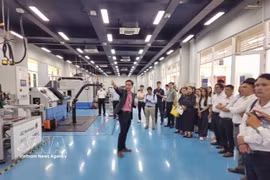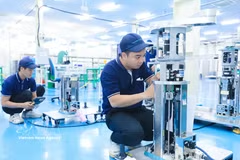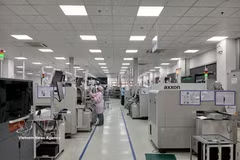
Ho Chi Minh City (VNA) – The rapid rise of artificial intelligence (AI) is reshaping not only the global technology race but also Asia’s trade landscape. Against this backdrop, Vietnam is emerging as one of the region’s biggest beneficiaries, steadily strengthening its role in the global AI hardware supply chain.
According to HSBC Global Investment Research, intra-Asian trade in AI-related goods, including semiconductors, electronic components and equipment supporting AI technologies, reached nearly 2 trillion USD in 2025, double the pre-COVID19-pandemic level. AI-related products now account for 35% of Asia’s total exports, up significantly from 19% a decade ago.
HSBC (Hongkong and Shanghai Banking Corporation Limited) identifies Vietnam as the economy that has recorded the fastest improvement in its position within the AI supply chain. The country’s share of global trade in AI-related equipment surged from 1.2% in 2015 to 12.4% in 2025, the strongest increase worldwide during the period.
Trade data from Vietnam’s key partners reflects this shift. In the first quarter of 2026, Taiwan (China) recorded its first quarterly trade deficit with Vietnam. During the three months ending in May, Taiwan’s imports from Vietnam jumped 173% year-on-year, driven largely by machinery, electrical equipment and household electrical appliances.
Meanwhile, exports of the Republic of Korea (RoK) to Vietnam posted the strongest growth among Southeast Asian markets, underscoring increasingly close production linkages between the two economies in electronics manufacturing and computer hardware, including equipment used for AI servers.
Tim Evans, CEO of HSBC Vietnam, said these developments demonstrate that Vietnam is gradually moving beyond its traditional role as a low-cost assembly base to become a more important node in regional supply chains.
He noted that Vietnam is importing more high-value components from the RoK and Taiwan (China), expanding domestic manufacturing capacity before exporting finished and semi-finished products to markets across Asia and other markets.
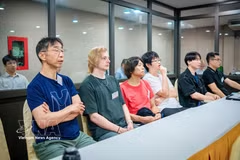
Speaking at the recent Vietnam–RoK Financial Cooperation Forum in Ho Chi Minh City, Lee Young Jick, head of the Korea-ASEAN Financial Cooperation Centre, described Vietnam as one of the region’s most promising growth performers, supported by stable macroeconomic fundamentals, including inflation, exports and the balance of payments.
According to Lee, global foreign direct investment (FDI) continues to shift toward ASEAN, particularly Vietnam, Indonesia, the Philippines and Malaysia. AI, semiconductors and digital platforms have become the most attractive investment sectors, contributing not only to economic growth and job creation but also to industrial upgrading and the development of new regional value chains.
Lee said Vietnam is increasingly being recognised as a new global manufacturing base, with strengths extending beyond traditional industries such as textiles and electronics to include precision engineering, smartphones, semiconductors and AI data centres. This transformation, he added, reflects the country's growing importance in international production networks and global value chains.
Experts attribute Vietnam’s progress to a combination of supportive government policies, including its semiconductor development strategy, and expanding investment by global technology companies in electronics manufacturing, semiconductor packaging and testing.
Vietnam is also investing heavily in human capital, aiming to train tens of thousands of semiconductor engineers by 2030 while identifying science, technology and digital transformation as new engines of economic growth.
Domestically, demand for AI applications is also expected to rise. Supported by its young population, strong digital adoption and expanding business ecosystem, Vietnam has the potential to become not only a leading AI hardware manufacturing hub but also a growing market for AI-enabled services./.
See more
Japan-based semiconductor expert sees broad cooperation opportunities with Vietnam
Japan is aware that no country can single-handedly manage the entire semiconductor supply chain, so cooperation with partners like the US, Europe, and Asian countries including Vietnam forms a crucial part of Japan's strategy, said Assoc. Prof. Dr Le Duc Anh of the University of Tokyo.
Expert proposes 3 strategies for Vietnam to develop strategic technology products
Dr Ta Anh Phuong, CEO of Seinetime, a French technology start-up specialising in data personalisation and artificial intelligence (AI) solutions, said Vietnam's strategic technology goods should pass a global relevance test and strive to achieve strategic indispensability, making them products that international corporations actively seek to incorporate into their operations.
ICISE urged to strengthen role in advancing Vietnam's science
Deputy Prime Minister Ho Quoc Dung expressed his hope that Professor Tran Thanh Van, the Rencontres du Vietnam Association and ICISE would continue serving as bridges between Vietnam and the international scientific community, attracting leading researchers and making practical contributions to the country's scientific and technological progress.
Gia Lai province hosts 10th Vietnam School on Neutrinos
During the event, participants receive both fundamental and advanced training in particle physics and neutrino science through lectures covering neutrino physics, the Standard Model, particle and radiation detectors, reactor neutrino experiments, high-energy neutrino astronomy, supernova neutrinos, and major international projects such as Super-Kamiokande, T2K and Hyper-Kamiokande.
Data resources key to transforming Vietnam’s growth model
Experts said an efficient data market will ensure that data flows to sectors where it generates the greatest economic value, thereby improving the economy's overall efficiency.
Vietnam tops Southeast Asia in AI learning on Gemini: Google
Academic queries account for 17% of all prompts submitted by Vietnamese users, well above the regional average of 11%, cementing Vietnam’s position as the region’s top adopter of AI for education.
Vietnam designates October 15 as National Digital Citizen Day
Under the newly issued resolution, citizens have the right to control the use of their personal data, access digital services and receive legal protection in the digital environment.
Top leader unveils people-centred vision for new development model
Vietnam's growth model, long fueled by low-cost labour, resource extraction, contract manufacturing, expanded investment, and capital accumulation, has run out of road. The country now needs a sweeping reform agenda to shift from extensive growth to a model driven by productivity, knowledge, science and technology, innovation, and digital transformation.
Digital governance transforms life in border commune of Dong Nai city
A year after adopting the two-tier local administration model, Bu Gia Map, a remote border commune in the southern city of Dong Nai with a significant ethnic minority community, has experienced notable improvements in public administration, making digital public services more accessible to residents and boosting governance efficiency.
Experts recommend risk-based data governance to strengthen legal protection
In the first quarter of 2026, more than 6.9 million accounts were exposed, double the figure recorded in the same period last years. Stolen personal data has frequently been exploited in sophisticated online scams, particularly impersonation schemes targeting victims through fake relatives or acquaintances.
Interactive "Cyber Security Wall" exhibition spreads digital safety awareness in Hanoi
Through a series of display areas, visitors can explore notable scientific and technological achievements of the People's Public Security Force in safeguarding national security in cyberspace. The exhibition also provides information on common forms of online fraud and cyber scams, along with practical guidance on how to identify and prevent them.
Samsung taps Vietnamese talent to strengthen AI, semiconductor workforce
Vietnam has been identified as one of Samsung's key markets for developing high-tech human resources.
Vietnam approves roadmap to build “Make in Vietnam” civil cryptography ecosystem
The initiative aims to establish and perfect mechanisms and policies to encourage greater participation from enterprises, organisations, training institutions and individuals in developing civil cryptography technology.
Experts call for strengthening innovation ecosystem through closer collaboration
According to the State Agency for Technology and Innovation under the Ministry of Science and Technology, Vietnam is now home to nearly 4,000 start-ups and enterprises operating in the fields of science, technology and innovation, supported by a workforce of more than 30,000 highly skilled professionals.
Deputy PM orders nuclear push as atomic energy institute marks 50 years
VINATOM is targeting not just research strength but strategic national entity status, accompanying the country in building a modern nuclear industry.
New decree offers major incentives for high-tech R&D
The decree, which took effect on July 1, gives priority to investment in high-tech R&D, including research into innovative and core technologies; efforts to decode, master and improve high technologies; and the application, testing and refinement of advanced technologies.
Vietnam shapes AI ecosystem following 18-month implementation of Resolution 57
Eighteen months after the launch of Resolution 57, a national AI ecosystem is gradually taking shape, bringing together institutions, data resources, computing infrastructure, technology enterprises, human resources and application markets.
Three strategic technology products expected to deliver breakthroughs in 2026
With strong leadership from the Party and the State, together with the determination of ministries, sectors, and localities, Vietnam will achieve important initial milestones in strategic technology development within this year
Vietnam accelerates STEM workforce development for strategic technologies
Vietnam’s challenge is not merely to train more engineers or scientists, but to cultivate a generation capable of mastering, improving and eventually creating core technologies.
PM urges faster development of national databases, strategic technologies
The PM stressed that ministers must take direct responsibility for the implementation of assigned tasks and ensure the quality and progress of database development.