Digital, AI competencies made mandatory for university graduates

Under Circular No. 54/2026/TT-BGDDT on higher education curricula, learning outcomes must be defined as measurable and assessable competencies, providing the basis for curriculum design, teaching, assessment, quality improvement, credit recognition and degree awarding.

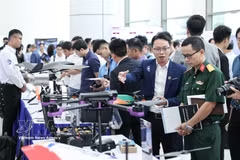
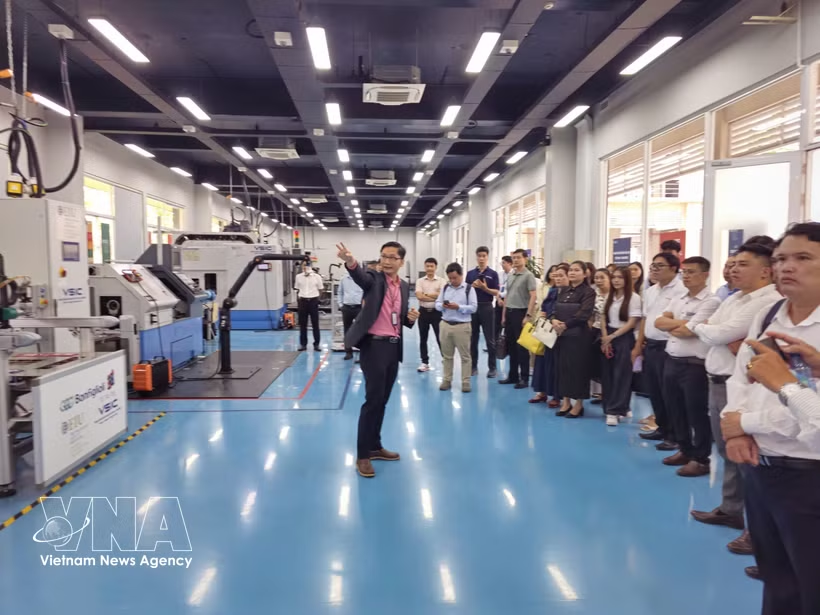
Delegates tour the facilities of the industrial innovation centre at Eastern International University in Binh Duong ward, Ho Chi Minh City (Photo: VNA)

Hanoi (VNA) – All university students will be required to graduate with digital competencies and knowledge of artificial intelligence (AI) under a new regulation issued by the Ministry of Education and Training (MoET), marking the first time these skills have been made compulsory learning outcomes for undergraduate programmes.

The requirement is among the key provisions of the ministry's Circular No. 54/2026/TT-BGDDT on higher education curricula, which establishes a unified framework for the design, implementation and quality assurance of bachelor's, master's and doctoral programmes.

Under the circular, learning outcomes must be defined as measurable and assessable competencies, providing the basis for curriculum design, teaching, assessment, quality improvement, credit recognition and degree awarding.

For undergraduate programmes, graduates must demonstrate digital competencies, AI-related knowledge, proficiency in a foreign language, and the ability to adapt and pursue lifelong learning.

Master's programmes must equip students with research, innovation, applied knowledge, and development capabilities. Doctoral programmes are required to foster independent research capacity, the ability to propose new technologies or solutions, produce scientific publications or applied research outcomes, and guide research and innovation.

The circular also sets minimum credit requirements for each qualification level. Undergraduate programmes and Level-6 qualifications must comprise at least 120 credits, while specialised programmes require a minimum of 150 credits. Master's programmes must include at least 45 credits, and doctoral programmes 90 credits.

Curricula must clearly align educational objectives, learning outcomes, course content, teaching methods, assessment and quality assurance conditions. They must also specify compulsory and elective components to enable students to build learning pathways suited to their abilities and career goals.

Along with foundational and specialised knowledge, undergraduate programmes must include supplementary training in foreign languages, digital competencies, AI and other essential knowledge and skills. Meanwhile, academic and research-oriented programmes are required to strengthen scientific research and innovation activities, while application-oriented programmes must place greater emphasis on practical training, internships, professional experience and real-world projects.

The circular also introduces detailed requirements for interdisciplinary, multidisciplinary, double-major, major-minor and integrated programmes, as well as specialised tracks such as honours engineering and honours bachelor's programmes, among others.

These regulations provide a legal foundation for higher education institutions to develop academic programmes tailored to the specific characteristics of each discipline, training objectives, and workforce demands, while ensuring learning outcomes and maintaining quality education.

It also tightens faculty requirements. In undergraduate programmes, full-time lecturers holding doctoral degrees must teach at least half of the specialised curriculum. The proportion rises to at least 75% for specialised Level-7 and master's programmes. All doctoral lecturers must hold PhDs, maintain active research and scientific publications, and meet supervision requirements for doctoral candidates.

To ensure quality, higher education institutions must provide adequate practice facilities, libraries, digital learning resources, information technology platforms and other teaching support systems.

Special provisions are also introduced for disciplines such as health sciences, teacher education, the arts, sports, ethnic minority and rare languages, reflecting their specific professional and training requirements./.

VNA

See more

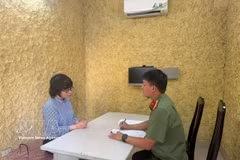
Nguyen Thuy Hang, Director of the Writers Association Publishing House, is questioned at the security agency for investigation under the Hanoi Department of Public Security. (Photo published by VNA)

Publishers detained over alleged anti-State propanganda

The move was made as part of an expanded investigation into a criminal case involving Nguyen Thanh Nam, who is accused of “making, storing, distributing or spreading information, documents and items aimed at sabotaging the State of the Socialist Republic of Vietnam.”

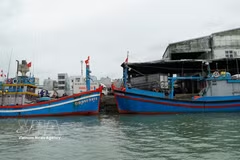
Fishing boats at Quy Nhon Port of Gia Lai province (Photo: VNA)

Gia Lai digitises fishing fleet to strengthen fight against IUU fishing

Under Directive No. 16/CT-UBND, recently issued by the provincial People's Committee, combating IUU fishing has been identified as an urgent political priority requiring concentrated resources to address shortcomings in fishing fleet management, while holding agency heads and local leaders accountable for the results achieved.

The General Association of Vietnamese People in Laos, in coordination with Bang Long Pagoda, organises the “Mid-Autumn Festival Night” programme to celebrate the Mid-Autumn Festival. (Photo: VNA)

Vietnamese community organisation network completed across Laos

The official establishment of the Vietnamese Community Management Committee and the Vietnamese Association in Vientiane province on July 14 has completed the organisational network serving the Vietnamese community in all 18 provinces and centrally administered cities of Laos.

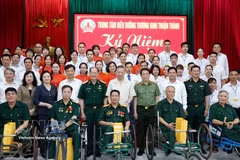
Party General Secretary and State President To Lam (centre, standing, first row) poses for a group photo with staff and invalids and sick soldiers at the Thuan Thanh Invalids Nursing Centre. (Photo: VNA)

Top leader calls for better care for invalids, revolutionary contributors

Party General Secretary and State President To Lam on July 15 affirmed that caring for revolutionary contributors is both a political responsibility and a moral obligation, calling for more comprehensive and timely policies to ensure that those who sacrificed for the nation receive the care and respect they deserve.

A sailboat carrying tourists cruises in the waters off Phu Quoc, An Giang province. (Photo: VNA)

Phu Quoc tightens inland waterway safety, traffic management

Operators of inland ports and terminals must carry out regular inspections, maintenance and repairs to ensure facilities remain safe and operational. They are also required to work with competent authorities and the Inland Waterway Port Authority to verify that vessels operating at ports and terminals meet all safety requirements.

Delegates visit the exhibition booths at the announcement ceremony of three strategic technology industry innovation networks on August 25, 2025. (Illustrative image. Source: VNA)

Attracting high-quality talent to strategic science, technology fields

Under the decree, students admitted to eligible programmes who meet entrance score requirements or are directly admitted, and rank among the top 30% of entrants, will be eligible for Government scholarships. The scholarships will be renewed annually based on academic performance and conduct.

Biological samples are collected from the remains of unidentified fallen soldiers at the Pho An Martyrs' Cemetery in Tra Cau ward, Quang Ngai province. (Photo: VNA)

Tireless efforts made to restore the names of fallen soldiers

Quang Ngai currently has 127 martyrs' cemeteries containing 37,689 graves, including 26 collective ones. Of these, 16,758 have complete information, 5,134 contain partial information, while 15,771 remain unidentified. Around 6,000 martyrs from the province have yet to have their remains located.

Overseas Vietnamese delegates attend the opening ceremony of the Vietnam Summer Camp 2026. (Photo: VNA)

Vietnam Summer Camp 2026 strengthens cultural identity, deepens young OVs’ bond with homeland

Addressing the ceremony, Deputy Minister of Foreign Affairs Le Thi Thu Hang said the participants return to Vietnam at a particularly significant moment, as the country enters a new stage of development following the 14th National Party Congress. She noted that the ongoing reorganisation of administrative units has created new development space for localities and the nation, unlocking fresh potential, encouraging innovation and providing new momentum for faster and more sustainable growth.

Members of Team K51 under the Dak Lak provincial Military Command travel through remote forests and mountains in Vietnam and Cambodia in search of the remains of Vietnamese volunteer soldiers and military experts who died during wartime. (Photo published by VNA)

Dak Lak team presses on with search for fallen soldiers

During the 2025–2026 dry season, Team K51 recovered and repatriated the remains of 27 Vietnamese volunteer soldiers and experts who died in Cambodia. The achievement came after nearly seven months of searching through forests, crossing streams and following even the smallest leads.

Documents containing the Prime Minister's commendation decisions awarding the “To quoc ghi cong” (The Fatherland acknowledges the merit) certificate to the families of martyrs, including Decision No. 04TtgA awarding the certificate to the family of martyr Huynh Van Quen (Photo: VNA)

Unlocking value of archives in search for fallen soldiers’ identities

Once digitisation is completed and a unified database is established, searches will become much faster and more accurate, providing an important foundation for the search for, recovery and identification of martyrs’ remains and for better implementing policies for people with meritorious service.