Innovation challenge seeks AI-native solutions to real-world problems

Following a rigorous five-week intensive bootcamp led by experts from Google Research, Stanford, and NVIDIA, the teams entered a grueling 48-hour AI hackathon to develop AI-native applications.

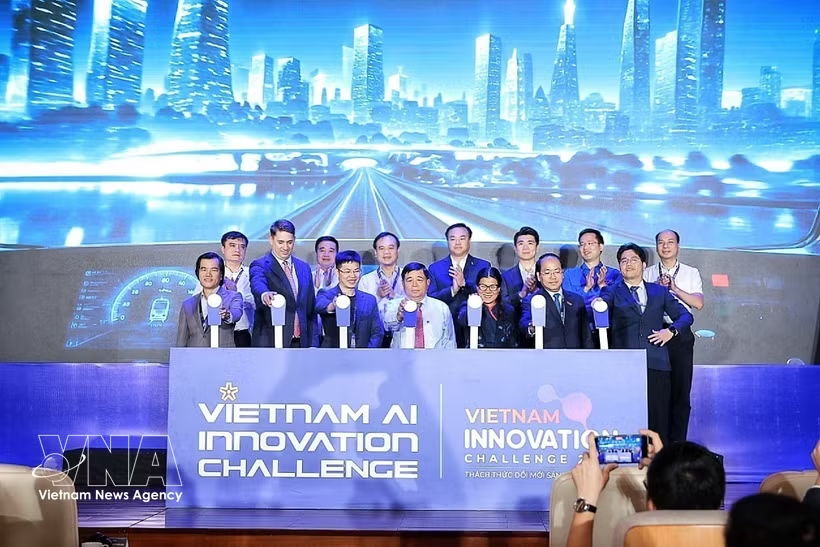
The launch of the final round of the Vietnam AI Innovation Challenge 2026 in Hanoi on July 17 (Photo: VNA)

Hanoi (VNA) – The final round of the Vietnam AI Innovation Challenge 2026 kicked off in Hanoi on July 17, featuring a 48-hour hackathon in which finalists develop AI-native solutions to real-world problems proposed by businesses and public-sector organisations.

The challenge, running through July 19, is organised under the Vietnam Innovation Challenge 2026 by the National Innovation Centre (NIC) under the Ministry of Finance, Meta, AI for Vietnam Foundation, FPT and Duy Tan University.

Challenge tracks cover finance – banking, health care, education – training, agriculture, smart public services, innovation, SME operations, and disaster management.

NIC said this year’s event attracts a record of nearly 2,500 registrations and more than 300 teams from around the world.

Following a rigorous five-week intensive bootcamp led by experts from Google Research, Stanford, and NVIDIA, the teams entered a grueling 48-hour AI hackathon to develop AI-native applications.

Throughout the competition, teams will receive round-the-clock support from a network of experts, mentors, and the Genius Station tech-support hub. Workshops on data security, product thinking, and presentation skills will also be held to help participants refine both the technical viability and market readiness of their solutions.

Following the finale, outstanding teams will stand a chance to join research programmes in Europe, collaborate with AI Singapore at Nanyang Technological University, access the Silicon Valley tech ecosystem, work directly with enterprises, or join the NIC support network.

NIC Director Vu Quoc Huy said the Vietnam Innovation Challenge, held annually by NIC and Meta since 2022, now enters its fifth year. The initiative has been recognised by the White House Portal as a flagship activity in technology and innovation cooperation between Vietnam and the US.

Moving forward, he noted, NIC plans to expand its partnerships with global tech giants to foster the innovation ecosystem, promote strategic technologies and AI, and contribute to socio-economic development and national competitiveness.
vnanet-vietnam-ai-innovation-challenge-2026.jpg
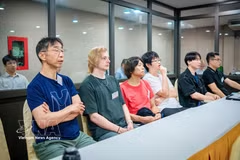
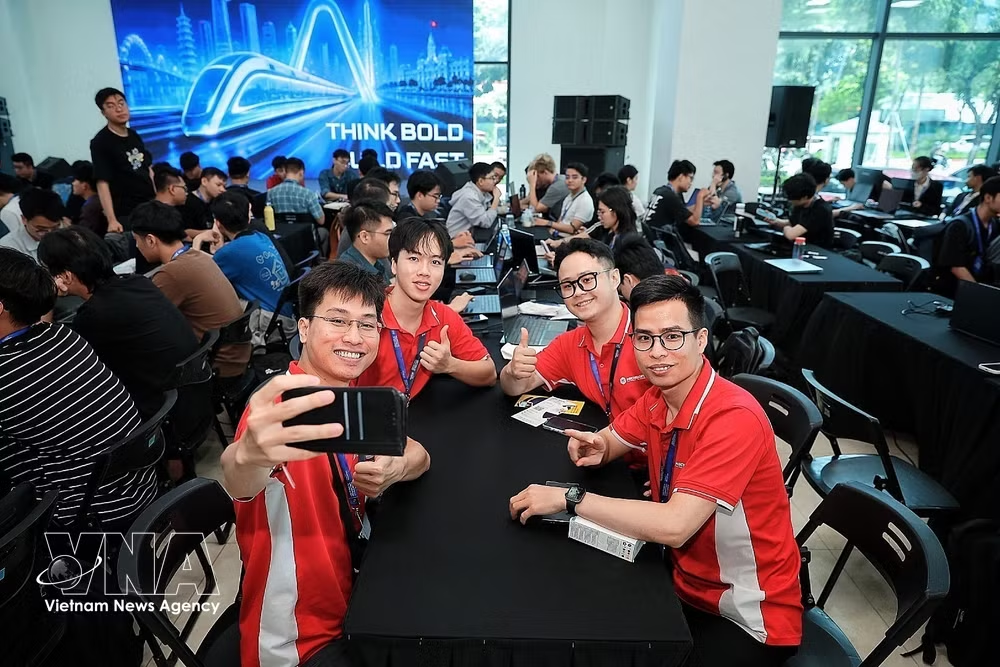
Competitors gather ahead of the final round of the Vietnam AI Innovation Challenge 2026. (Photo: VNA)

Benjamin Embury, Economic Counsellor of the US Embassy in Vietnam, said the US highly values the two countries’ strategic cooperation in science and technology, as well as the connection of global expert networks to help young Vietnamese talent deeply integrate into the global AI ecosystem.

He affirmed the continued promotion of these partnerships, not only at the government level but also among businesses, scientists, and innovation researchers.

Notably, NIC, in collaboration with UNESCO, the Institute for Research on Innovation and Quality Assurance (RIVA) under the Vietnam Union of Science and Technology Associations, and other partners, launched the 2027 National Artificial Intelligence Olympiad (VAIO 2027) as part of preparations for Vietnam to host the International Artificial Intelligence Olympiad (IAIO) next year.

The national competition will identify and train secondary and high school students with strengths in mathematics, computer science, programming and AI to represent Vietnam at IAIO 2027.

Organisers said the national preliminary round is scheduled for October 18, 2026, with the final expected to take place in Hanoi on January 10, 2027. The international event is set to take place in Da Nang from February 25 to March 2, 2027, bringing together around 300 delegates from more than 40 countries and territories./.

VNA

See more

Elevating digital infrastructure to drive new era of development

Elevating digital infrastructure to drive new era of development

o create new growth momentum for the country in a new development phase, the Politburo's Resolution No. 57-NQ/TW emphasises the need to develop modern digital infrastructure, expand access to high-quality Internet services and build large-scale data centres as the foundation for a national data platform.

Visitors to UBTECH, a company major in the research and development of humanoid robots (Photo: VNA)

Sci-tech diplomacy: A new mission for diplomatic sector

The directive by General Secretary and State President Lam reflects a shift in Vietnam’s development mindset, in line with the Politburo’s Resolution 57-NQ/TW dated December 22, 2024 on breakthroughs in sci-tech, innovation and national digital transformation. For the first time, sci-tech has been placed at the very centre as a driver of growth model.

Prof. Nghiem Duc Long from University of Technology Sydney (UTS), who is also Chairman of the Vietnam-Australia Scholars & Experts Association (VASEA) (Photo: VNA)

Science, technology to become new pillar of Vietnam-Australia ties: expert

The visit to Australia by Party General Secretary and State President To Lam will open a new chapter of cooperation, enabling Vietnamese intellectuals and experts in Australia to contribute more effectively to national development and helping science, technology and innovation become an important driver of the Comprehensive Strategic Partnership.

Deputy Director of the Vietnam National Innovation Centre (NIC) Do Tien Thinh speaks at the launch of RE:ACT in Hanoi on August 7. (Photo: NIC)

Youth innovation challenge for sustainable communities launched

Unlike conventional idea-based competitions, RE:ACT focuses on deploying solutions that have already reached the minimum viable product stage through Living Labs – community-based pilot environments where innovations are tested under real-world conditions.

The special national science, technology and innovation programme on strategic technologies targets mastery of at least four strategic technologies for 2026-2030. (Photo: baochinhphu.vn)

Vietnam approves national programme on strategic technologies

The programme seeks to master, develop, perfect and commercialise highly competitive strategic technology products, with priority given to core technologies. It also aims to build a strategic technology ecosystem and strengthen linkages among the State, businesses and science and technology organisations.

FPT Group headquarters ( Photo courtesy of FPT)

FPT named an OpenAI Select Partner

Under the partnership, FPT and OpenAI will work together to help businesses develop AI transformation roadmaps, build AI platforms, strengthen workforce capabilities and deploy responsible AI solutions tailored to their operational needs.

Dak Lak province's Smart City Monitoring and Operations Centre manages and operates the provincial data centre, as well as shared digital platforms and software systems used across the province. (Photo: VNA)

Vietnam draws hyperscalers, cloud titans, AI players

These developments highlight growing confidence in Vietnam as a destination for hyperscale, cloud, and AI infrastructure. The broader digital infrastructure ecosystem also strengthened during the period.

 Da Nang seeks to become a strategic investment destination

Da Nang seeks to become a strategic investment destination

Da Nang is accelerating efforts to attract investment and mobilise social resources for new development models, leveraging expanded development space, special policy mechanisms and institutional reforms to position itself as a strategic investment destination and a pioneer in Vietnam's economic growth in the new era.

PM Le Minh Hung chairs the second meeting of the National Cybersecurity Steering Committee on August 6. (Photo: VNA)

PM urges stronger coordination in cybersecurity response

PM Le Minh Hung pushed for the Regional Counter Cybercrime Hub for Asia-Pacific to be put into operation in 2027, a “Cybersecurity Economy” initiative to be prepped for APEC 2027, stronger specialised cybersecurity agencies, and an expansion of the national cybersecurity operations centre by the second quarter of 2028.

An overview of BSides Hanoi 2026 on August 5 (Photo: baodautu.vn)

Trust emerges as one of modern cybersecurity’s biggest challenges

Speaking at the event, VSEC Chairman Truong Duc Luong said this was the second time BSides has been held in Hanoi, continuing to attract strong interest from the cybersecurity community. BSides Hanoi 2026 was designed as a platform connecting Vietnam’s cybersecurity community with international networks, encouraging knowledge sharing and contributing to the sustainable development of the cybersecurity ecosystem.

AI Day 2026 product showcase area. (Photo: VNA)

Vietnam positioned to harness AI wave, World Bank report says

The WB report identifies Vietnam as one of the few economies outside the European Union (EU) to have adopted a comprehensive AI regulatory framework as early as 2025. Vietnam applies a risk-tiered approach similar to that of the EU AI Act, imposing different obligations depending on whether an AI system poses “unacceptable,” “high,” “low” or “minimal” risks. The approach is viewed as a strategic step towards ensuring safe and transparent AI governance.

Thai Binh Seed Group JSC is one of Vietnam’s leading crop seed producers, holding rights for 30 varieties and operating three globally certified plants. (Photo: VNA)

Politburo’s Resolution 57-NQ/TW powers new growth momentum

NSO Director Nguyen Thi Huong said alongside foreign investment and the green economy, science – technology, innovation, the digital economy and digital transformation are the new drivers that can can pack a serious second-half punch.

Research lab of the Vietnam National University Ho Chi Minh City. (Illustrative photo published by VNA)

Drastic measures taken to turn Resolution 57 into action

A recent meeting of the Central Steering Committee on science, technology, innovation and digital transformation, chaired by Party General Secretary and State President To Lam, marked a new phase in implementing Resolution 57 following the committee’s restructuring.

A view of Kinh Bac Ward in Bac Ninh Province. (Photo: VNA)

Bac Ninh targets world's top 50 smart cities by 2030

According to Chairman of the provincial People's Committee Pham Hoang Son, the province will pursue a people-centred smart city model driven by science, technology, innovation and digital transformation to improve public services, urban management and competitiveness.