Hanoi (VNA) – After years of growth driven largely by urban expansion, infrastructure investment and capital inflows, Hanoi is entering a new phase of development centred on knowledge, technology and innovation.
Over the past year, the capital has steadily shifted from simply applying digital technologies to embracing data-driven governance, laying the groundwork for faster and more sustainable growth.
According to Nguyen Van Phong, Deputy Secretary of the Hanoi Party Committee, the implementation of the Politburo’s Resolution No. 57-NQ/TW on breakthroughs in science and technology development, innovation and national digital transformation is aimed not only at promoting sci-tech development but also at fundamentally modernising governance and improving the effectiveness of the public administration system. This vision has become even more evident following the adoption of the two-tier local administration model in July 2025. The city views administrative streamlining as more than reducing intermediate layers, linking it with simplified procedures, integrated data systems and improved public services for citizens and businesses.
At the core of this new governance model is data. The goal, Phong said, is not digitalisation for its own sake, but ensuring that every management decision is evidence-based, every task is transparently monitored, and every outcome is measurable.
A key initiative has been the rollout of HanoiWork, a unified digital workspace that enables real-time monitoring of tasks from the municipal level to grassroots administrations. The platform clearly assigns responsibilities to agencies and officials while integrating OKR (Objectives and Key Results)- and KPI (Key Performance Indicator)-based performance management and automatic alerts for delayed assignments. The system has now been deployed across 179 units, involving more than 77,000 officials and managing nearly 240,000 tasks digitally.
Along with the digital governance platform, Hanoi has also prioritised digital workforce development. The city has issued a digital competency framework for officials, civil servants and citizens, while approving a digital skills development programme for 2026–2030. Tens of thousands of public employees have already received training in digital transformation, cybersecurity and artificial intelligence (AI), while more than 5,400 community digital transformation teams continue supporting digital adoption at the grassroots level.
Hanoi aims for every public servant to have access to an AI assistant by 2026 to help search legal documents, prepare reports, review records, analyse data and support policy formulation.
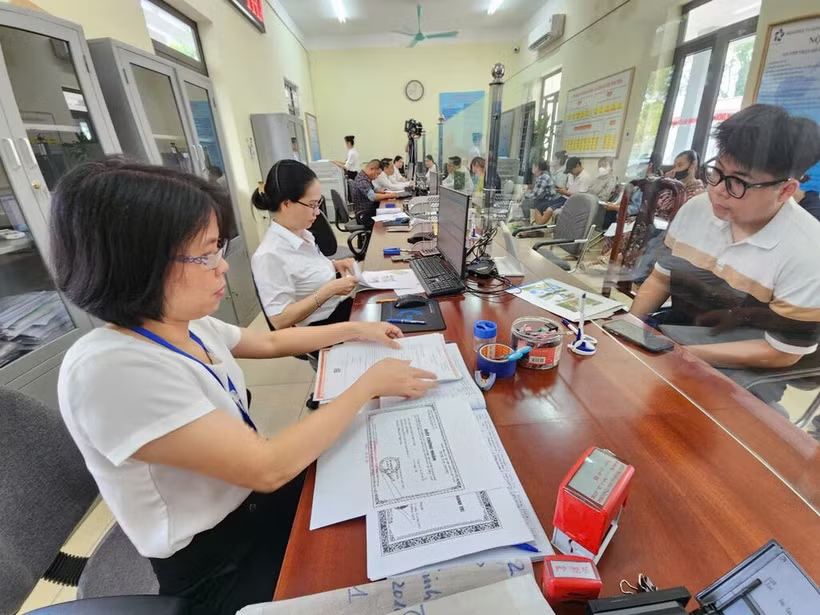
The city is also pursuing comprehensive administrative reform under the principle of “standardise before digitalise.” Instead of merely transferring existing procedures online, Hanoi has redesigned administrative processes to improve efficiency and service quality. More than 700,000 applications have been processed regardless of residency status, over 2,000 administrative procedures have been restructured, and data reuse has exceeded 97%. The iHanoi application has become the city’s official digital platform for government-citizen interaction, with more than 6.2 million registered accounts and hundreds of millions of visits.
Beyond public administration, Hanoi increasingly views data as a strategic resource for innovation and economic development. The city has built extensive shared databases, including information on more than 2.1 million land parcels, 93 open datasets and over 9.2 million electronic health records covering nearly 99% of the population, while linking data across all public hospitals. A centralised transport database is also under development to support real-time traffic management.
Rather than relying solely on internal resources, the city is encouraging universities, research institutes, enterprises and startups to develop solutions for practical challenges in transport, health care, education, urban planning, environmental protection, heritage conservation and traditional craft villages.
To support this strategy, Hanoi is establishing an innovation centre based on an integrated ecosystem combining research, incubation, startup acceleration, venture capital connections and technology commercialisation. The city is also introducing policy measures such as regulatory sandboxes, venture capital funds and incentives to attract high-quality talent and technology enterprises.
The capital city aims for the digital economy to contribute around 40% of its Gross Regional Domestic Product (GRDP) by 2030, with the Hoa Lac Hi-Tech Park serving as the core research and development hub./.
See more
Vietnam, Japan launch five joint semiconductor research projects
The signing and implementation of the five projects mark a concrete step toward realising the Party and State’s policies on science – technology development, innovation and digital transformation, with the semiconductor industry identified as one of strategic technologies fundamental to national competitiveness and technological autonomy.
Vietnam urged to develop sovereign AI in digital era
Data has become a strategic asset and a key resource for socio-economic development, as well as a foundation of national competitiveness. As a result, effective data governance, utilisation and protection have become increasingly urgent for organisations and businesses.
Talent strategy seen as key to Vietnam's next growth phase
Building a national talent ecosystem is a long-term development strategy that will underpin Vietnam's competitiveness and innovation-driven growth.
Expert calls for secure national digital archives system
Building a national electronic archives system is not merely a matter of investing in technological infrastructure. It must be designed in an integrated manner from the outset, encompassing system architecture, governance procedures, and data protection mechanisms, to ensure long-term security, integrity, and data sovereignty.
Vietnam can deepen role in global semiconductor supply chain: Taiwan-based expert
Vietnam’s biggest takeaway from Taiwan isn’t just cutting-edge technology alone, but how to build an entire semiconductor ecosystem from the ground up, said Dr. Vo Duc Thang, Assistant Professor at the National Taiwan University of Science and Technology (Taiwan Tech) and President of the Vietnam Innovative and Intellectual Network in Taiwan (China) (VIN Taiwan) told the Vietnam News Agency.
Vietnam needs tens of thousands of nuclear power workers by 2035
According to the Agency for Radiation and Nuclear Safety under the Ministry of Science and Technology, human resources will be among the decisive factors determining whether the country can successfully implement its nuclear power programme on schedule.
Ho Chi Minh City to complete 1st recruitment drive for top science, technology experts in Q3
To strengthen its competitiveness in attracting global talent, the city has introduced a comprehensive package of incentives, including housing assistance, transportation support, streamlined immigration and work permit procedures, improved research facilities, and favourable working conditions.
Vietnam approves national digital transformation strategy for 2026 - 2030
Vietnam aims to become a developed digital nation where digital transformation is implemented comprehensively across all sectors and serves as the country's principal development model. The strategy envisions a modern system of national governance powered by data and AI, strong domestic capabilities in strategic digital technologies, platforms and products, and firm protection of national digital sovereignty.
Vietnam needs “open technological sovereignty” to strengthen position in AI era: expert
Vietnam possesses significant advantages for deeper participation in the global technology value chain. Its young engineering workforce, strong capacity to absorb new technologies and strategic location have made the country an increasingly attractive destination for technology-related foreign direct investment.
Int’l scientists gather at 2nd advanced school on topological quantum matters in Gia Lai
Jointly organised by the Rencontres du Vietnam (Meeting Vietnam) association and the International Centre for Interdisciplinary Science and Education (ICISE), the five-day event features lectures by leading professors and scientists in quantum physics and materials science, providing participants with a solid theoretical foundation. They are also updated on the latest research advances in quantum topological materials.
Vietnam AI Innovation Challenge 2026 spotlights real-world AI solutions
The Vietnam AI Innovation Challenge 2026 showcased a new generation of AI solutions with the potential to move beyond the lab and into real-world use.
More than 80% of Vietnam's population uses smartphones
The 2025 household living standards survey showed that 87.3% of the population used mobile phones, up 2.5 percentage points from 84.8% in 2024. Of those, 80.3% used smartphones, while the proportion of people using feature phones fell to 8.5%.
Vietnam RWA Summit 2026 highlights need to balance innovation with risk management
A healthy tokenised asset market must be built on reliable data, verifiable identities, transparent information on assets and cash flows, and effective disclosure and supervision mechanisms, an expert has said.
Vietnam seeks safe, regulated development of tokenised asset market
The two-day event, organised by the Vietnam Blockchain Association in partnership with the National Cybersecurity Association and the Vietnam National Real Estate Association, aims to foster policy dialogue, attract investment and position Vietnam as a regional hub for real-world asset (RWA) tokenisation during 2026-2030.
Vietnam pushes stronger basic research to drive innovation, self-reliance
Prof. Dr. Nguyen Van Minh, former rector of the Hanoi National University of Education, said basic research not only generates new knowledge but also fosters innovation and improves the quality of economic growth. Vietnam's growing research capacity has enhanced its regional and international standing while contributing to sustainable development, strategic autonomy, national defence and governance.
Global technology firms partner with Da Nang to develop AI infrastructure
Da Nang is committed to supporting businesses, particularly small- and medium-sized enterprises (SMEs), in digital transformation, AI adoption, and workforce development, with the goal of becoming a hub for innovation and AI development in central Vietnam, said a local official.
Deputy PM outlines five strategic pillars for AI development
Deputy PM Ho Quoc Dung said the current priority is to change the mindset. AI should not be developed in isolation by individual agencies or organisations but through an interconnected ecosystem linking the State, universities and research institutes, and businesses.
Innovation challenge seeks AI-native solutions to real-world problems
Following a rigorous five-week intensive bootcamp led by experts from Google Research, Stanford, and NVIDIA, the teams entered a grueling 48-hour AI hackathon to develop AI-native applications.
Vietnam, IAEA expand cooperation in peaceful nuclear applications
Vietnam is implementing 19 cooperation projects with the IAEA in different areas, including agriculture, healthcare, nuclear safety and security, and physical and chemical sciences. The initiatives demonstrate how nuclear technologies can contribute to socio-economic development.
Vietnam, RoK deepen startup ecosystem connectivity
Both sides agreed that Vietnam-RoK startup cooperation must pivot from fact-finding tours, trade shows and short-term networking towards a hard-nosed partnership model that delivers concrete market access, business partner matchmaking, product validation, technology piloting and investor connectivity.