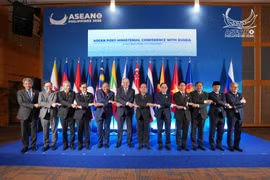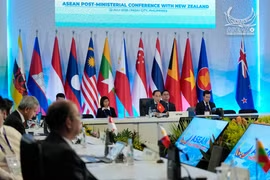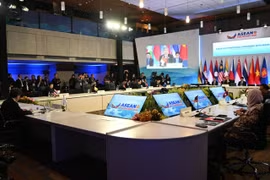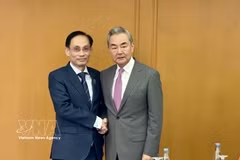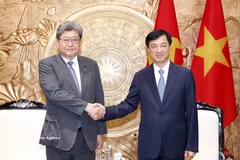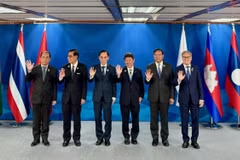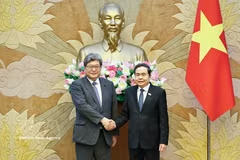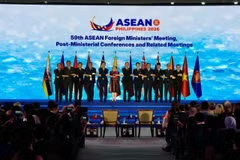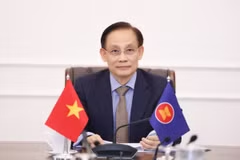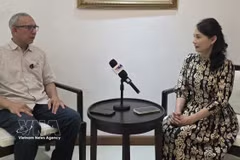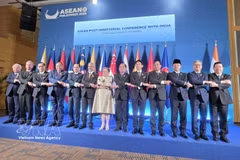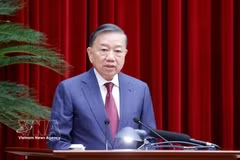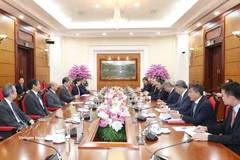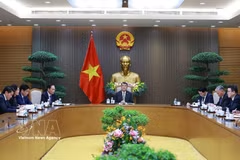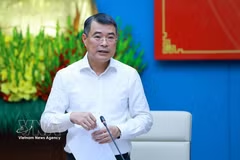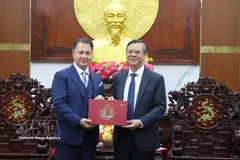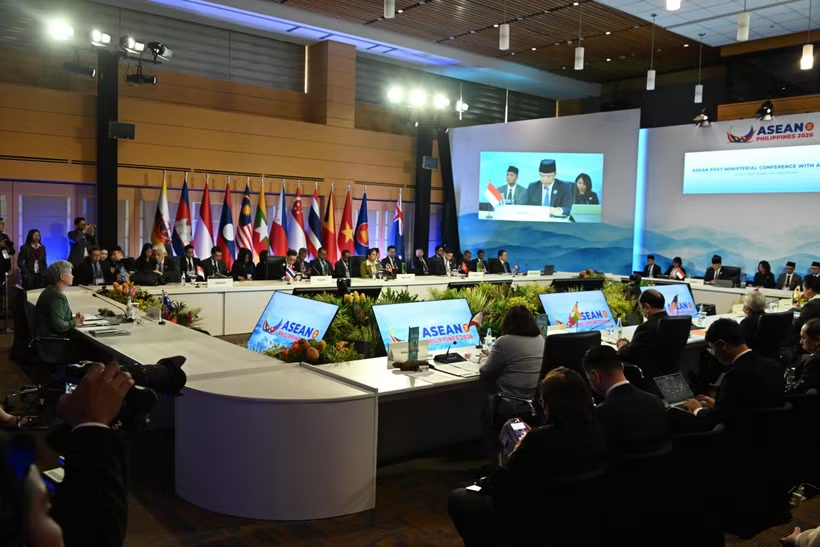
Manila (VNA) – Authorised by Minister of Foreign Affairs Le Hoai Trung, the Vietnamese delegation on July 22 attended meetings between ASEAN foreign ministers and their counterparts from Canada, the Republic of Korea (RoK), and Australia, and the fifth Conference on Cooperation among East Asian Countries for Palestinian Development (CEAPAD) as part of the 59th ASEAN Foreign Ministers’ Meeting (AMM-59) and Related Meetings in Manila, the Philippines.
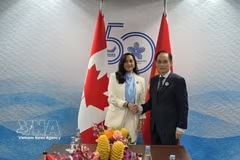
At the ASEAN-Canada Foreign Ministers’ Meeting, the two sides noted the positive development of the bilateral relationship since it was elevated to a Strategic Partnership in 2023.The meeting adopted an action plan to implement the ASEAN-Canada Strategic Partnership for 2026-2030, providing a framework for bilateral cooperation.
Canadian Minister of Foreign Affairs Anita Anand reaffirmed Canada’s commitment to further strengthening cooperation with the Association of Southeast Asian Nations (ASEAN), a trusted partner that plays a central role in promoting dialogue, consensus-building and substantive cooperation in the region.
Canada pledged to support and strengthen cooperation with ASEAN in ensuring energy and food security, while expanding collaboration in artificial intelligence (AI), digital governance and infrastructure, cybersecurity, and sustainable infrastructure development, as well as supporting education, healthcare and disaster management, she said.
The ASEAN countries welcomed Canada’s commitment to supporting ASEAN’s central role and the ASEAN Outlook on the Indo-Pacific (AOIP), and called for further deepening the Strategic Partnership in a substantive and mutually beneficial manner through enhanced cooperation in energy security, digital transformation, AI, science, technology and innovation, food security, disaster management, education and narrowing the development gap.
The two sides showed their determination to conclude negotiations on the ASEAN-Canada Free Trade Agreement (ACAFTA) in 2026 and sign it in 2027.
The Vietnamese delegation proposed making energy security and transition a pillar of ASEAN-Canada relations, and urged Canada to support the implementation of the ASEAN Power Grid and expand cooperation in renewable energy, hydrogen, energy storage and nuclear power for civilian purposes. They also called for deeper cooperation in digital transformation, science, technology and innovation, as well as education, healthcare, disaster response, Mekong subregional development.
Vietnam highly evaluated Canada’s commitment to multilateralism, international law and ASEAN’s central role; and called for Canada’s support for ASEAN’s common principles and stances, including the maintenance of peace, stability, security, safety and freedom of navigation and overflight in the East Sea, as well as the peaceful settlement of disputes in accordance with international law, particularly the 1982 United Nations Convention on the Law of the Sea (UNCLOS).
At the ASEAN-RoK Foreign Ministers’ Meeting, Korean Minister of Foreign Affairs Cho Hyun stressed that ASEAN is one of the RoK’s most central and trusted partners. He reaffirmed support for ASEAN’s central role and the bloc-led mechanisms.
The RoK side agreed to effectively implement the ASEAN-RoK Comprehensive Strategic Partnership, thus practically supporting the realisation of the ASEAN Community Vision 2045.
ASEAN pledged to work with the RoK to effectively implement the ASEAN-RoK AI Companionship Initiative; cooperate on green transition and clean energy; develop and expand the ASEAN Power Grid, further promote people-to-people and educational exchanges, and work towards the ASEAN-RoK Commemorative Summit in 2029.
Vietnam described the ASEAN-RoK relations as a strategic anchor for peace, stability and prosperity across the region. It proposed focusing cooperation on an innovation-driven economic partnership, digital transformation alongside energy transition, and safeguarding shared prosperity through the maintenance of peace and stability.
Vietnam also welcomed the RoK’s support for ASEAN’s principled position on the East Sea, stressing the importance of maintaining peace, security, safety and freedom of navigation and overflight, and peacefully settling disputes in accordance with international law, particularly the 1982 UNCLOS.
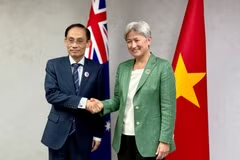
At the ASEAN-Australia Foreign Ministers' Meeting, ministers welcomed the positive progress achieved over the past five years since the establishment of the ASEAN-Australia Comprehensive Strategic Partnership, and outlined priorities for further strengthening cooperation.
The two sides agreed to make better use of the upgraded ASEAN-Australia-New Zealand Free Trade Area (AANZFTA), while enhancing collaboration in trade and investment, infrastructure development, connectivity, energy security, digital transformation, artificial intelligence (AI), science, technology and innovation, smart agriculture, education and healthcare.
They reaffirmed their commitment to advancing cooperation under the ASEAN Outlook on the Indo-Pacific (AOIP), strengthening collaboration on cybersecurity and maritime security, supporting ASEAN centrality, and reinforcing ASEAN-led regional mechanisms.
Marking the 50th anniversary of the signing of the Treaty of Amity and Cooperation in Southeast Asia (TAC), the ministers agreed to issue a statement reaffirming their shared commitment to the treaty's fundamental principles and values.
Australian Foreign Minister Penny Wong emphasised that ASEAN occupies a central place in Australia's regional strategy. Australia is proud to be ASEAN's first dialogue partner, she said, noting that the relationship between the two sides is built on trust, friendship, shared interests and substantive cooperation.
Against the backdrop of the rapid, complex and development in the regional and global landscape, Wong stressed that Australia remains committed to being a long-term and reliable partner of ASEAN, supporting the bloc's central role through concrete cooperation in economic development, security and people-to-people exchanges.
The Vietnamese delegation welcomed the positive progress in ASEAN-Australia relations and called on both sides to continue working towards a partnership that is more competitive, resilient and future-ready.
Vietnam proposed prioritising stronger economic integration through the effective implementation of the upgraded AANZFTA and the ASEAN Digital Economy Framework Agreement (DEFA) once it enters into force. It also highlighted the importance of enhancing collective resilience, ensuring food and energy security, and expanding support for infrastructure development, particularly in less-developed sub-regions, thereby helping narrow development gaps in ASEAN.
On peace and security, Vietnam called for the effective implementation of the ASEAN-Australia Joint Leaders’ Statement on Conflict Prevention and Crisis Management in the ASEAN-led Regional Architecture, with priority given to strengthening early warning capabilities and preventive diplomacy.
At the fifth Conference on Cooperation among East Asian Countries for Palestinian Development (CEAPAD), participating countries reaffirmed their commitment to supporting Palestine's development and state-building efforts, while discussing responses to the humanitarian crisis in Gaza and addressing the long-term development needs of the occupied Palestinian territories.
As co-chair of the meeting, Philippine Secretary of Foreign Affairs Theresa Lazaro reiterated her country's long-standing support for the two-state solution, calling for greater humanitarian assistance and stronger international cooperation to reinforce Palestinian institutions.
Co-chair Japan, represented by Foreign Minister Motegi Toshimitsu, reaffirmed its commitment to cooperation under the CEAPAD framework, particularly in supporting essential healthcare and education systems, promoting private sector development and expanding trilateral cooperation.
Representing Palestine, Minister of Social Development Dr Samah Hamad briefed participants on the severe humanitarian crisis in Gaza, highlighting the heavy losses of life and infrastructure.
The conference underscored the CEAPAD's role as a key platform for mobilising East Asia's development experience, technical expertise and financial resources to support Palestine's recovery, resilience and sustainable development.
Participants shared updates on their contributions under the CEAPAD framework, including humanitarian assistance, support for the United Nations Relief and Works Agency for Palestine Refugees in the Near East (UNRWA), scholarships, technical cooperation and capacity-building programmes in public administration, healthcare, agriculture and human resource development.
A representative of UNRWA called for stable and sustainable funding to ensure the continued delivery of education, healthcare and other essential services for Palestinian refugees.
The Vietnamese delegation said that, as a country that has experienced war and post-war reconstruction, Vietnam deeply understands the hardships and aspirations of the Palestinian people. Vietnam reaffirmed its consistent support for the Palestinian people's just cause and expressed its readiness to work closely with CEAPAD partners and the international community to help Palestine pursue peace, justice and sustainable development.
This year, Vietnam will continue coordinating with China to organise training programmes for officials from Palestinian ministries and agencies, contributing to international efforts to help Palestine overcome current challenges and move towards lasting peace, sustainable development and a brighter future for its people./.
VNA