AMM-59: Vietnam proposes three priorities to advance ASEAN-Japan cooperation

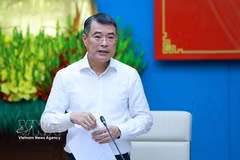
Minister of Foreign Affairs Le Hoai Trung proposed promoting the co-creation of a secure digital economy by leveraging Japan’s strengths in technology and innovation to effectively implement the ASEAN-Japan Artificial Intelligence (AI) Innovation and Co-Creation Roadmap, the FOIP Digital Corridor and the Hanoi Convention against Cybercrime.

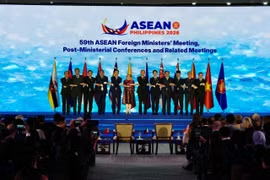
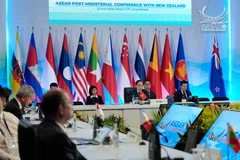
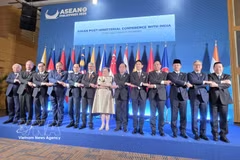
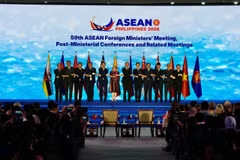
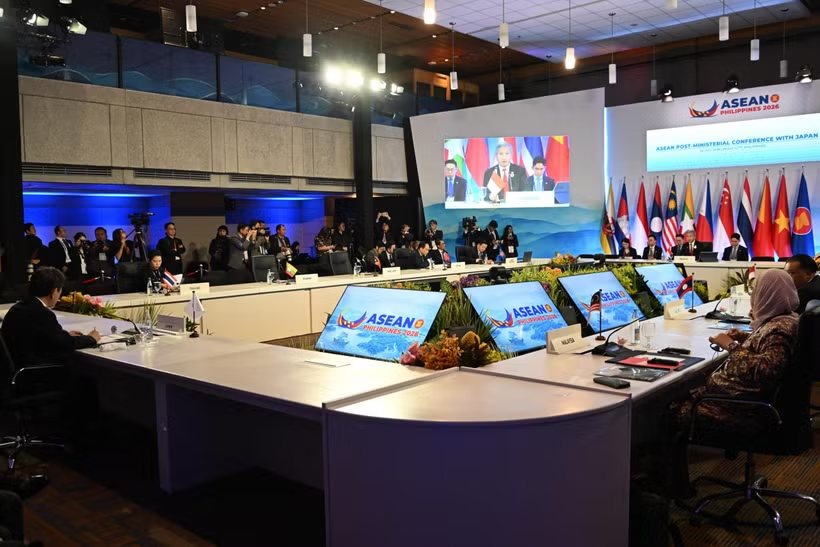
A view of the ASEAN-Japan Foreign Ministers’ Meeting in Manila, the Philippines, on July 22 (Photo: the Vietnamese Ministry of Foreign Affairs)

Manila (VNA) – Vietnamese Minister of Foreign Affairs Le Hoai Trung proposed three strategic priorities to make ASEAN-Japan cooperation more substantive and future-oriented at the ASEAN-Japan Foreign Ministers’ Meeting in Manila, the Philippines, on July 22, focusing on security and economic resilience, a safe digital economy, and green and sustainable development.

As part of the 59th ASEAN Foreign Ministers’ Meeting (AMM-59) and related meetings, the event was co-chaired by the Foreign Ministers of Singapore – the country coordinating ASEAN-Japan relations, and Japan.

Speaking at the meeting, Minister Trung stressed that amid profound changes in the global geopolitical and geoeconomic landscape, ASEAN-Japan relations not only serve the interests of both sides but also make an important contribution to strengthening an open, transparent and inclusive regional architecture based on rules.

He called for stronger cooperation to consolidate security and enhance economic resilience, with a focus on strategic areas such as supply chains, essential minerals, digital infrastructure, semiconductors and energy security.

​Trung proposed promoting the co-creation of a secure digital economy by leveraging Japan’s strengths in technology and innovation to effectively implement the ASEAN-Japan Artificial Intelligence (AI) Innovation and Co-Creation Roadmap, the FOIP Digital Corridor and the Hanoi Convention against Cybercrime.

He also suggested stronger cooperation toward a green and sustainable future through expanded collaboration in renewable energy, smart grids and sustainable infrastructure, while making effective use of initiatives such as AZEC 2.0 and POWERR Asia to ensure energy security and promote a green and low-emission transition.

Regarding regional and international issues, FM Trung welcomed Japan’s support for efforts to strengthen ASEAN maritime cooperation and capacity, affirming that ASEAN and Japan share common interests in maintaining peace, stability, security, safety and freedom of navigation and overflight in the East Sea and other seas. He also underscored the need to uphold international law, particularly the 1982 United Nations Convention on the Law of the Sea (UNCLOS 1982).

Delegates affirmed that ASEAN-Japan relations continue to develop on the basis of a long-standing, equal, substantive, trusted and mutually respectful partnership, while sharing the goal of building an open, transparent and inclusive regional architecture based on international law and ASEAN’s centrality.

ASEAN countries described Japan as one of their leading trusted partners that makes practical contributions to the development of ASEAN member states and the region as a whole.

Japanese Foreign Minister Motegi Toshimitsu reaffirmed Japan’s long-term commitment to ASEAN in the spirit of a “heart-to-heart” partnership and pledged to continue supporting the intra-bloc unity and ASEAN’s central role, the implementation of the ASEAN Community Vision 2045, and deepening of the ASEAN-Japan Comprehensive Strategic Partnership.

The Japanese side also pledged to continue supporting ASEAN's efforts to strengthen capacity in maritime security, energy security, food security, combating transnational crime, AI, digital transformation, people-to-people exchanges and high-quality human resources development.

The ministers agreed to strengthen cooperation in maritime security, cybersecurity and addressing non-traditional security challenges through ASEAN-led mechanisms. For economic cooperation, the two sides committed to promoting regional integration through the effective implementation and eventual upgrading of trade agreements, including the ASEAN-Japan Comprehensive Economic Partnership (AJCEP) and the Regional Comprehensive Economic Partnership (RCEP).

ASEAN appreciated Japan’s support for digital transformation, energy security and climate change response through initiatives such as the Asia Zero Emissions Community (AZEC), the ASEAN-Japan AI Innovation and Co-Creation Roadmap, and the Japan-ASEAN Integration Fund (JAIF) 3.0./.

VNA

See more

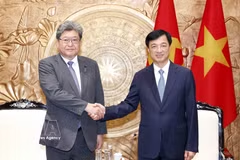
Nguyen Duy Ngoc, Politburo member, Chairman of the Communist Party of Vietnam (CPV) Central Committee's Organisation Commission and Chairman of the Vietnam-Japan Parliamentary Friendship Group (R) hosts a reception in Hanoi on July 22 for Executive Acting Secretary-General of Japan's Liberal Democratic Party (LDP) Hagiuda Koichi and his delegation. (Photo: VNA)

Vietnam, Japan seek to deepen cooperation between ruling parties and legislatures

The two sides expressed satisfaction with the robust development of the Vietnam-Japan Comprehensive Strategic Partnership across all fields, noting that Japanese Prime Minister Takaichi Sanae's official visit to Vietnam in May 2026 had created fresh momentum for strengthening ties between the two parties and the two countries.

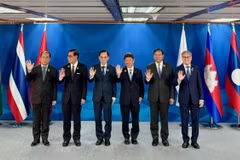
Foreign ministers of the Mekong countries and Japan reaffirm commitment to strengthening partnership through co-creation (Photo: Vietnamese Ministry of Foreign Affairs)

Mekong, Japanese foreign ministers reaffirm commitment to co-creating partnership

Mekong-Japan cooperation, together with ASEAN-led mechanisms, contributes to building a peaceful, stable, resilient and prosperous Asia-Pacific and Indo-Pacific region, they stressed, noting that amid growing uncertainties, emerging cooperation opportunities and challenges, the mechanism should continue to innovate and adapt to better meet the development demands of Mekong countries and Japan.

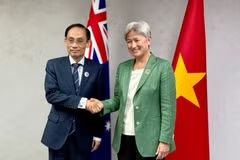
Vietnamese Minister of Foreign Affairs Le Hoai Trung (L) and his Australian counterpart Penny Wong in their meeting in Manila on July 22. (Photo: Courtesy of the Ministry of Foreign Affairs)

Vietnam, Australia agree to deepen cooperation in priority areas

The two ministers reaffirmed their support for ASEAN's common position and underscored the need to maintain peace, security, stability, safety, and freedom of navigation and overflight. They reiterated that disputes should be resolved through peaceful means in accordance with international law, particularly the 1982 United Nations Convention on the Law of the Sea (UNCLOS).

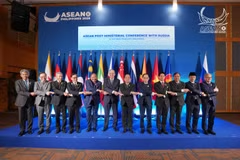
Delegates at the ASEAN Post-Ministerial Conference with Russia on July 22. (Photo: The Courtesy of the Foreign Affairs)

Vietnam calls for deeper, more practical ASEAN-Russia strategic partnership

Addressing the ASEAN-Russia Foreign Ministers' Meeting held on July 22 on the sidelines of the 59th ASEAN Foreign Ministers' Meeting (AMM-59) and related meetings in the Philippines, Trung described the ASEAN-Russia Commemorative Summit marking 35 years of dialogue relations held in Kazan, Russia, in June as an important milestone that reaffirmed the strategic value of ASEAN-Russia relations and injected fresh momentum into bilateral cooperation.

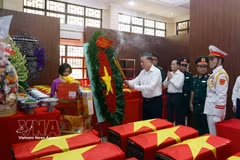
Party General Secretary and State President To Lam offers incense in tribute to fallen heroes and martyrs at Le Thi Rieng Park in Ho Chi Minh City on July 17, 2026. (Photo: VNA)

Top leader hails sacrifices, contributions of generations to national development

In a letter on the occasion of the 79th anniversary of War Invalids and Martyrs' Day (July 27, 1947–2026), the top leader said every piece of land in Vietnam is steeped in the sweat, blood, will and enduring aspirations of generations who devoted their youth, personal happiness, health and lives to the independence of the Fatherland, the freedom of the people, the noble ideals of the Party and the enduring future of the nation.

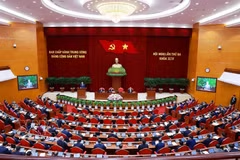
An overview of the third meeting of the 14th Party Central Committee (Photo: VNA)

Party Central Committee discusses marine economy, climate resilience

The 14th Party Central Committee on July 22 considered proposals on building a disciplined, safe, civilised, harmonious and development-oriented society, and developing a national security strategy, as well as discussed the establishment of Quang Ninh and Bac Ninh as centrally-governed cities.

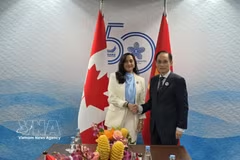
Vietnamese Minister of Foreign Affairs Le Hoai Trung and Canadian Foreign Minister Anita Anand pose for a commemorative photo. (Photo: VNA)

Vietnam promotes ties with Canada, New Zealand at AMM-59

Vietnamese Minister of Foreign Affairs Le Hoai Trung met separately with his Canadian and New Zealand counterparts on the sidelines of the 59th ASEAN Foreign Ministers' Meeting (AMM-59) and related meetings in Manila, the Philippines, on July 22.

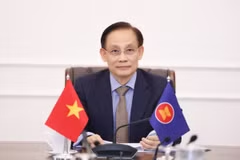
Minister of Foreign Affairs Le Hoai Trung (Photo published by VNA)

Vietnam proposes priorities to advance ASEAN–US relations

Vietnamese Minister of Foreign Affairs Le Hoai Trung proposed that ASEAN and the US promote trade and investment in an open, transparent and mutually beneficial manner, while expanding joint work in the digital economy, artificial intelligence (AI), semiconductors, science and technology, innovation, energy transition and regional energy connectivity.

Party General Secretary and State President To Lam addresses the third meeting of the 14th Party Central Committee. (Photo: VNA)

📝 OP-ED: Sustainable national prosperity begins with people, cultural values

A nation's greatest wealth lies not only in economic achievements but also in the character of its people, the strength of its compassion and the vitality of its cultural identity. These enduring human values have sustained Vietnam throughout its long history and will continue to underpin its future development.

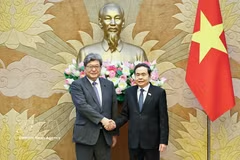
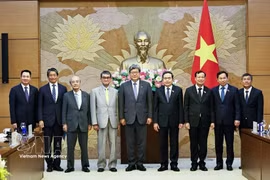
The meeting between Politburo member and Permanent member of the Communist Party of Vietnam (CPV) Central Committee’s Secretariat Tran Cam Tu and Executive Acting Secretary General of the LDP Hagiuda Koichi in Hanoi on July 21 (Photo: VNA)

Vietnam considers Japan long-term partner

Vietnam and Japan agreed to work closely to realise the agreements reached during Prime Minister Takaichi’s visit to Vietnam in May, including bolstering economic connectivity and economic security, sci-tech collaboration, and pushing concrete joint projects in digital transformation, green transition, innovation, semiconductors, and artificial intelligence.

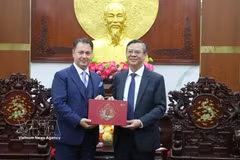
Chairman of the Can Tho People's Committee Chairman Truong Canh Tuyen (right) presents a souvenir to Pakistani Ambassador to Vietnam Kohdayar Marri at the meeting on July 21. (Photo: VNA)

Can Tho boosts trade ties with Pakistani partners

Can Tho also aims to strengthen cooperation with Pakistani partners in science, technology and human resource development, while exploring opportunities in information technology, innovation, digital transformation and high-tech agriculture.