People-to-people diplomacy reform contributes to building overall strength of Vietnam's diplomacy: official

Under the leadership of the Party and the unified management of the State, people-to-people diplomacy will continue to be a sustainable bridge of friendship, an important channel for converging resources, spreading soft power, and protecting national interests, contributing to building the overall strength of Vietnamese diplomacy in the new era of development.

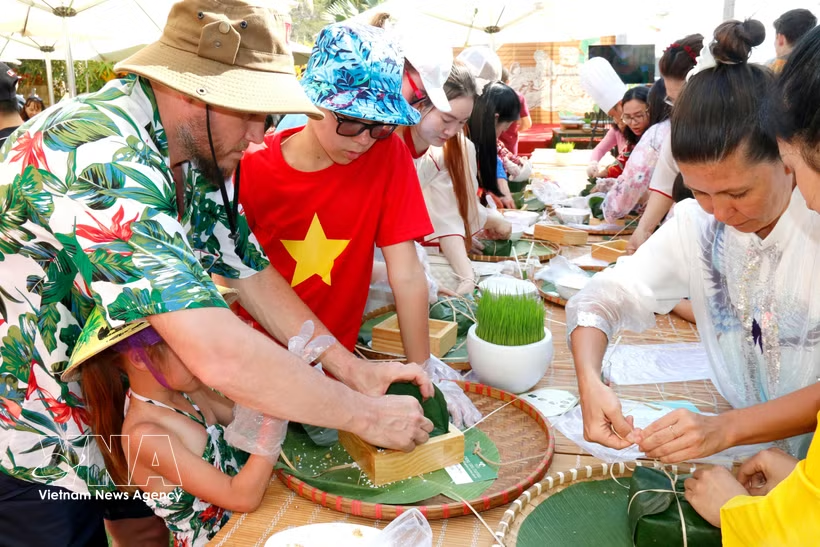
Foreign tourists experience wrapping up Chung cake on the occasion of Vietnam's Lunar New Year. (Photo: VNA)

Hanoi (VNA) - Towards the upcoming 33rd National Diplomatic Conference and the 22nd National Conference on Foreign Affairs, Deputy Minister of Foreign Affairs Ngo Le Van has written an article on innovating people-to-people diplomacy to contribute to building the overall strength of Vietnam's diplomacy.

In his article, Van affirmed that throughout its history of nation building and defence, the Vietnamese people have always valued peace, humanity, and righteousness, taking sincerity, loyalty, and trust as the foundation in relations with other nations. Throughout different revolutionary periods, people-to-people diplomacy has contributed to gaining international support for the cause of national liberation and reunification, while helping heal the wounds of war, break the blockade and embargo, and pave the way for the normalisation of relations with several countries and deep international integration.

The 14th National Party Congress opened a new stage of national development with a long-term vision, clear goals, and high political determination, creating a foundation for the country to move forward strongly and steadily in the era of national rise. In this context, Van wrote, people-to-people diplomacy continues to play its role as one of the three pillars of Vietnam's comprehensive and modern diplomacy, alongside Party diplomacy and State diplomacy.

With its advantages of broad partnerships, flexible and close forms, people-to-people diplomacy has contributed to consolidating the social foundation of relations between Vietnam and other countries; enhancing understanding and trust; mobilising international resources for development; promoting the image of Vietnam and its people; and participating in protecting national interests early and from afar.

The irreplaceable value of people-to-people diplomacy lies in its ability to reach places that formal diplomacy finds difficult to access. As the country enters a new era of development, the reform of people-to-people diplomacy stems not only from the rapid and complex changes in the international situation but also from an internal requirement to fully unleash the strength of the people, the strength of national unity, and the strength of the times, thereby contributing to building the overall strength of Vietnamese diplomacy.

According to the official, the strength of people-to-people diplomacy lies first and foremost in the strength of trust. Relations between nations are only truly sustainable when supported by the understanding, goodwill, and support of their people. The flexibility of people-to-people channels allows access to various social forces, open exchange on differing issues, the delivery of Vietnam's message in a relatable way, and the understanding of public opinion for research and advisory purposes.

Along with significant achievements gained over the recent times, people-to-people diplomacy still faces numerous limitations, some of which are particularly evident in the new context. The integration of friendship activities with development cooperation and resource mobilisation is uneven; the network of partners is not truly diverse, and access to new forces – especially the younger generation, academics, experts, and influential figures abroad – remains limited. The capacity for presence and leadership in the digital space is weak, even though this has become a crucial area for public opinion mobilisation. Research, forecasting, database development, and the quality of personnel have also not kept pace with requirements.

Notably, digital technology, artificial intelligence, and social media are profoundly changing the way public opinion is influenced, with information transmitted quickly but also easily distorted and manipulated. This presents both challenges and new opportunities for people-to-people diplomacy.

The demand for rapid and sustainable national development places a more direct task on people-to-people diplomacy in leveraging resources, knowledge, technology, markets, and international networks; building national soft power; and enhancing the country's self-reliance, self-strengthening, as well as international standing.

The reform of people-to-people diplomacy must be carried out synchronously in terms of thinking, content, forces, partners, and organisational methods, shifting from an operation-based mindset to a strategic mindset; from a reactive and short-term to proactive and long-term approach; from a piecemeal approach to a systematic approach; and from an emphasis on quantity to an emphasis on quality, impact, and ripple effect.
vnanet-diplomacy-2.jpg
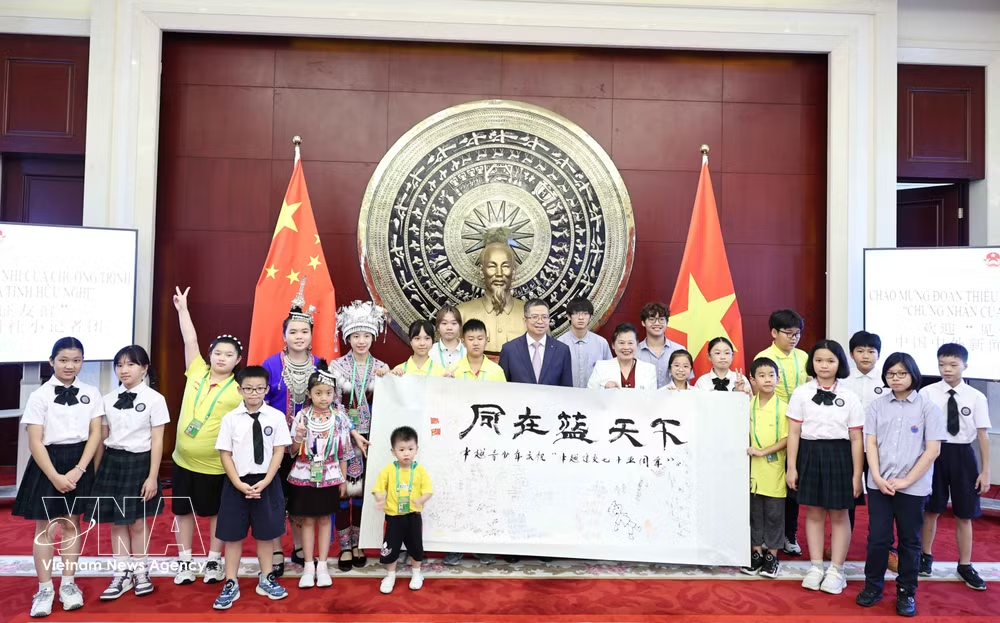
Vietnamese and Chinese child delegates pose for a group photo with leaders of the Vietnamese Embassy in China. (Photo: VNA)

To strongly innovate people-to-people diplomacy to promote the all-round strength of Vietnamese diplomacy, the deputy minister proposed six priorities. First, he stressed the need to continue raising awareness and responsibility of the entire political system regarding people-to-people diplomacy.

Second, it is necessary to clearly define the focuses and priorities, and link people-to-people diplomacy with the country's strategic priorities. According to the official, activities must directly serve the maintenance of a peaceful and stable environment; protect independence and sovereignty; promote socio-economic development; and enhance Vietnam's international standing and prestige. Friendly exchanges should be linked to concrete cooperation in economy, trade, investment, science and technology, innovation, digital transformation, education, culture, and green development.

Thirdly, Van suggested building a sustainable, multi-layered, multi-sectoral partnership network; and simultaneously improve the quality of participation in multilateral people's mechanisms.

Fourth, he underscored the importance of creating a substantive breakthrough in providing information for external service and digital diplomacy through people-to-people channels. Proactively designing messages tailored to each audience group, conveyed through authentic and vivid stories, he wrote, will help present the country's image naturally and reliably in the digital space.

Fifth, the official noted innovating the evaluation process, and considering measuring effectiveness as a mandatory step in the overall process. According to him, it is necessary to gradually build a set of criteria and a database to monitor and evaluate the impact and reach of people-to-people diplomacy, instead of focusing on quantity and form.

Sixth, he noted the need to perfect the coordination mechanism to ensure the cohesion between Party diplomacy, State diplomacy, and people-to-people diplomacy. These three pillars have different roles, methods, and strengths, but are unified in their goal of protecting national interests, serving national development, and enhancing Vietnam's position, he affirmed, adding that coordination is needed from the policy formulation stage, partner selection, and activity organisation, to result evaluation.

The official concluded by emphasising that innovating people-to-people diplomacy requires political determination, strategic thinking, synchronised coordination, and the creativity and proactivity of all levels, sectors, localities, and people's organisations. This is not simply about innovating the form of organisation and activities, but more profoundly, about innovating thinking and methods to maximise the effectiveness of people-to-people diplomacy.

Under the leadership of the Party and the unified management of the State, people-to-people diplomacy will continue to be a sustainable bridge of friendship, an important channel for converging resources, spreading soft power, and protecting national interests, contributing to building the overall strength of Vietnamese diplomacy in the new era of development, added Van./.
VNA

See more

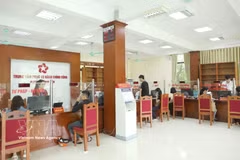
Local residents conduct procedures at the Public Administrative Service Centre of Vinh Yen ward, Phu Tho province. (Photo: VNA)

📝 OP-ED: Indicators of success in streamlining State apparatus

More than a year after Vietnam embarked on its sweeping administrative restructuring, the country's governance system has undergone significant changes. The administrative apparatus at all levels has been streamlined, intermediate layers reduced, and the functions, responsibilities and authority of state agencies gradually clarified. Greater decentralisation has also strengthened the role of grassroots authorities.

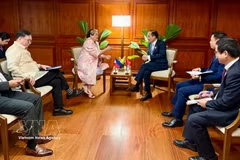
Vietnamese Minister of Foreign Affairs Le Hoai Trung (R) and Philippine Secretary of Foreign Affairs Maria Theresa Lazaro at their meeting on the sidelines of the 59th ASEAN Foreign Ministers' Meeting (AMM-59) and related meetings in the Philippines on July 23, 2026. (Photo: VNA)

Vietnam promotes bilateral cooperation with Philippines, EU, Norway on AMM-59 sidelines

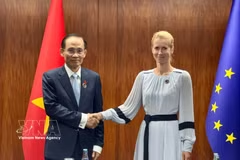
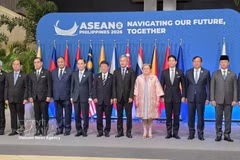
Vietnamese Minister of Foreign Affairs Le Hoai Trung held separate bilateral meetings with Philippine Secretary of Foreign Affairs Maria Theresa Lazaro, Vice-President of the European Commission and EU High Representative for Foreign Affairs and Security Policy Kaja Kallas, and Norwegian Minister of Foreign Affairs Espen Barth Eide, on the sidelines of the 59th ASEAN Foreign Ministers' Meeting (AMM-59) and related meetings in the Philippines on July 23.

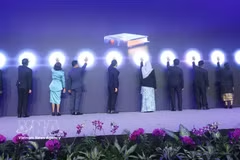
Leaders of ASEAN member states' education ministries launch the ASEAN Education Work Plan 2026–2030. (Photo: VNA)

Vietnam attends ASEAN Education Ministers’ Meeting and related meetings in Singapore

At ASED 14, the ASEAN Education Work Plan 2026–2030 was launched, setting out the region’s shared priorities for building inclusive, comprehensive and transformative education systems. The plan focuses on nurturing resilient and well-rounded individuals, developing a highly skilled and competitive workforce, and strengthening a common ASEAN identity rooted in shared values.

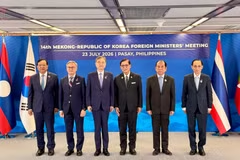
Vietnamese Minister of Foreign Affairs Le Hoai Trung (1st from right) and other participants at the 14th Mekong–Republic of Korea Foreign (RoK) Foreign Ministers' Meeting in Manila, the Philippines, on July 23, 2026. (Photo: Vietnamese Ministry of Foreign Affairs)

Vietnam proposes three priorities to advance Mekong–RoK cooperation

In its capacity as co-chair in 2025, Vietnam worked closely with the RoK and the Mekong countries to maintain high-level exchanges, enhance the effectiveness of the Mekong–RoK Business Forum, organise the Mekong–RoK Forum for the first time to share project outcomes and implementation experience, and promote innovative solutions in water resource management through the third Mekong–RoK Water Forum.

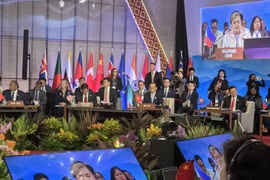
Vietnamese Minister of Foreign Affairs Le Hoai Trung attends the 33rd ASEAN Regional Forum in the Philippines on July 23, 2026. (Photo: VNA)

ASEAN Regional Forum adopts Manila Plan of Action for 2026–2036

Vietnamese Minister of Foreign Affairs Le Hoai Trung affirmed that ASEAN would continue working with China to fully and effectively implement the Declaration on the Conduct of Parties in the East Sea (DOC) and to conclude at an early date a substantive and effective Code of Conduct in the East Sea (COC) that is consistent with international law, particularly the 1982 United Nations Convention on the Law of the Sea (UNCLOS).

A view of the third plenum of the 14th Party Central Committee on July 23, 2026. (Photo: VNA)

Press release on fourth working day of 14th Party Central Committee's third plenum

The Party Central Committee on July 23 discussed a proposal to transfer responsibility for giving advice on mass mobilisation work from the Party Central Committee's Commission for Information, Education and Mass Mobilisation to the Party Committee of the Vietnam Fatherland Front and central mass organisations, as well as a proposal to rename the Commission for Information, Education and Mass Mobilisation as the Commission for Information and Education.

Spokeswoman of the Ministry of Foreign Affairs Pham Thu Hang (Photo: Ministry of Foreign Affairs)

Vietnam calls on parties concerned to fully implement DOC in East Sea

Responding to a reporter's question about recent clashes around Bai Co May (internationally known as Second Thomas Shoal) in the East Sea, Hang said Vietnam urged the parties concerned to act with restraint, respect the sovereign rights and jurisdiction of coastal states over their exclusive economic zones and continental shelves as established in accordance with the 1982 United Nations Convention on the Law of the Sea (UNCLOS), and fully and effectively implement the DOC.

Vietnamese Minister of Foreign Affairs Le Hoai Trung (L) and Vice-President of the European Commission and the EU High Representative for Foreign Affairs and Security Policy Kaja Kallas (Photo: VNA)

AMM-59: Vietnam proposes substantive, sustainable ASEAN-EU ties

Looking ahead, Vietnam proposed the two sides prioritise stronger regional resilience by scaling up energy cooperation, pooling financial resources and cracking down on illegal, unreported and unregulated fishing, all aimed at building a resilient and sustainable blue economy.

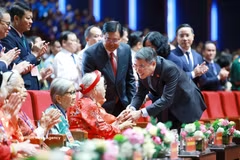
Prime Minister Le Minh Hung greets Heroic Vietnamese Mothers at the national conference honouring revolution contributors ahead of the 79th anniversary of War Invalids and Martyrs’ Day (July 27) in Hanoi on July 23. (Photo: VNA)

Caring for revolution contributors reflects Vietnam’s deep humanitarian value: PM

The PM urged all-level authorities, sectors, localities, and the public to fully implement relevant Party resolutions and directives as well as preferential policies for revolution contributors, push ahead with the 500-day campaign, expand gratitude movements, accelerate housing support for children of Agent Orange/dioxin victims and strengthen patriotic education.

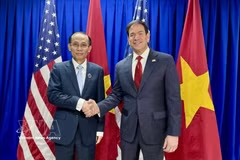
Minister of Foreign Affairs Le Hoai Trung (L) meets with US Secretary of State Marco Rubio in Manila on July 23. (Photo: VNA)

Vietnam, US pledge to deepen Comprehensive Strategic Partnership

At the meeting, Trung welcomed Rubio's participation and active contributions to the ASEAN meetings, saying they reflected the US' commitment to maintaining engagement in the region, supporting ASEAN centrality, and contributing to peace, stability and prosperity in Southeast Asia.

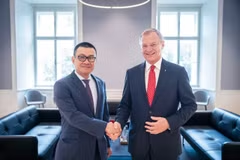
Ambassador Vu Le Thai Hoang meets with Governor of Upper Austria Thomas Stelzer on July 22. (Photo published by VNA)

Vietnam, Austria seek to promote strategic technology cooperation

Highlighting strengths of Linz city and Upper Austria in general in advanced technology, innovation and high-quality human resources training, Vietnamese Ambassaor to Austria Vu Le Thai Hoang proposed stronger links among businesses, research institutes and universities. He identified artificial intelligence (AI), semiconductors, robotics, automation, quantum computing and biotechnology as promising areas for cooperation.