Public disbursement recovers, accelerates toward double-digit growth

In the first six months of the year, the disbursement of public investment capital nationwide reached over 356 trillion VND (13.52 billion USD), equivalent to 35.5% of the plan assigned by the Prime Minister. Compared to the same period in 2025, the rate reached a similar level, but the volume of disbursed capital rose by 38.4 trillion VND, thanks to the highest ever increase recorded in the total planned public investment capital for 2026 (1.01 quadrillion VND).

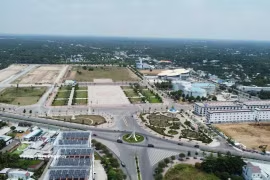
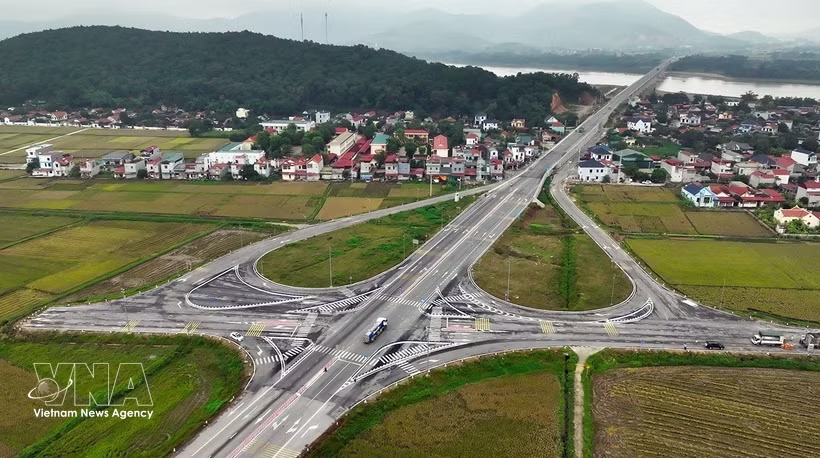
A view of the approach road to the Xuan Quang bridge on the side of Thieu Quang commune, Thanh Hoa province. (Photo: VNA)

Hanoi (VNA) – The acceleration of disbursement, coupled with improving the efficiency of public investment management, is identified as a key task to fulfill a dual goal of promoting economic growth and social investment capital utilisation.

In response to the requirement of ushering the country into a period of rapid and sustainable growth, investment continues to be identified as one of the important growth drivers. Public investment plays the role of seed capital, leading and creating a ripple effect across many sectors and industries.

Disbursement rate reaches 35.5% of plan

The Ministry of Finance reported that in the first six months of the year, the disbursement of public investment capital nationwide reached over 356 trillion VND (13.52 billion USD), equivalent to 35.5% of the plan assigned by the Prime Minister. Compared to the same period in 2025, the rate reached a similar level, but the volume of disbursed capital rose by 38.4 trillion VND, thanks to the highest ever increase recorded in the total planned public investment capital for 2026 (1.01 quadrillion VND). Among the leading localities, Hanoi is a bright spot, having disbursed 51.8% of the capital allocated by the PM, with an absolute figure of over 62 trillion VND, ranking third and first nationwide, respectively.

Nguyen Ngoc Tu, Director of the Hanoi Department of Finance, stated that the city has identified public investment disbursement as a key political task and an important driving force for growth in 2026 and subsequent years.

Therefore, from the very beginning, the capital issued directives and plans, assigning key performance indicators to each department, sector, and investor, while strengthening progress supervision of each project.

It is expected that in the third quarter, Hanoi will complete related digitisation work to monitor and manage construction and disbursement progress in real time.

Focusing on efficiency of public investment

Although the disbursement rate of public investment capital in the first half was not high, the positive point is that there has been a very clear trend of recovery and acceleration, reflecting the great efforts of ministries, sectors, and localities in their determination to promote the important growth drivers of the economy.

Notably, many important national infrastructure projects have entered the peak construction phase, generating a large volume of acceptance testing in the final months of the year. Furthermore, geopolitical fluctuations, raw material prices, and transportation costs are also tending to stabilise, creating favourable conditions for accelerating implementation and disbursement in the time ahead.

Le Thanh Quan, head of the Ministry of Finance’s infrastructure development department, stated that from the perspective of capital utilisation efficiency, rapid disbursement is only a necessary condition; the ultimate goal is to improve investment efficiency. Therefore, if public investment projects are delayed, adjusted multiple times, or slow to be put into operation, it will increase costs, reduce capital utilisation efficiency, and adversely affect the incremental capital output ratio (ICOR).

According to data from the National Statistics Office, the average ICOR for the period 2016-2020 was 6.77 and decreased slightly to 6.43 for 2021-2025. Between 2024 and 2025, it showed signs of cooling down, reaching 5.79 and 5.15 respectively.

Quan stated that Conclusion No. 18-KL/TW of the 14th Party Central Committee’s second plenum on the plan for socio-economic development, national finance and public borrowing and repayment, and medium-term public investment in the 2026-2030 period, associated with achieving the goal of double-digit growth, targets to reduce the ICOR index to 4.5-4.8. This requires close coordination and strong determination from ministries, sectors, and localities in organising and implementing comprehensive long-term solutions in disbursement and improving the efficiency of public investment capital utilisation.

In the final months of the year, Tuan requested that units under the Ministry of Finance, as the strategic advisory body on socio-economic development, coordinate with ministries, sectors, and localities to strive to disburse 100% of the planned capital for 2026, while ensuring efficient use of funds, thereby creating momentum for the economy./.

VNA
See more

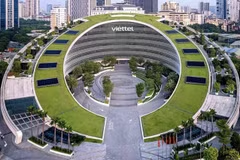
The headquarters of the Viettel Military Industry and Telecoms Group (Photo: Viettel)

Creating runway for Vietnam’s tech "eagles" to take off

Under the national plan for 2026–2030, Vietnam aims to develop at least 10 large strategic technology enterprises by 2030, each generating annual revenue of at least 1 billion USD, employing over 5,000 workers, operating a recognised science and technology organisation, and spending at least 3% of annual revenue on research and development.

Dr. Ho Quoc Tuan, senior lecturer at the UK’s University of Bristol, grants an interview to VNA (Photo: VNA)

Vietnam should focus on competitive niches in global tech value chain: UK-based expert

A young army of software engineers, competitive labour costs and deep mathematical skills have already made Vietnam a magnet for IT outsourcing. Companies like FPT Software and VNG have proved they can compete in international markets. These sectors demand relatively modest infrastructure spending while putting existing human capital to work.

Vietnamese Ambassador to Japan Pham Quang Hieu (R) and Gunma Governor Yamamoto Ichita co-chair the seminar on promoting public-private cooperation in digital transformation. (Photo: VNA)

Vietnam, Japan promote cooperation in digital transformation

The Vietnamese Embassy in Japan reaffirmed its commitment to serving as a trusted bridge connecting Gunma with Vietnamese ministries, localities, universities and businesses to promote concrete cooperation in investment, trade, science and technology, innovation, digital transformation and human resources development.

Minister of Science and Technology Vu Hai Quan delivers a pre-recorded address at the 68th series of meetings of the assemblies of the member states of the World Intellectual Property Organisation (Photo: Permanent Mission of Vietnam in Geneva)

Vietnam strengthens intellectual property system, targets economic value creation

During the recent 68th series of meetings of the assemblies of the member states of the World Intellectual Property Organisation (WIPO), Minister of Science and Technology Vu Hai Quan praised WIPO’s role in developing the global IP system, particularly in strengthening state management capacity, supporting businesses, training human resources, and promoting the commercialisation of intellectual assets.

At a supermarket in the US's Maryland state (Photo: VNA)

USDA to lead agricultural trade mission to Vietnam in November

Luke J. Lindberg, USDA Under Secretary for Trade and Foreign Agricultural Affairs, said the mission will build on the rapid response TRUMP mission that wrapped up in March, and lock in wins for US farmers and agricultural producers in Vietnam.

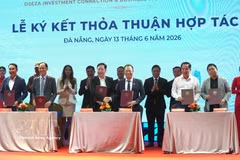
The signing ceremony of a cooperation agreement among strategic partners for the development of the Da Nang Free Trade Zone on June 13, 2026. (Photo: VNA)

Da Nang completes special administrative framework for free trade zone

The Da Nang Hi-Tech Park and Industrial Zones Authority has now finalised all administrative procedures under its jurisdiction in accordance with the FTZ’s special mechanisms and policies, leaving the system ready for deployment once the zone’s functional areas officially begin operations.

International buyers explore Vietnamese products at Vietnam International Sourcing 2025. (Photo: VNA)

Global buyers turn to Ho Chi Minh City for sourcing

The growing number of international retailers and importers choosing Ho Chi Minh City as a sourcing destination underscores the city's transformation from a trade promotion venue into a regional procurement hub.

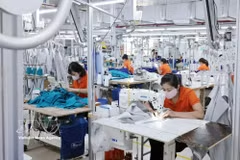
An export-oriented apparel factory of the Hung Viet Garment Joint Stock Company (Photo: VNA)

PM’s conclusions set to clear bottlenecks, spur corporate growth

The PM called on the business community, business associations and the Vietnam Chamber of Commerce and Industry (VCCI) to strengthen self-reliance, innovation and competitiveness by improving governance, adopting advanced technologies, enhancing product quality and using capital more efficiently.