Global buyers turn to Ho Chi Minh City for sourcing

The growing number of international retailers and importers choosing Ho Chi Minh City as a sourcing destination underscores the city's transformation from a trade promotion venue into a regional procurement hub.

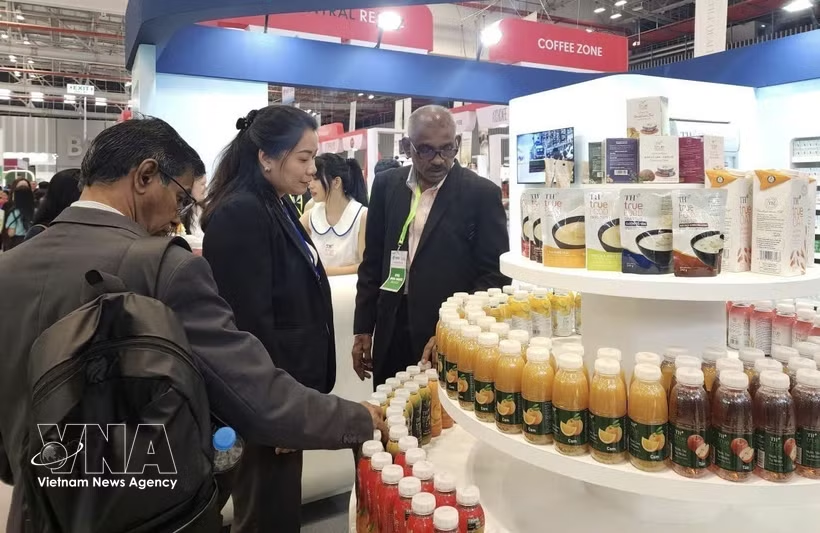
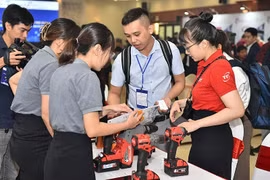
International buyers explore Vietnamese products at Vietnam International Sourcing 2025. (Photo: VNA)

Hanoi (VNA) – Ho Chi Minh City is attracting a growing number of international buyers seeking Vietnamese suppliers, signalling its emergence as a regional sourcing hub and creating new opportunities for local businesses to integrate more deeply into global supply chains.

According to Vu Ba Phu, Director of the Trade Promotion Agency (Vietrade) under the Ministry of Industry and Trade, Vietnam International Sourcing (VIS) 2026, scheduled for early September, has already drawn registrations from hundreds of international retailers and importers. Among them are major global players such as Walmart of the US, Reliance Retail of India and Pagoda of China, all looking to expand their supplier networks in Vietnam.

Many multinational buyers are already sourcing extensively in Vietnam, particularly in the country's key export sectors, Sai Gon Giai Phong newspaper reported.

Walmart is seeking suppliers of garments, footwear, household electronics, furniture, food and consumer goods, while Reliance Retail is looking for long-term partners to serve India's market of more than 1.4 billion consumers with processed foods, household products, furniture, apparel, footwear, personal care items and consumer electronics.

Pagoda, meanwhile, is expanding fruit procurement for its network of more than 6,000 stores across China. These are all sectors in which Vietnam has established strong manufacturing capabilities and extensive participation in global supply chains.

The shift is also giving Vietnamese businesses greater access to overseas markets by allowing them to engage directly with international buyers rather than relying on intermediaries. Dang Tho, a representative of Sofaland JSC, owner of the Sofaland Factory brand in Hanoi, said the company's first sofa shipment to Mexico, although relatively small, demonstrated that Vietnamese-made furniture can meet international quality standards. With the right market connections, he said, domestic manufacturers can compete through product quality, production capacity and reliable order fulfilment.

Huynh Thanh Trung, Director of Leanwares JSC in Ho Chi Minh City, said many Vietnamese firms have strengthened their competitiveness by investing in quality management, digital transformation, product traceability, emissions accounting and environmental, social and governance (ESG) practices, positioning themselves for deeper integration into multinational supply chains.

Tran Thi Phuong Hoa, Vice Chairwoman of the Ho Chi Minh City Food and Foodstuff Association, said businesses should move beyond meeting individual certification requirements and instead establish internationally compliant management systems. Standardising production processes, digitalising data, improving traceability and strengthening quality control throughout the production chain would not only lower compliance costs but also enhance credibility across multiple export markets.

She added that investment in technology must translate into commercial gains. While modern equipment is essential, lasting competitiveness will depend on companies' ability to harness data, artificial intelligence and automation to forecast demand, optimise costs, improve quality control and develop products tailored to individual markets. Greater investment in research and development, deep processing, packaging design and brand building will also be needed to meet rising demand for sustainable, convenient and environmentally friendly products.

According to Phu, the growing number of international retailers and importers choosing Ho Chi Minh City as a sourcing destination underscores the city's transformation from a trade promotion venue into a regional procurement hub. As business matching activities increasingly lead to factory visits, product development and long-term contracts, Vietnamese enterprises will be better positioned to move up the global value chain as higher value-added manufacturing partners./.
VNA

See more

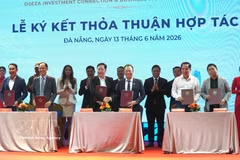
The signing ceremony of a cooperation agreement among strategic partners for the development of the Da Nang Free Trade Zone on June 13, 2026. (Photo: VNA)

Da Nang completes special administrative framework for free trade zone

The Da Nang Hi-Tech Park and Industrial Zones Authority has now finalised all administrative procedures under its jurisdiction in accordance with the FTZ’s special mechanisms and policies, leaving the system ready for deployment once the zone’s functional areas officially begin operations.

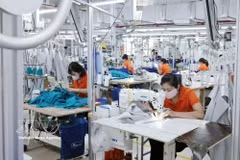
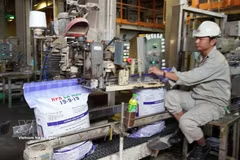
An export-oriented apparel factory of the Hung Viet Garment Joint Stock Company (Photo: VNA)

PM’s conclusions set to clear bottlenecks, spur corporate growth

The PM called on the business community, business associations and the Vietnam Chamber of Commerce and Industry (VCCI) to strengthen self-reliance, innovation and competitiveness by improving governance, adopting advanced technologies, enhancing product quality and using capital more efficiently.

According to the State Bank of Vietnam (SBV)’s Region 2 Branch, remittances transferred through credit institutions and economic organisations total 2.03 billion USD in the second quarter, up 1.4% from the first quarter but down 27.9% from the same period last year. (Illustrative photo: VNA)

Remittances to Ho Chi Minh City down 23% in H1

According to the State Bank of Vietnam (SBV)’s Region 2 Branch, remittances transferred through credit institutions and economic organisations totalled 2.03 billion USD in the second quarter, up 1.4% from the first quarter but down 27.9% from the same period last year.

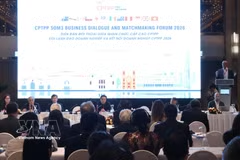
The dialogue and business networking forum between CPTPP senior officials and business leaders is held in Ho Chi Minh City on July 22, as part of the 2026 CPTPP Senior Officials' Meeting (SOM3) hosted by Vietnam. (Photo: VNA)

Public-private dialogue unlocks CPTPP potential

The CPTPP has evolved beyond tariff reductions into a broad framework covering goods, services, investment and digital trade. Its success, however, ultimately depends on businesses' ability to turn commitments into new investment, stronger supply chains and innovative business models.

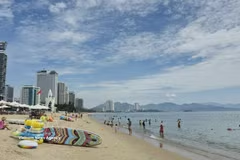
Tourists on Nha Trang beach in Khanh Hoa province (Photo: VNA)

Promoting integrated governance to advance sea-based economy

Khanh Hoa has positioned itself as the renewable energy industrial and service hub for the south-central and southern regions. Its economic development strategy identifies four key growth drivers, all built on the foundation of the marine economy.

An overview of the seminar entitled "Opportunities and challenges for market development in Turkish market" (Photo: Ministry of Industry and Trade)

Türkiye offers export potential for Vietnamese food producers: seminar

Türkiye’s target of lifting total exports of goods and services to more than 400 billion USD in 2026 could create additional opportunities for Vietnamese agricultural products, food and beverages, said Ta Manh Cuong, director of the Trade and Investment Promotion Support Centre.

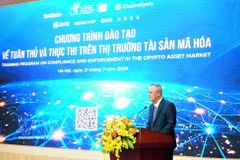
SSC Vice Chairman Bui Hoang Hai speaks at the opening of the programme on July 21. (Photo: VNA)

Vietnam boosts crypto market oversight capabilities

Diederik Van Wersch, Chainalysis' ASEAN Regional Director, noted that Vietnam has a high level of crypto asset adoption, offering significant opportunities for innovation while creating greater demands for oversight and risk management.

Vietnam Railways has introduced a range of tourism, heritage and dedicated train services, attracting growing numbers of passengers. (Photo: VNA)

Railways reinvent themselves with tourism, heritage trains

One of the most notable successes is the premium Hoa Phuong Do (Flamboyant Flower) train operating between Hanoi and Hai Phong city. Since entering service in May 2025, the train has completed nearly 3,000 trips and carried around 1.33 million passengers.