Railways reinvent themselves with tourism, heritage trains

One of the most notable successes is the premium Hoa Phuong Do (Flamboyant Flower) train operating between Hanoi and Hai Phong city. Since entering service in May 2025, the train has completed nearly 3,000 trips and carried around 1.33 million passengers.

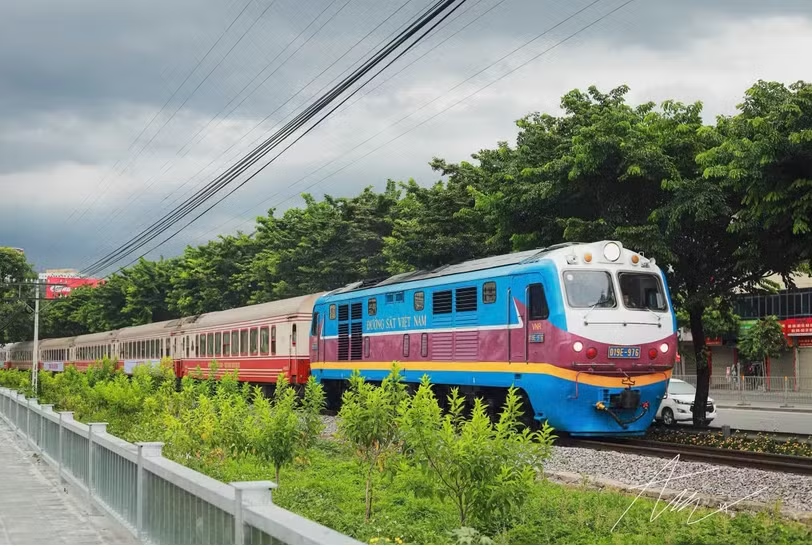
Vietnam Railways has introduced a range of tourism, heritage and dedicated train services, attracting growing numbers of passengers. (Photo: VNA)

Hanoi (VNA) – Vietnam’s railway sector is gaining fresh momentum as a series of innovative services, including tourism, heritage and dedicated commuter trains, have attracted growing numbers of passengers and opened up new opportunities for the industry.

One of the most notable successes is the premium Hoa Phuong Do (Flamboyant Flower) train operating between Hanoi and Hai Phong city. Since entering service in May 2025, the train has completed nearly 3,000 trips and carried around 1.33 million passengers, according to the Hai Phong railway transport branch, part of the Hanoi Railway Transport Joint Stock Company under the Vietnam Railways Corporation.

Four pairs of Hoa Phuong Do trains run daily on the route, transporting between 2,500 and 3,000 passengers each day. Passenger numbers rise to around 5,500-6,000 daily during weekends and public holidays, prompting Vietnam Railways to add extra carriages or services to meet demand.

Tran Van Hanh, Director of the Hai Phong railway transport branch, said revenue on the Hanoi–Hai Phong route increased 15% year-on-year in the first half of 2026. The online ticketing system allows operators to monitor bookings in real time and quickly add carriages when demand increases.

Beyond its distinctive design inspired by Hai Phong, known as the city of Flamboyant Flowers, the train is integrated with tourism services, including buses, motorbike rentals, city tours, digital tourism maps and QR codes displayed insider the carriages, enabling passengers to conveniently access travel information and local attractions, he added.
vnanet-railway.png
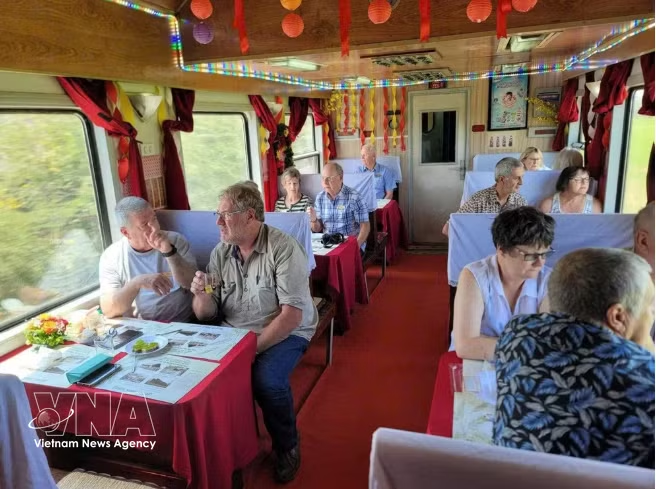
The railway sector is attracting a growing number of passengers, especially foreign tourists, by introducing new products and services designed to enhance the travel experience. (Photo: VNA)

Vietnam Railways has also introduced the “heritage journey” between the central cities of Hue and Da Nang, which entered service in March. Two pairs of heritage trains operate daily, offering passengers a scenic journey through one of Vietnam’s most spectacular coastal landscapes. The train makes a special stop at Lang Co for sightseeing and photo opportunities while passengers can also enjoy panoramic views of Hai Van Pass, live traditional music performances and culinary specialties of the central region on board.

The sector is studying plans to extend the heritage train network with a new Hue–Dong Hoi (Quang Tri province) route. The proposed 190km service will connect major cultural and historical attractions, including the imperial city of Hue, the Quang Tri Ancient Citadel, the Vinh Moc Tunnels and Phong Nha – Ke Bang National Park, creating a distinctive inter-regional tourism product.

Dedicated commuter trains have also delivered encouraging results. After nine months of operation, the Hai Duong–Hai Phong service for public employees has carried more than 170,000 passengers across nearly 400 trips, maintaining an average seat occupancy rate of over 90%.

Likewise, a charter commuter train launched on June 26 for Bach Mai Hospital’s medical staff travelling between Hanoi and Phu Ly (Ninh Binh province) has recorded high occupancy, averaging around 400 passengers per trip on working days.

vnanet-railway2.png
Passengers on the "heritage journey” train between Hue and Da Nang can enjoy live music and cultural performances by local artists during the trip. (Photo: VNA)

According to Vietnam Railways, the sector transported approximately 3.9 million passengers in the first six months of 2026, up 5.2% year-on-year. Several routes posted double-digit revenue growth such as Hanoi–Lao Cai 27%, Hanoi–Da Nang 12% and Hanoi–Hai Phong over 12%. The Hue–Da Nang heritage train recorded an 11% increase in passenger numbers and a 41% rise in revenue. Charter train services also generated more than 16 billion VND (608,000 USD) from 13 charter operations.

Despite fluctuations in fuel prices, Vietnam Railways attributed the positive performance to its flexible introduction of new transport products and services. In the first half of 2026, the corporation reported consolidated revenue exceeding 5.2 trillion VND, up 4.1% year-on-year, while after-tax profit surpassed 180 billion VND, reaching 151% of its annual target. Transport operations remained the key growth driver, with revenue rising 8.8% to nearly 3 trillion VND.

It plans to further expand tourism, heritage, charter, dedicated commuter and short-distance train services, while integrating rail transport with tourism, accommodation and sightseeing to strengthen the sector’s competitiveness and achieve double-digit growth in 2026./.


VNA

See more

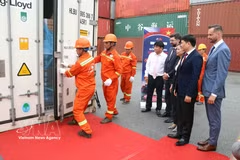
Representatives of relevant parties witness the arrival of the shipment. (Photo: VNA)

First Czech pork shipment officially enters Vietnamese market

A Czech diplomat described the arrival of the first container as the successful outcome of a long and complex market-opening process involving years of negotiations, regulatory approvals and close cooperation between Czech and Vietnamese authorities.

A view of financial buildings in downtown Ho Chi Minh City along the Saigon River. (Photo: VNA)

HSBC: Vietnam’s growth, macroeconomic stability to face tougher test in H2

In a recently released report, Vu Binh Minh, CFA, Associate Director, FX Trading, Markets and Securities Services at HSBC Vietnam, said Vietnam’s economy has built a relatively favourable position in the first six months of the year with GDP expanding 8.18% – the highest first-half growth rate in recent years – as key growth drivers have operated in tandem.

Ha Tay Shoes has secured numerous export orders from the US and European markets. (Photo: VNA)

CPTPP strengthens free trade, expands global economic connectivity

Since taking effect, the CPTPP has significantly expanded Vietnam's access to major markets across North America, the EU, and the Asia-Pacific, contributing to strong export growth in key sectors such as textiles and garments, footwear, and agricultural, forestry and fishery products. The agreement has also encouraged greater investment into Vietnam by promoting regional production networks and clearer rules of origin.

Tan Mingming, Deputy Director of the Foreign Affairs Office of the Dezhou Municipal People’s Government. (Photo: VNA)

Chinese firms put Vietnam on expansion radar

Tan Mingming, Deputy Director of the Foreign Affairs Office of the Dezhou Municipal People’s Government, told Vietnam News Agency reporters that the city has spent years deliberately tightening its links with the Association of Southeast Asian Nations (ASEAN), with Vietnam seen as a key partner.

A perspective of the Viettel Military Industry and Telecoms Group's high-tech semiconductor chip manufacturing plant at Hoa Lac Hi-Tech Park. (Photo: Viettel)

Hanoi builds momentum as Vietnam's semiconductor hub

As Hanoi continues to strengthen its semiconductor ecosystem, the city is creating a new growth driver for both the capital and the country, enhancing Vietnam's technological capabilities and paving the way for deeper integration into the global semiconductor value chain.

Clams are processed for export at the factory of Thanh Hoa Seafood Import-Export JSC in Thanh Hoa province. (Photo: VNA)

Vietnam steps up export to achieve 550-billion-USD target

Against a backdrop of persistent uncertainty in global commerce, the Government is implementing a broad range of measures to strengthen export growth during the remainder of the year. These include expanding overseas markets through economic diplomacy, maximising the benefits of free trade agreements (FTAs), streamlining administrative procedures, reducing logistics costs, improving access to credit and helping businesses overcome trade barriers. Authorities are also encouraging deeper processing, official cross-border exports and greater market diversification to improve the competitiveness of Vietnamese products.

A hydroponic vegetable garden in Nguyet Hoa ward operated by Green Farm Co., Ltd. (Photo: VNA)

Incentive policies for high-tech agricultural zones

Under Decree No. 263/2026/ND-CP, qualified projects are given priority to participate in State support programmes as well as funds and policies on research and development, technological innovation, technology transfer, human resource training, investment promotion and trade promotion.

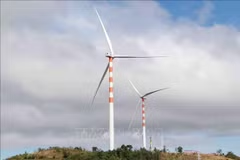
Wind turbines stand fully installed at a wind power project in Gia Lai province. (Photo: VNA)

Gia Lai approves 56-million-USD wind power project

The 42MW wind farm is expected to generate about 123,780.8 MWh of electricity each year. Power generated will be transmitted to the national grid via the 220kV Pleiku 2–Krong Buk transmission line.

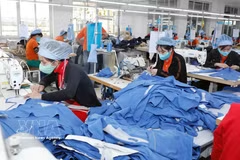
Garments for export to the Japanese market are produced at Hung Viet Garment Company in Hung Yen province. (Photo: VNA)

Vietnam’s garment sector pivots towards value-added growth

Future growth can no longer rely on expanding production capacity alone. Meeting this year's 48 billion USD export target will require greater productivity, higher value addition, stronger domestic sourcing, broader market diversification, and faster digital and green transformation.

Trucks carrying goods wait for customs clearance at the Thanh Thuy International Border Gate in Tuyen Quang province. (Photo: VNA)

Border economy strengthens Tuyen Quang’s growth momentum

While the stronger performance provides momentum for the province's 2026 growth target of 10.17%, officials say the focus must now shift from increasing cargo volumes to expanding services, reducing costs and retaining more value locally.