CPTPP strengthens free trade, expands global economic connectivity

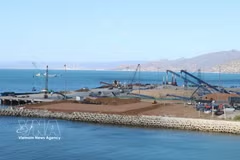
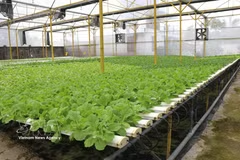
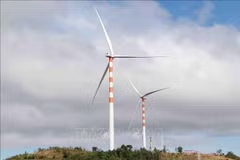
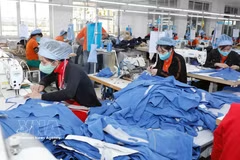
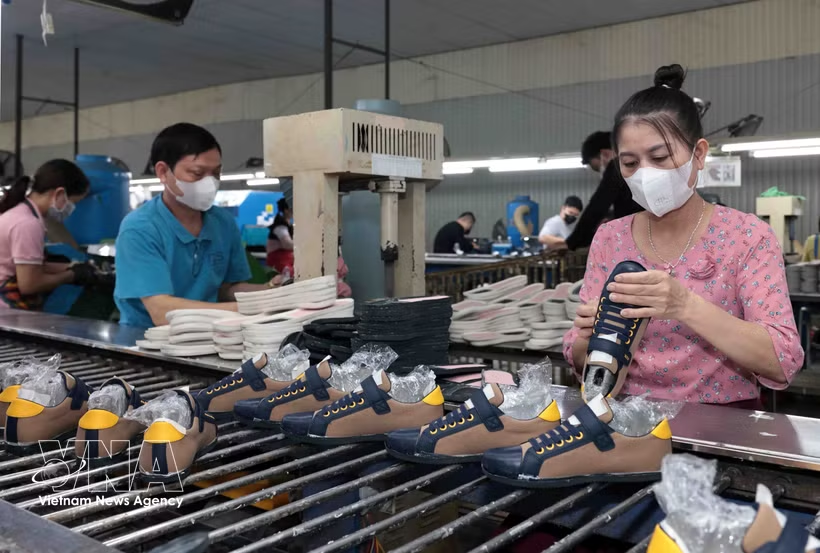
Since taking effect, the CPTPP has significantly expanded Vietnam's access to major markets across North America, the EU, and the Asia-Pacific, contributing to strong export growth in key sectors such as textiles and garments, footwear, and agricultural, forestry and fishery products. The agreement has also encouraged greater investment into Vietnam by promoting regional production networks and clearer rules of origin.

Ha Tay Shoes has secured numerous export orders from the US and European markets. (Photo: VNA)

Ho Chi Minh City (VNA) – The Comprehensive and Progressive Agreement for Trans-Pacific Partnership (CPTPP) continues to reinforce its position as one of the world's most comprehensive and high-standard new-generation free trade agreements (FTAs), providing a vital anchor for free trade amid mounting geopolitical uncertainty, supply chain disruptions and rising protectionism.

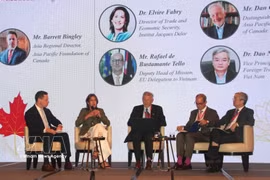
Mary-Catherine Speirs, Director General for Trade Negotiations at Global Affairs Canada and senior CPTPP official of Canada, said the rapidly evolving geopolitical landscape is fundamentally reshaping the global trading system. Rather than simply adapting to change, economies must actively help shape new frameworks for international economic cooperation.

According to Speirs, Canada views stronger dialogue between CPTPP members and the EU as an important platform for middle-power economies to promote an open, transparent and rules-based trading system. Enhanced connectivity will also enable member economies to play a more active role in shaping international trade rules instead of merely responding to global economic shifts.

Nguyen Son Tra, Head of the WTO and Trade Negotiations Division under the Ministry of Industry and Trade's Multilateral Trade Policy Department and Vietnam's Deputy Chief CPTPP Negotiator, said member economies have agreed on five key priorities during Vietnam's CPTPP Chairmanship Year in 2026.

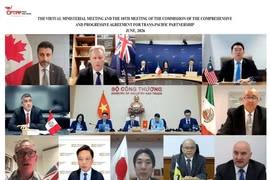
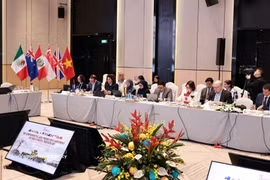
These include reviewing and updating the agreement to ensure it remains a high-standard framework that can adapt to evolving trends, including digital trade and more resilient supply chains, as well as emerging trade issues. Another major priority is strengthening engagement with external partners, particularly the EU. Ministers of CPTPP members agreed to deepen cooperation with the bloc in 2025, and focus on implementing these commitments through practical cooperation programmes in 2026.

Against the backdrop of global supply chain restructuring, digital transformation and the transition towards sustainable development, maintaining an open, transparent and rules-based trading system has become increasingly important for strengthening economic resilience and facilitating international trade and investment. Accordingly, CPTPP members are focusing on improving the implementation of the agreement to increase utilisation of tariff preferences while expanding opportunities in services, investment, digital trade and regional supply chains through closer cooperation between government agencies and the business community.

Businesses expect stronger CPTPP-EU connectivity to diversify supply chains, attract more investment and create greater opportunities for Vietnamese exports to access major markets. They also believe that a free trade environment with zero tariffs will enhance business competitiveness and significantly expand international partnerships.

Although the CPTPP and the EU are located in different geographical regions, they are becoming increasingly interconnected through investment flows, technology cooperation and integrated supply chains. Together with other new-generation FTAs, these links are helping facilitate the movement of goods, services, investment and data, and improve predictability and stability in the global business environment.
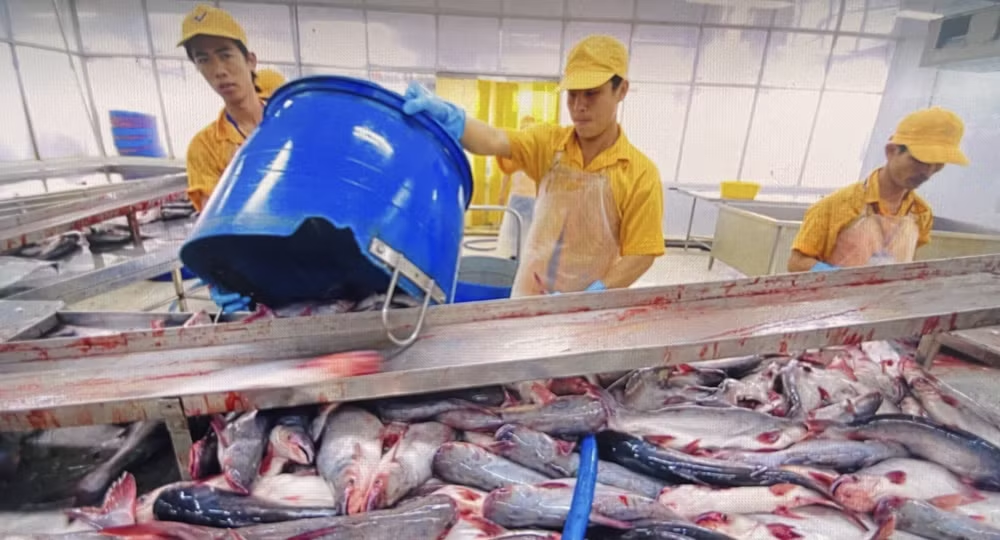
cptpp.jpg
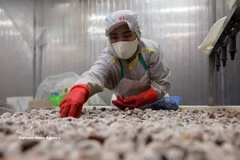
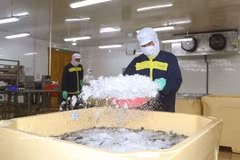
Workers prepare tra fish for processing at Vinh Hoan Corporation in Dong Thap province. (Photo published by VNA)

Michele D'Ercole, General Manager of Henoto Vietnam, said closer ties between the CPTPP and the EU will create a larger, more competitive marketplace, providing businesses with greater opportunities under a liberalised trading environment. Given current global economic uncertainties, he stressed that maintaining open markets is more important than ever.

He added that energy represents one of the most promising areas for cooperation between Vietnam and Canada under the CPTPP, particularly as Vietnam accelerates its sustainable development agenda. Agriculture and food industries also hold considerable potential.

Meanwhile, Jack Nguyen, CEO of InCorp Vietnam, noted that businesses still face challenges in fully implementing CPTPP commitments, including compliance with rules of origin, logistics and transportation costs. To maximise the agreement's benefits, enterprises should strengthen their understanding of the CPTPP and seek professional guidance to ensure their products meet all applicable requirements.

Since taking effect, the CPTPP has significantly expanded Vietnam's access to major markets across North America, the EU, and the Asia-Pacific, contributing to strong export growth in key sectors such as textiles and garments, footwear, and agricultural, forestry and fishery products. The agreement has also encouraged greater investment into Vietnam by promoting regional production networks and clearer rules of origin./.
VNA

See more

Air Premia, a carrier of the Republic of Korea, will resume flights between Incheon and Ho Chi Minh City from November 5. (Photo: The Courtesy of Air Premia)

Air Premia to resume Incheon–Ho Chi Minh City route from November

Flights will depart Incheon International Airport at 6:40 pm (RoK time) and arrive at Tan Son Nhat International Airport in Ho Chi Minh City at 11 pm (Vietnam time). Return flights will leave Ho Chi Minh City at 12:30 am on Mondays, Tuesdays, Thursdays, Fridays and Sundays, landing in Incheon at 7:40 am.

Production at Viet Hai High-Tech Structure Production Company Limited in Vung Ang Economic Zone. Ha Tinh province aims to develop Vung Ang Economic Zone into a regional centre for industry, energy, seaports and logistics (Photo: VNA)

Revised master plan of Vung Ang EZ approved

The adjustment aims to create a more rational development framework to maximise the zone’s potential and advantages while providing a legal foundation for construction management and ensuring sustainable development.

Illustrative image (Photo: VNA)

Vietnam looks to domestic market to sustain wood industry growth

Vietnam’s wood sector has long been a top foreign-currency earner. Exports of wood and wooden products neared 17.3 billion USD in 2025, reaching more than 160 countries and territories and clearing the high bars set by the US, the European Union and Japan.

Delegates at the event (Photo: VNA)

Vietnam remains key market for Polish food producers

The campaign promotes selected European Union agricultural and food products, including fresh, chilled and frozen beef and pork, fresh apples, apple juice and dried apples, targeting consumers, importers, distributors, retailers and the hospitality sector.

Wei Xiaoli, a representative of Shandong Jindafeng Machinery Co., Ltd., in an interview granted to the Vietnam News Agency. (Photo: VNA)

Chinese firms see strong potential for agricultural mechanisation cooperation with Vietnam

Business representatives said mechanisation not only helps reduce reliance on manual labour but also improves production efficiency, shortens planting and harvesting times, reduces post-harvest losses and enhances the quality of agricultural products. For rice-producing countries like Vietnam, they noted, accelerating mechanisation is an inevitable trend to strengthen the competitiveness of the agricultural sector.

Community-led fisheries groups have become frontline defenders of coastal fisheries. (Photo: VNA)

Community-led fisheries groups strengthen IUU fight in Ha Tinh

With a long coastline and abundant inshore fishing grounds, Ha Tinh has long identified the marine economy as a key growth driver. However, growing fishing pressure and destructive practices have posed major management challenges. Community-led self-management initiatives are now providing an effective solution.

At the VIFC-HCMC (Photo: VNA)

700 bln USD for net zero: Vietnam bets on VIFC

Assoc. Prof. Dr. Nguyen Huu Huan, Vice Chairman of the Executive Board of VIFC-HCMC, said the VIFC will focus on building market infrastructure needed to bridge the gap between big investment pledges and bankable projects.

A view of the launch ceremony for the expanded Vietnam–China cross-border QR payment service. (Photo: NAPAS)

Over 1 billion Weixin Pay users can make QR code payments in Vietnam

NAPAS, Weixin Pay, and BIDV will study the rollout of the reverse payment service, enabling users of Vietnamese banking applications and e-wallets to make QR code payments in China, with the aim of completing a comprehensive cross-border payment ecosystem between the two countries.

Vietnam cuts retail fuel prices on August 6. (Photo: VNA)

Vietnam cuts retail fuel prices on August 6

The maximum retail price of E5RON92 biofuel was reduced by 1,160 VND to 21,728 VND (0.83 USD) per litre, while that of E10RON95-III fell by 1,035 VND to 22,324 VND per litre.

Production of electronic components at Star Engineers Vietnam Co. Ltd. in Binh Xuyen I Industrial Park in Phu Tho province. (Photo: VNA)

Vietnam targets higher-quality FDI under Resolution 10

During the first seven months of 2026, Vietnam attracted more than 38 billion USD in registered FDI, up nearly 58% year-on-year. More importantly, the increase was driven by large-scale, high-tech projects rather than a surge in the number of new investments, signalling a significant improvement in the quality of capital inflows.

A woodchip production line at a plant in Vinh Thuy commune, Quang Tri province (Photo: VNA)

Tackling timber supply bottlenecks needed for value-added processing: experts

Vietnam's wood industry has grown rapidly in recent years, with exports reaching 17.2 billion USD in 2025. Wood and wood products are now shipped to more than 140 countries and territories, making Vietnam an important processing hub in the global supply chain, with key markets such as the US, Japan, China, the European Union and the Republic of Korea.