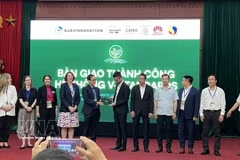
Hanoi (VNA) – Vietnam is stepping up efforts to build a new generation of competitive private enterprises capable of driving innovation and strengthening the country's integration into global value chains.
A new programme on developing 1,000 pioneering enterprises for 2026–2030 is expected to provide fresh momentum for enhancing the competitiveness of Vietnamese businesses while fostering sustainable economic development.
Hoang Quang Phong, Vice Chairman of the Vietnam Chamber of Commerce and Industry (VCCI), said Vietnam currently has around 1 million operating enterprises, contributing nearly 60% of GDP, accounting for about 98% of the country's total export turnover, and creating jobs for approximately 85% of the workforce. Many Vietnamese companies have successfully built strong brands and gradually integrated into global supply chains.
However, he noted that the vast majority remain small- or micro-sized companies with limited management capacity, modest competitiveness and insufficient long-term development strategies. Addressing these constraints is essential for the private sector to fully assume its role as a key engine of economic growth.
Meanwhile, the global economy is undergoing rapid transformation, driven by emerging industries, shifting investment flows, intensifying trade competition and growing tariff barriers. These trends require Vietnamese enterprises to strengthen innovation, master advanced technologies and move further up on global value chains.
To cultivate a group of market-leading firms, the Prime Minister issued Decision No. 631/QD-TTg on April 6, 2026, approving the programme on developing 1,000 pioneering enterprises for the 2026–2030 period.
Rather than applying broad-based support policies, the programme focuses on identifying and assisting businesses with outstanding growth potential. By 2030, it aims to develop 1,000 pioneering enterprises, including at least 200 high-growth companies, 20 firms deeply integrated into global value chains, and a minimum of 15% led by women.
To qualify, enterprises must satisfy stringent criteria covering financial capacity, innovation capability and governance sustainability. Eligible companies are required to have operated continuously for at least three years, comply fully with legal regulations, record profits in at least two of the previous five years or be undertaking major investment and technological upgrade.
Innovation is another key criterion. Participating enterprises are expected to allocate at least 3% of annual revenue to research and development (R&D), own at least one patent, industrial property right or utility solution, possess core technologies, and develop products for export or import substitution.
In terms of governance, enterprises must demonstrate transparency, sustainable development practices and the application of internationally recognised management systems, including ESG standards and certifications such as ISO 14001, ISO 45001, ISO 50001, ISO 26000, GMP, HACCP or GlobalGAP.
The programme offers six major groups of support policies covering investment procedures, customs clearance and stock market listing; testing, certification and public procurement; finance and credit; research and development, digital and green transformation; corporate governance; and trade promotion and market expansion.
Notably, the Ministry of Finance is finalising a circular on a new credit access mechanism for pioneering enterprises. Under the proposed framework, companies may be eligible for financing based on future assets and intangible assets, including patents, data and projected cash flows, instead of relying primarily on traditional collateral. The mechanism is expected to improve financing opportunities for technology and innovation-driven enterprises.
The ministry is also building a programme to train 10,000 chief executive officers by 2030 through both in-person and digital learning platforms, with the aim of strengthening corporate leadership and governance./.
VNA