Vietnam proposes priorities to strengthen international cooperation on world heritage conservation

On behalf of Vietnam, the deputy minister proposed three priorities of strengthening international cooperation and capacity-building for member states, particularly developing countries; promoting science-based conservation that strikes a balance between preservation and development while placing local communities at the centre; and enhancing coordination among relevant conventions and programmes, alongside the responsible application of digital technologies and artificial intelligence in heritage conservation.

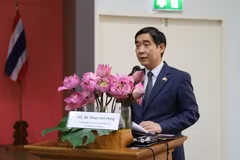
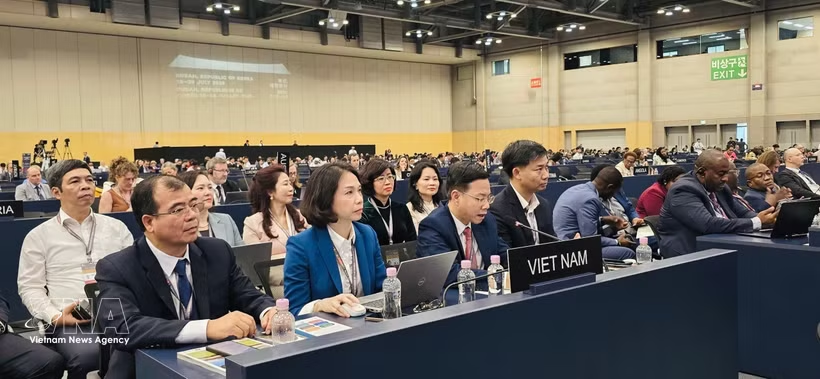
Deputy Minister of Foreign Affairs Ngo Le Van, Chairman of the Vietnam National Commission for UNESCO, speaks at plenary session of the 48th session of the UNESCO World Heritage Committee in Busan on July 20, 2026. (Photo: VNA)

Busan (VNA) – Deputy Minister of Foreign Affairs Ngo Le Van, Chairman of the Vietnam National Commission for UNESCO, is leading the Vietnamese delegation to the 48th session of the UNESCO World Heritage Committee, taking place in Busan from July 19 to 29.

Addressing the plenary session on July 20, Van underscored the need to strengthen international cooperation to ensure the effective protection of humanity's shared heritage. He also welcomed the spirit of the Busan Declaration, which promotes enhanced cooperation within the world heritage system.

On behalf of Vietnam, the deputy minister proposed three priorities of strengthening international cooperation and capacity-building for member states, particularly developing countries; promoting science-based conservation that strikes a balance between preservation and development while placing local communities at the centre; and enhancing coordination among relevant conventions and programmes, alongside the responsible application of digital technologies and artificial intelligence in heritage conservation.

Affirming that culture and heritage constitute the spiritual foundation of society, as well as an endogenous resource and key driver of sustainable development, he announced that Vietnam will host the Asia-Pacific Dialogue on Heritage and Authenticity in Hanoi from September 27 to 30.

The deputy foreign minister also reaffirmed Vietnam's commitment to close cooperation with the UNESCO World Heritage Centre, the International Council on Monuments and Sites (ICOMOS), the International Union for Conservation of Nature (IUCN), and the International Centre for the Study of the Preservation and Restoration of Cultural Property (ICCROM).

He cited the conservation and restoration project at Hanoi’s Thang Long Imperial Citadel, which preserves more than 1,300 years of history and distinctive cultural strata, as a notable example of such effective international cooperation, ensuring authenticity, integrity and a science-based conservation approach.
vnanet-vietnam-unesco-2.jpg
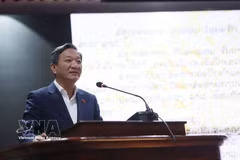
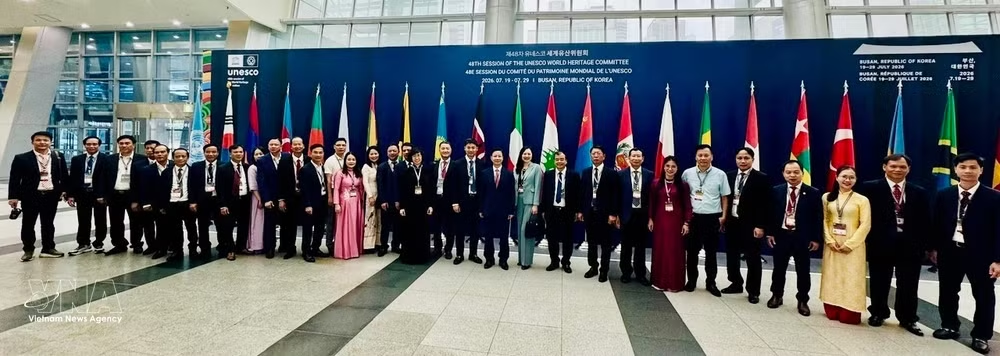
The Vietnamese delegation attends the plenary session of the 48th session of the UNESCO World Heritage Committee, on July 20, 2026. (Photo: VNA)

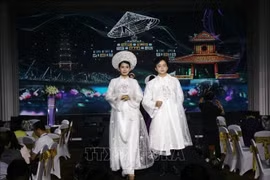
On the sidelines of the session, the Vietnamese delegation attended a roadshow in Busan showcasing the culture, tourism, cuisine and traditional craft villages of the central city of Hue, organised by the municipal People's Committee.

Speaking at the event, Van said the programme not only highlights the unique heritage of the former imperial capital but also demonstrated the role of culture and heritage as a bridge connecting peoples, thereby contributing to the further development of the Vietnam–Republic of Korea comprehensive strategic partnership. He expressed confidence that the event would foster new opportunities for cooperation in heritage conservation and promotion, tourism development, cultural industries and people-to-people exchanges.

At the roadshow, Hue authorities introduced the city as home to eight UNESCO-recognised heritage titles and outlined its ambition to position itself as a destination for green tourism, high-quality resort services and the circular economy. The city also showed its desire to strengthen cooperation with Korean airlines, travel companies and investors, while reaffirming its commitment to providing a transparent and favourable investment environment for Korean partners.

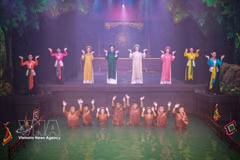
The event featured exhibitions of traditional craft villages, presentations of Hue cuisine, performances of Nha nhac (court music), and business networking activities linking Hue with Korean partners in tourism, aviation, cultural industries and investment.

The UNESCO World Heritage Committee is one of the organisation's principal governing bodies. Comprising 21 member states, it is responsible for decisions on the inscription of cultural and natural world heritage sites, reviewing the conservation status of world heritages worldwide, and determining the policies, budget and strategic direction for implementing the World Heritage Convention. At its current session, the committee is expected to consider 33 new world heritage nominations and review the conservation status of nearly 180 inscribed sites./.
VNA

See more

Xuan Son comes on in the second half and contributes to Vietnam’s second goal, with his shot forcing a Cambodian defender into an own goal to put Vietnam 2-1 ahead (Photo: VNA)

Vietnam's 22-match unbeaten run draws praise from RoK media

Under the tournament format, the semifinals and final will be played over two legs. Vietnam will travel to Malaysia for the first leg on August 16 before hosting the second leg on August 19. Should Vietnam overcome Malaysia, they will meet the winner of the other semifinal between Thailand and Singapore in the final.

A performance at the Vietnam–Korea Festival 2026 in Da Nang city (Photo: VNA)

Vietnam–Korea Festival 2026 kicks off in Da Nang

Now in its fifth edition, the festival has cemented its place as Da Nang’s signature annual diplomatic event, spotlighting the distinct cultures of both nations, fostering friendship and driving cooperation with Korean localities and partners.

A performance at the opening ceremony of the 2026 Hanoi International Martial Arts Festival on August 7 (Photo: VNA)

Hanoi opens international martial arts festival

The event attracts about 2,000 martial artists of 66 delegations, including seven international delegations from six countries, namely Indonesia, Russia, France, Germany, Switzerland and Morocco.

The statue of Vietnam's King Ly Thai To ( (974 - 1028) in Bonghwa county (Photo: VNA)

RoK to develop K-Vietnam Valley project linked to Ly Dynasty heritage

With the designation in place, Bonghwa will carry out eight specialised projects worth a combined 347.6 billion KRW (245.1 million USD) from 2026 to 2030 – among them the K-Vietnam Valley itself, tourism development around Changpyeong Reservoir, rental smart farms, and a Baekdudaegan healing ‘pet village.’

The organising committee presents awards to outstanding martial artists at the festival. (Photo: VNA)

9th Int’l Festival of Vietnamese Traditional Martial Arts wraps up

The ninth International Festival of Vietnamese Traditional Martial Arts has fostered the martial spirit, strengthened national pride, promoted cultural exchanges and reinforced the aspiration to bring Vietnamese traditional martial arts to a wider international audience.

An appetising bowl of My Quang features a rich combination of ingredients. (Photo: VNA)

Da Nang to host festival honouring Quang Nam-style noodle soup

My Quang is not only a signature dish of the Quang region but also reflects the history, culture and daily life of communities in central Vietnam. With its diverse ingredients, preparation methods and distinctive flavours, the noodle soup has become one of Vietnam's best-known culinary specialities, helping strengthen Da Nang's position on the culinary tourism map.

Hanoi’s traditional silk weaving craft continues to be preserved and developed today. (Photo: VNA)

Van Phuc silk weaving village officially recognised as Hanoi tourist destination

With its millennia-old heritage and growing integration of preservation and innovation, Van Phuc silk weaving village is poised to become a distinctive cultural destination, helping promote Hanoi’s sustainable cultural tourism and bring the quintessence of Vietnamese silk weaving closer to domestic and international visitors.

Minister of Construction Tran Hong Minh speaks at the session (Photo: VNA)

Lawmakers mull over changes to architecture law

On architectural management, the draft Law amending and supplementing several articles of the Law on Architecture clarifies the concept of “national cultural identity in architecture”, tying design to the preservation and promotion of regional heritage. It pushes architecture that mirrors local identity and fits each locality’s natural, historical and social conditions, while setting criteria to identify, assess and protect architecturally valuable buildings as a distinct form of cultural heritage.