Hanoi (VNA) – Amid rapid urbanisation and globalisation, Vietnam's centuries-old tradition of “ket cha” (establishing village twinning relations or alliances) – a ceremonial bond between villages – continues to endure as a symbol of solidarity, mutual support and community cohesion. Today, the custom is increasingly viewed not only as intangible cultural heritage but also as a source of cultural vitality and soft power in the country's new era of development.
A millennium of friendship
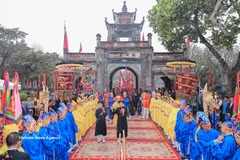
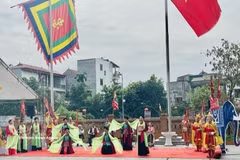
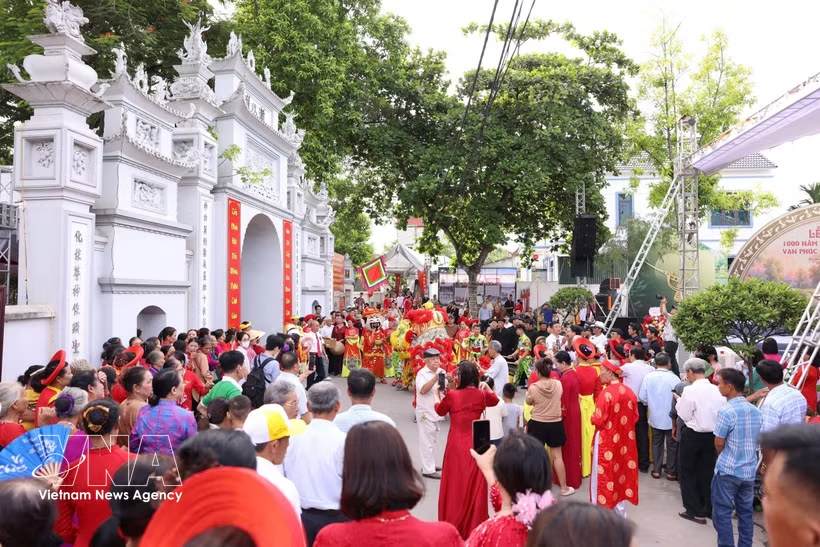
On July 18–19 (the fifth and sixth days of the sixth lunar month), residents of Van Phuc village, now in Nam Phu commune, and Nga My village, now in Thanh Oai commune, Hanoi, commemorated 1,000 years of ceremonial brotherhood through a series of cultural and artistic events.
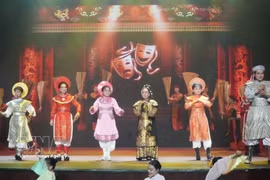
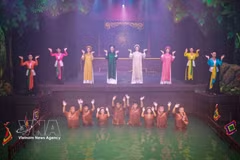
The highlight was a commemorative ceremony at the Van Phuc communal house, accompanied by an epic stage production, "Van Phuc – Nga My: Ancient villages, enduring legacy", which brought together historical records, music, dance, narration and theatrical performance to recount the villages' shared history. Drawing on images of the Red River Delta, traditional festivals, dyke construction and the enduring “ket cha” ritual, the production celebrated a living heritage that continues to resonate in contemporary life.
According to village elders, the tradition has been passed down through generations as a testament to the Vietnamese spirit of solidarity and mutual assistance.
Researchers note that what makes the Van Phuc–Nga My relationship particularly remarkable is not only its thousand-year history but also the wealth of historical evidence that has survived, including imperial decrees, village genealogies and valuable Han-Nom manuscripts preserved in both villages.
Traditional accounts trace the custom back to the reign of King Ly Thai To (974–1028), following the relocation of the capital to Thang Long, now Hanoi. Repeated breaches of the Dinh Nhi dyke south of the capital caused devastating floods until residents of Van Phuc helped reinforce the embankment in Nga My. In gratitude, Nga My villagers sought to establish a permanent bond of friendship, pledging to support one another in farming, flood control and community affairs. The emperor is said to have endorsed the agreement, which has endured ever since.
The relationship evolved into a distinctive social tradition. Residents address one another as family. Marriages between the two villages are traditionally discouraged because they are regarded as members of the same extended family. Delegations regularly visit one another during festivals, jointly worship village guardian deities, inspect flood defences and cooperate in community matters.
Historical documents further attest to the depth of the relationship. A study published in the Han-Nom Studies Bulletin 2011 by Associate Professor Bui Xuan Dinh from the Institute of Anthropology and Religious Studies and Dr Nguyen Thu Hien from the Hanoi Museum identified seven Han-Nom manuscripts dating from the King Tu Duc to King Bao Dai reigns (from the 19th century to the early 20th century) that document invitations to festivals, ceremonial exchanges and mutual assistance between the villages. They also record how Nga My residents contributed to rebuilding Van Phuc's communal house after flooding in the late 19th century, while Van Phuc villagers later reciprocated during Nga My's restoration projects and religious ceremonies.
Historian Le Van Lan described the Van Phuc–Nga My relationship as one of the most exceptional examples of village alliances in Vietnam, noting that few such traditions have remained intact for a millennium.
A living heritage for modern Vietnam
Unlike physical monuments or artefacts, “ket cha” survives through collective memory, shared customs and enduring social relationships. Developed from the practical need for neighbouring communities to cooperate in land reclamation, flood control, production and mutual defence, the tradition reflects the core Vietnamese values of solidarity, reciprocity, respect and collective responsibility.
Lan said the custom's greatest significance lies not in its rituals but in the humanistic philosophy it embodies – placing community and enduring relationships above individual interests. That ethos, he noted, remains highly relevant today.
As Vietnam seeks to preserve its cultural identity while promoting sustainable development, “ket cha” offers more than a historical legacy. It demonstrates how traditional values can contribute to education, tourism, cultural industries and community development.
This vision aligns with the Politburo's Resolution No. 80 on developing Vietnamese culture in the new era, which identifies culture not only as the spiritual foundation of society but also as an internal resource and a key driver of national development. Under this approach, heritage is no longer viewed simply as something to be preserved but as a source of creativity, soft power and economic growth.
At the second meeting of the Central Steering Committee for the Development of Vietnamese Culture, Party General Secretary and State President To Lam underscored the importance of "cultural sovereignty" in the digital age. Beyond protecting territorial integrity, he said, safeguarding national identity, preserving cultural values and promoting the system of Vietnamese values in the digital space have become a crucial aspect of national strength.
Viewed in this context, the thousand-year bond between Van Phuc and Nga My represents more than the history of two villages. It illustrates how living heritage can reinforce Vietnam's cultural identity while contributing to the country's soft power. As more traditional values are preserved, reinterpreted and shared with new generations, they become not only a bridge to the past but also a foundation for Vietnam's future cultural development./.
See more
Vietnam charts course for regional culture, creativity hub status by 2045
The blueprint seeks to deepen international cultural integration, export Vietnamese values and absorb the essence of world cultures. The end goal is an advanced culture steeped in national identity, deployed as a soft power to fuel rapid, sustainable growth, lift Vietnam’s global standing, and add a distinct thread to the tapestry of human civilisation.
Vietnam proposes priorities to strengthen international cooperation on world heritage conservation
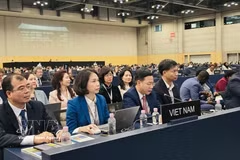
On behalf of Vietnam, the deputy minister proposed three priorities of strengthening international cooperation and capacity-building for member states, particularly developing countries; promoting science-based conservation that strikes a balance between preservation and development while placing local communities at the centre; and enhancing coordination among relevant conventions and programmes, alongside the responsible application of digital technologies and artificial intelligence in heritage conservation.
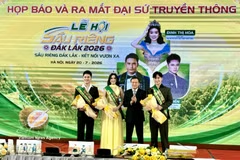
Dak Lak to hold first provincial-level durian festival next month
The event aims to promote the Dak Lak durian brand, foster sustainable development of the industry, expand markets and exports, attract investment, and showcase the province’s culture and tourism potential.
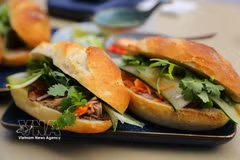
Cultural storytelling seen as key to strengthening Vietnam’s culinary brand
It is the stories behind each dish that create lasting memories, transforming a meal into a journey of cultural discovery that visitors are eager to share, an expert has said.
Vietnam attends multicultural festival in Germany as guest of honour
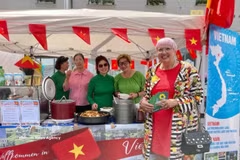
The Vietnamese booth attracted a large number of visitors with traditional dishes such as "nem cuon" (fresh spring rolls) and "bun cha" (grilled pork with vermicelli), along with displays of ao dai (traditional long dress), conical hats and cultural performances imbued with Vietnamese identity. These activities helped spread Vietnamese culture and foster understanding and closer ties between the Vietnamese community, German residents and international friends.
Resolution 80 paves way for new momentum in Vietnam’s cultural development
The initial results in heritage conservation, digital transformation, cultural industry development and artistic creativity facilitation suggest that Resolution No. 80 is gradually taking effect across the country.
Vietnamese film helps promote gratitude, pride in special Vietnam–Laos solidarity
The screening not only met the need for cultural and artistic enjoyment but also created a meaningful opportunity, especially for younger generations of both countries, to revisit their shared history, promote revolutionary traditions, and foster patriotism, said Ambassador Nguyen Minh Tam.
10th Asian Pencak Silat Championship opens in Dong Nai
Speaking at the opening ceremony, Director of the municipal Department of Culture, Sports and Tourism Le Thi Ngoc Loan said the championship offers athletes an opportunity to compete in a spirit of fairness and sportsmanship while promoting exchanges, mutual understanding and friendship among participating countries.
Khanh Hoa Sea Festival 2026 opens, promoting sustainable marine development
Having been held 10 times, the Khanh Hoa Sea Festival has evolved beyond a local celebration into an event of national significance in culture, economy and external relations. This year's edition continues to honour Vietnam's maritime cultural heritage while promoting tourism, the marine economy and international integration.
Around 7,000 athletes to compete at Sports Festival 2026
This year's festival will feature 12 sports, introducing several new events such as national youth triathlon and beach tennis championship, while expanding its international scope by bringing together clubs, athletes, and police forces from ASEAN countries for events such as the ASEAN Police Open Golf Tournament 2026.
Truong Tuoi Dong Nai FC sign Serbian midfielder Milos Vulic
Truong Tuoi Dong Nai FC have continued to make waves in the transfer market, with reports that the club has completed the signing of Serbian midfielder Milos Vulic ahead of the 2026/27 V.League 1 season.
Quang Ninh, Hai Phong strengthen governance of Ha Long Bay – Cat Ba Archipelago heritage
The UNESCO World Heritage Committee approved the extension of Ha Long Bay to include the Cat Ba Archipelago in September 2023, marking Vietnam’s first trans-provincial heritage model. The designation has created new opportunities, but also poses challenges in harmonising management across administrative boundaries.
Beyond preservation: Unlocking the value of Vietnam's heritage
Dr. Nguyen Thu Hanh, Director of the Centre for Research and Development of Vietnam Cultural Industry (SDCI), said Vietnam has traditionally focused on preserving heritage rather than creating new value from it. The key obstacle, she noted, is the weak connection between heritage and science, technology, education, design, communications and the marketplace, limiting its economic, educational and social impact despite the country's abundant cultural resources.
People-to-people, cultural connectivity forms bedrock of Vietnam–Thailand friendship
In 2025 alone, more than 1.1 million Vietnamese and Thai tourists visited each other's countries, reflecting the steadily expanding connections between the two societies.
Music tourism reshapes how Vietnamese travellers plan their trips
Rather than choosing a destination first, many travellers now plan their trips around concerts and music festivals, turning music tourism from a niche trend into a powerful driver of travel demand across Southeast Asia.
Film screening in Vientiane highlights Vietnam-Laos strategic cohesion
A screening of the special Vietnamese feature film Mua Do (Red Rain) was held in Vientiane on July 16 to mark the 49th anniversary of the signing of the Vietnam-Laos Treaty of Amity and Cooperation (July 18, 1977–2026), reaffirming the two countries' strategic cohesion through cultural exchange.
Top leader's directives chart new course for culture-led development: experts
Artists and cultural experts shared the view that the top leader's guidance at the second meeting of the Central Steering Committee for the Development of Vietnamese Culture not only reviewed the initial implementation of the Politburo's Resolution No. 80-NQ/TW but also identified four major gaps requiring urgent action and three strategic shifts to unlock the full potential of culture.
Nha Trang to host Asian sailing regatta for first time
The regatta is part of the 2026 Khanh Hoa Sea Festival and is jointly organised by the provincial Department of Culture, Sports and Tourism and Seanata Sailing Yacht and Technical Services Company.
Digital transformation in heritage should adopt people-centred approach: UNESCO
Digital transformation in the heritage sector should adopt a people-centred approach, ensuring the meaningful participation of communities at every stage-from documentation and preservation to the management, use and dissemination of cultural data. Jonathan Baker, Representative of the United Nations Educational, Scientific and Cultural Organization (UNESCO) told the Vietnam News Agency during an interview on July 8.
Pho roadshow ends European journey with Berlin finale
The initiative brought together eight leading Vietnamese chefs and culinary experts, who introduced pho and other traditional dishes at eight destinations – Prague, Warsaw, Trnava, Bratislava, Vienna, Budapest, Bochum and Berlin. Each stop celebrated a different facet of Vietnam's culinary heritage while fostering professional exchanges and discussions on the future of Vietnamese cuisine.