Top leader's directives chart new course for culture-led development: experts

Artists and cultural experts shared the view that the top leader's guidance at the second meeting of the Central Steering Committee for the Development of Vietnamese Culture not only reviewed the initial implementation of the Politburo's Resolution No. 80-NQ/TW but also identified four major gaps requiring urgent action and three strategic shifts to unlock the full potential of culture.

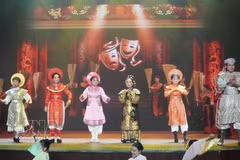
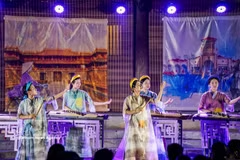
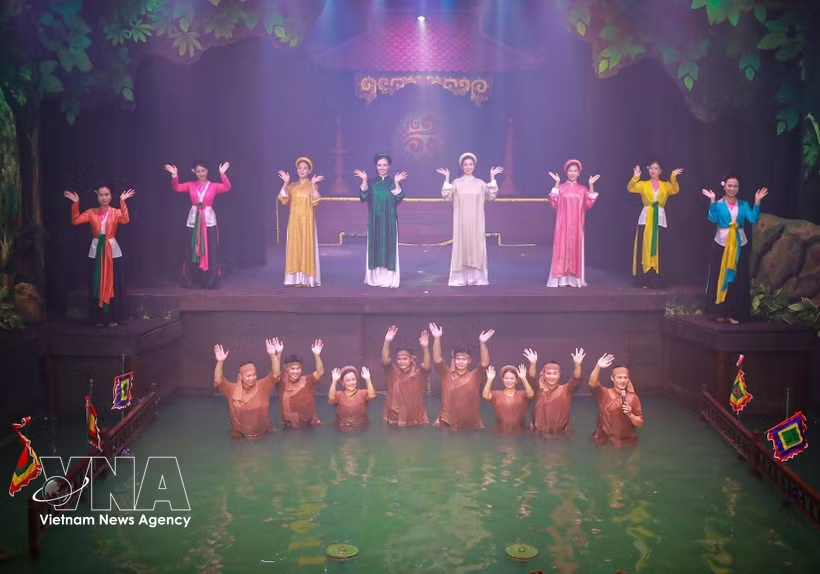
Artists from the Vietnam National Puppetry Theatre deliver emotionally compelling performances that recreate the rich historical legacy of Thang Long–Hanoi. (Photo: VNA)

​Hanoi (VNA) – Leading artists and cultural experts have described Party General Secretary and State President To Lam's recent directives on cultural development as reflecting a new development mindset, positioning culture as the nation's spiritual foundation, endogenous resource and motivation for national development in the new era.

They said the top leader's guidance at the second meeting of the Central Steering Committee for the Development of Vietnamese Culture not only reviewed the initial implementation of the Politburo's Resolution No. 80-NQ/TW but also identified four major gaps requiring urgent action and three strategic shifts to unlock the full potential of culture.

Tran Le Chien, Vice President and Secretary General of the Vietnam Classical Music Association (VCMA), said the Party General Secretary and President's view that culture is not only the spiritual foundation of society but also a source of national soft power and important impetus for sustainable development marked a fundamental shift in mindset.

According to Chien, the real strength of culture lies not in the number of heritage assets a country possesses but in its ability to transform them into competitive cultural products, economic resources and international influence.

She said the top leader had candidly pointed out the gap between Vietnam's rich cultural potential and its limited capacity to convert cultural resources into development value. In her view, the resolution should be implemented not only through action plans but also through a profound change in mindset.

Chien paid particular attention to the leader's call for a shift from managing culture to creating conditions for cultural development. She argued that culture should no longer be viewed merely as a sector dependent on State funding but as a creative ecosystem where the State, artists, businesses, communities and the public all play active roles.

“Without proactively embracing this transformation, we risk not only missing the opportunity to develop cultural industries but also losing the chance to enhance the country's soft power,” she said.

She also highlighted the importance of building a modern cultural industry ecosystem that combines heritage preservation with innovation, enabling traditional values to thrive in contemporary life. Developing cultural sovereignty in the digital space, she added, is becoming increasingly strategic as digital platforms play a growing role in shaping public perceptions and promoting national identity globally.

To achieve this, it is necessary of build a cultural ecosystem with policymakers who understand culture, artists with the aspiration to create and dedicate themselves to their work, investors who recognise the latent value of culture, and a policy framework that is open enough to enable talent to thrive, Chien said.

To ensure Resolution No. 80 delivers tangible results, Chien called for reforms in cultural institutions, resource allocation and governance, while directing more investment towards creative works, young talent and cultural promotion. She stressed that talented and innovative people remain the decisive factor in cultural development.

Sharing a similar view, Assoc. Prof. Dr. Nguyen Binh Dinh, former Director of the Vietnam National Institute of Music, said the top leader’s directives demonstrated the Party’s and State's strategic vision of culture as a driver of the country's development.

Dinh noted that cultural industries would offer significant economic potential, citing Sweden's ABBA and the Republic of Korea's K-pop industry as examples of how cultural industries can boost tourism, exports, national branding and soft power.

He also welcomed the Party and State leader's emphasis on supporting artists through training, creation and performance, notably the Government's newly issued Decree No. 261/2026/ND-CP on professional allowances and benefits for performing artists, saying the new policies have strengthened confidence among arts and cultural practitioners.

According to the experts, the top leader's directives have reinforced confidence that, with strong political commitment and comprehensive reforms, Resolution No. 80 will help culture assume its rightful role as one of the country's key pillars of the national development./.
VNA

See more

Digital transformation in heritage should adopt people-centred approach: UNESCO

Digital transformation in heritage should adopt people-centred approach: UNESCO

Digital transformation in the heritage sector should adopt a people-centred approach, ensuring the meaningful participation of communities at every stage-from documentation and preservation to the management, use and dissemination of cultural data. Jonathan Baker, Representative of the United Nations Educational, Scientific and Cultural Organization (UNESCO) told the Vietnam News Agency during an interview on July 8.

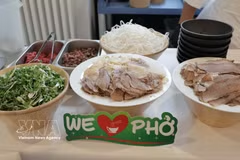
After covering more than 4,000 km across Europe, the Pho Cultural Roadshow Europe 2026 makes its final stop at Viet Pho Restaurant in Berlin. (Photo: VNA)

Pho roadshow ends European journey with Berlin finale

The initiative brought together eight leading Vietnamese chefs and culinary experts, who introduced pho and other traditional dishes at eight destinations – Prague, Warsaw, Trnava, Bratislava, Vienna, Budapest, Bochum and Berlin. Each stop celebrated a different facet of Vietnam's culinary heritage while fostering professional exchanges and discussions on the future of Vietnamese cuisine.

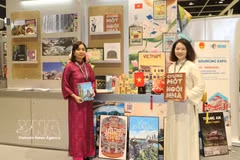
The Vietnamese Consulate General's booth at the Hong Kong Book Fair (Photo: VNA)

Vietnamese cultural heritage promoted at Hong Kong Book Fair

The booth of the Vietnamese Consulate General in Hong Kong has attracted considerable attention with a vibrant display featuring traditional conical hats painted with Vietnamese landscapes, red lanterns and large images of popular destinations such as Ha Long Bay, Sa Pa, Hue and Da Nang.

Martial arts practitioners demonstrate techniques using a flute. (Photo: VNA)

First int’l martial arts festival to debut in Hanoi

Hanoi will host its inaugural International Martial Arts Festival from August 7–9 at the Thang Long Imperial Citadel and other venues across the capital, bringing together thousands of martial arts practitioners from Vietnam and overseas.

Members of the Mong ethnic group in Cao Bang province say that embracing Protestantism and participating in local congregations has brought positive changes to their lives, fostering closer bonds and a strong sense of solidarity among followers. (Photo: VNA)

Digital transformation in religion: When religious teachings spread with a single tap

As Vietnam's digital transformation continues, technology is opening new avenues for religious communities to share their teachings more quickly, more broadly and with more diverse audiences than ever before. Yet these opportunities also bring responsibilities: safeguarding the authenticity of religious teachings, cultivating a healthy and trustworthy digital environment, and equipping religious communities with the digital literacy needed to navigate the online world responsibly.

A performance of classic "cai luong" excerpts at a 2026 competition to look for talents. (Photo: VNA)

Vietnamese culture expected to undergo sharp transformation

Drawing on Party General Secretary and State President To Lam's detailed and practical guidance, artists and researchers voiced confidence that Vietnamese culture will undergo a sharp transformation and truly become both a spiritual foundation and a key driver of sustainable development in the new era.

A working session between Deputy Minister of Culture, Sports and Tourism Ta Quang Dong (centre, right) and UNESCO representative to Vietnam Jonathan Wallace Baker (Photo: baovanhoa.vn)

UNESCO, culture ministry discuss Photography City proposal

Jonathan Wallace Baker, UNESCO representative to Vietnam, confirmed that UNESCO stands ready to work alongside the culture ministry throughout the planning and implementation of the Photography City project, helping identify effective solutions to ensure its success.

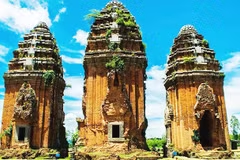
The Duong Long tower complex is a special national relic built by the Cham people in the late 12th and early 13th centuries. (Photo: nhandan.vn)

Restoration breathes new life into Southeast Asia's tallest Cham tower

After more than 800 years, the towers have suffered damage from weather, time and plant growth. In late 2025, the provincial Department of Culture, Sports and Tourism launched a restoration project worth more than 90 billion VND (3.4 million USD). Scheduled to last 10 months, the project now sees 40% of its workload completed.

A space for performing traditional Vietnamese music at the Temple of Literature. (Photo: VNA)

Art breathes new life into Vietnam's heritage spaces

In Hanoi, many historical and cultural landmarks have successfully enhanced their value through creative artistic activities. The Thang Long Imperial Citadel regularly hosts historical re-enactments, exhibitions and cultural experiences, while popular night tours at Hoa Lo Prison relic site demonstrate the effectiveness of storytelling through the combination of sound, light and performance.

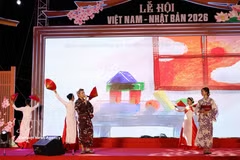
An art performance at the Vietnam-Japan Festival 2026 in Da Nang city. (Photo: VNA)

Vietnam-Japan Festival 2026 opens in Da Nang

Speaking at the opening ceremony, Vice Chairwoman of the municipal People's Committee and head of the festival's organising committee Nguyen Thi Anh Thi said that after many editions, the festival has become one of the city's signature external affairs events, helping reinforce the increasingly close partnership between Da Nang and Japanese localities and partners.

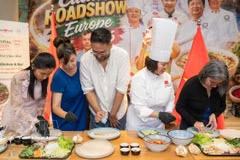
Visitors participate in a live demonstration of pho roll preparation at the event. (Photo: VNA)

Pho takes Vietnam’s flavours, identity on Europe journey

More than a food showcase, the programme combines live cooking demonstrations, cultural talks, chef-to-chef exchanges, and business networking to strengthen the global profile of Vietnamese cuisine and promote deeper international connections through gastronomy.

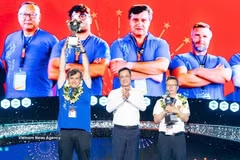
The opening ceremony of The Grand Esports 2026 on July 9 (Photo courtesy of the Sports Authority of Vietnam)

The Grand Esports 2026 opens in Hanoi

The Grand Esports 2026 officially opened in Hanoi on July 9, demonstrating that esports has entered a new stage of development and is increasingly recognised as an important part of Vietnam's national sports strategy, cultural industries and digital economy.

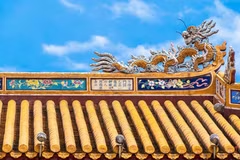
The poem inscribed on the roof ridge of Ngo Mon Gate is part of the Poetry on Hue Royal Architecture collection, which was recognised by UNESCO as documentary heritage under the Memory of the World Programme for Asia and the Pacific. (Photo: qdnd.vn)

Workforce vital to documentary heritage

The combination of a transparent legal framework, a comprehensive digitisation strategy and an internationally qualified workforce will provide a solid foundation for preserving, utilising and disseminating the value of Vietnam’s documentary heritage, enabling the nation’s collective memory to be passed on sustainably to future generations.