Vietnam charts course for regional culture, creativity hub status by 2045

The blueprint seeks to deepen international cultural integration, export Vietnamese values and absorb the essence of world cultures. The end goal is an advanced culture steeped in national identity, deployed as a soft power to fuel rapid, sustainable growth, lift Vietnam’s global standing, and add a distinct thread to the tapestry of human civilisation.

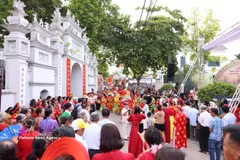
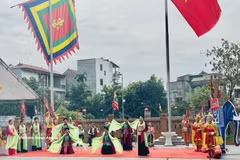
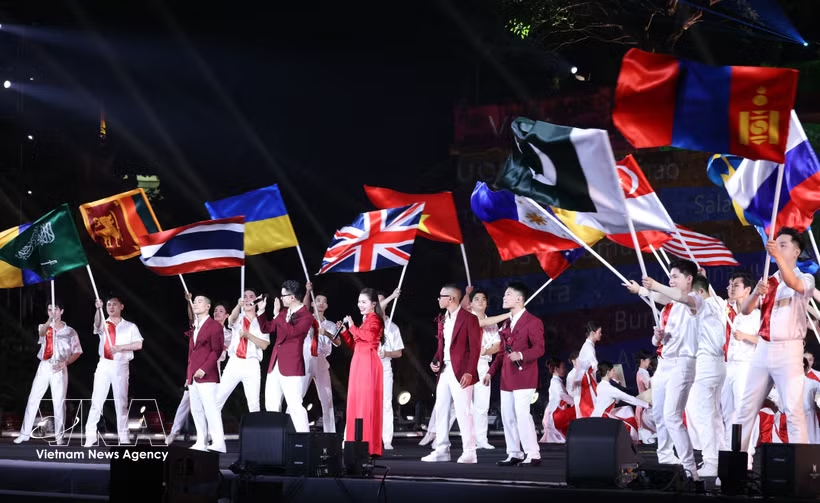
At the opening of the first-ever Cultures of the World Festival in Hanoi. (Photo: VNA)

Hanoi (VNA) - Deputy Prime Minister Pham Thi Thanh Tra has signed a decision approving Vietnam's cultural diplomacy strategy through 2030, with a vision to 2045.

The blueprint seeks to deepen international cultural integration, export Vietnamese values and absorb the essence of world cultures. The end goal is an advanced culture steeped in national identity, deployed as a soft power to fuel rapid, sustainable growth, lift Vietnam’s global standing, and add a distinct thread to the tapestry of human civilisation.

Targeting at least 10 globally competitive cultural - heritage tourism destinations

Between 2026 and 2030, Vietnam plans to expand and sharpen cultural cooperation with countries, territories, cultural bodies and creative industry corporations across the region and beyond, creating new momentum for cultural industries, particularly in film, performing arts, cultural tourism and heritage.

The strategy targets at least five prestigious international awards in culture and arts, zeroing in on music, film and literature. On top of that, it aims to launch and sustainably operate five globally branded arts festivals in key localities, turning them into must-visit cultural stops on the regional map.

Vietnam also aims to secure UNESCO recognition or similar designation for at least five more heritage elements. It plans to develop a minimum of 10 cultural and heritage tourism sites into globally competitive, nationally branded attractions, plus opening 1-3 new Vietnam cultural centres in strategic overseas locations.

2045 vision: 15 more UNESCO laurels, cultural hub status

Fast-forward to 2045, Vietnam sees itself ranking among the region’s leading cultural and creative hubs, using a booming digital economy and digital society to break through on soft power.

The country wants to cement its reputation as a heritage-rich nation with the capacity and credibility to host high-profile global and regional events, and even steer the next era’s global cultural trends.

Specific targets include bagging at least 15 more international culture, arts and creative industry awards and successfully hosting a marquee global event, whether a World Expo, a specialised expo, or a massive international sports or cultural event.

The strategy also directs Vietnam to set up at least five more cultural centres overseas in countries that are comprehensive strategic partners, in line with the Party and State’s foreign policy.
vnanet-u.jpg
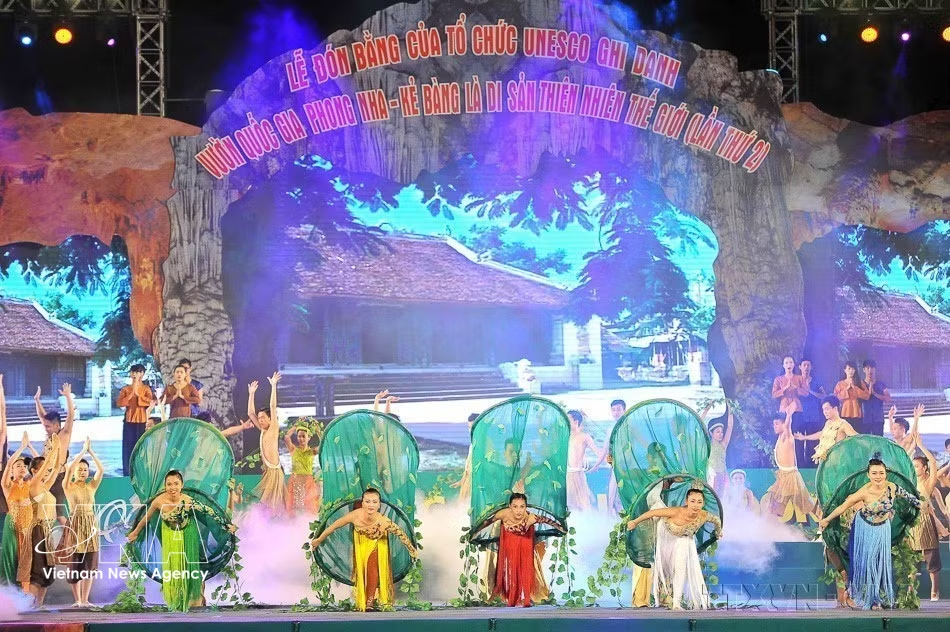
At the UNESCO certificate presentation ceremony for Phong Nha-Ke Bang's second World Natural Heritage listing. (Photo: VNA)

By the numbers, Vietnam wants another 15 heritage elements or titles recognised by UNESCO and other specialised bodies. It’s also aiming for a spot among the top three soft-power players in ASEAN and a top-30 ranking globally.

Building a cultural diplomacy talent pipeline

To deliver on these ambitions, the strategy identifies developing a highly qualified cultural diplomacy workforce, both at home and overseas, a core task.

It directs the assignment of officials in charge of cultural affairs to overseas missions based on operational needs and local conditions, while strictly adhering to the Party’s and State’s policy of streamlining the apparatus without new agencies or extra headcount.

A phased rollout will send cultural counsellors or attachés to diplomatic missions in strategic partner countries, starting with comprehensive strategic partners by 2030 and extending to all strategic partners and above by 2045.

Vietnam will proactively recruit, train and sharpen cultural diplomacy personnel at central and local levels, equipping them with fluency in both Vietnamese and global cultures. Priority goes to negotiation skills, international law and intellectual property, event production, multimedia communications, digital cultural governance, and hands-on mastery of modern tech, with artificial intelligence, big data, virtual and augmented reality included.

The strategy also pushes to place capable Vietnamese professionals inside international and regional cultural bodies.

Before students, researchers, workers and experts head abroad, they’ll now get beefed-up training in national history, culture and communications. The broader mission is to lift aesthetic education, political awareness and national cultural pride among young people, forging a generation of global citizens who can handle the heat of integration and globalisation.

Pushing Vietnam’s cultural brand to every corner of the planet

The whole strategy demands renewed mindset, sharper operations and a diversified push to project Vietnam’s cultural brand worldwide.

Top priority goes to pumping more creativity and quality into cultural diplomacy during overseas trips by senior Vietnamese Party and State leaders, and inbound visits by foreign counterparts.

Vietnam will overhaul its culture weeks and culture days abroad, team up with host countries for more joint performances, pull in bigger audiences and amplify mass media coverage. Wherever it fits, traditional sports, martial arts and folk games that show off Vietnamese identity will be woven into promotions.

The country plans to muscle its way into more major international cultural and art events, including blockbuster exhibitions, A-list film festivals, high-profile art shows, long-established book fairs, thematic cultural events, cultural promotion activities, alongside major international economic and political gatherings.

Finally, Vietnam will step up sports diplomacy by hosting and actively competing in major international competitions and continental and regional multi-sport events, while showcasing the country’s traditional sports and performing arts through exchanges, festivals, fairs and exhibitions./.
VNA

See more

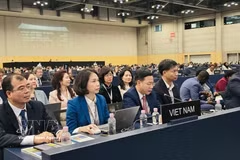
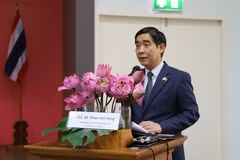
Deputy Minister of Foreign Affairs Ngo Le Van, Chairman of the Vietnam National Commission for UNESCO, speaks at plenary session of the 48th session of the UNESCO World Heritage Committee in Busan on July 20, 2026. (Photo: VNA)

Vietnam proposes priorities to strengthen international cooperation on world heritage conservation

On behalf of Vietnam, the deputy minister proposed three priorities of strengthening international cooperation and capacity-building for member states, particularly developing countries; promoting science-based conservation that strikes a balance between preservation and development while placing local communities at the centre; and enhancing coordination among relevant conventions and programmes, alongside the responsible application of digital technologies and artificial intelligence in heritage conservation.

Claudia Roth, a member of the German Bundestag, visits the Vietnamese booth at the festival. (Photo: VNA)

Vietnam attends multicultural festival in Germany as guest of honour

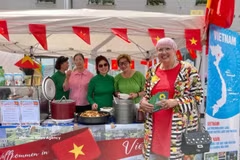
The Vietnamese booth attracted a large number of visitors with traditional dishes such as "nem cuon" (fresh spring rolls) and "bun cha" (grilled pork with vermicelli), along with displays of ao dai (traditional long dress), conical hats and cultural performances imbued with Vietnamese identity. These activities helped spread Vietnamese culture and foster understanding and closer ties between the Vietnamese community, German residents and international friends.

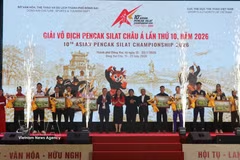
Representatives of countries and territories participating in the Asian Pencak Silat Championship. Photo: VNA)

10th Asian Pencak Silat Championship opens in Dong Nai

Speaking at the opening ceremony, Director of the municipal Department of Culture, Sports and Tourism Le Thi Ngoc Loan said the championship offers athletes an opportunity to compete in a spirit of fairness and sportsmanship while promoting exchanges, mutual understanding and friendship among participating countries.

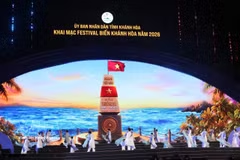
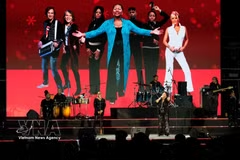
A special art performance at the Khanh Hoa Sea Festival 2026 (Photo: VNA)

Khanh Hoa Sea Festival 2026 opens, promoting sustainable marine development

Having been held 10 times, the Khanh Hoa Sea Festival has evolved beyond a local celebration into an event of national significance in culture, economy and external relations. This year's edition continues to honour Vietnam's maritime cultural heritage while promoting tourism, the marine economy and international integration.

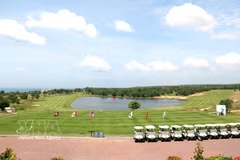
The golf course at NovaWorld Phan Thiet will host international tournaments during Sports Festival 2026. (Photo: VNA)

Around 7,000 athletes to compete at Sports Festival 2026

This year's festival will feature 12 sports, introducing several new events such as national youth triathlon and beach tennis championship, while expanding its international scope by bringing together clubs, athletes, and police forces from ASEAN countries for events such as the ASEAN Police Open Golf Tournament 2026.

A performance of Cheo Tau folk singing, a distinctive cultural tradition of O Dien commune in Hanoi. (Photo: VNA)

Beyond preservation: Unlocking the value of Vietnam's heritage

Dr. Nguyen Thu Hanh, Director of the Centre for Research and Development of Vietnam Cultural Industry (SDCI), said Vietnam has traditionally focused on preserving heritage rather than creating new value from it. The key obstacle, she noted, is the weak connection between heritage and science, technology, education, design, communications and the marketplace, limiting its economic, educational and social impact despite the country's abundant cultural resources.

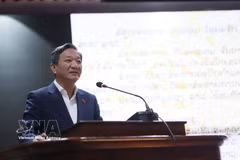
Vietnamese Ambassador to Laos Nguyen Minh Tam speaks at the event. (Photo: VNA)

Film screening in Vientiane highlights Vietnam-Laos strategic cohesion

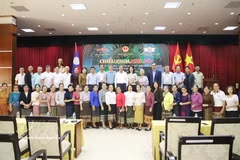
A screening of the special Vietnamese feature film Mua Do (Red Rain) was held in Vientiane on July 16 to mark the 49th anniversary of the signing of the Vietnam-Laos Treaty of Amity and Cooperation (July 18, 1977–2026), reaffirming the two countries' strategic cohesion through cultural exchange.

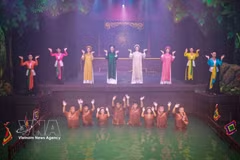
Artists from the Vietnam National Puppetry Theatre deliver emotionally compelling performances that recreate the rich historical legacy of Thang Long–Hanoi. (Photo: VNA)

Top leader's directives chart new course for culture-led development: experts

Artists and cultural experts shared the view that the top leader's guidance at the second meeting of the Central Steering Committee for the Development of Vietnamese Culture not only reviewed the initial implementation of the Politburo's Resolution No. 80-NQ/TW but also identified four major gaps requiring urgent action and three strategic shifts to unlock the full potential of culture.

Digital transformation in heritage should adopt people-centred approach: UNESCO

Digital transformation in heritage should adopt people-centred approach: UNESCO

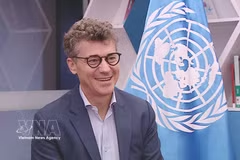
Digital transformation in the heritage sector should adopt a people-centred approach, ensuring the meaningful participation of communities at every stage-from documentation and preservation to the management, use and dissemination of cultural data. Jonathan Baker, Representative of the United Nations Educational, Scientific and Cultural Organization (UNESCO) told the Vietnam News Agency during an interview on July 8.

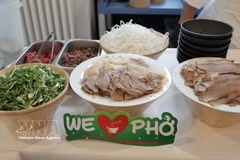
After covering more than 4,000 km across Europe, the Pho Cultural Roadshow Europe 2026 makes its final stop at Viet Pho Restaurant in Berlin. (Photo: VNA)

Pho roadshow ends European journey with Berlin finale

The initiative brought together eight leading Vietnamese chefs and culinary experts, who introduced pho and other traditional dishes at eight destinations – Prague, Warsaw, Trnava, Bratislava, Vienna, Budapest, Bochum and Berlin. Each stop celebrated a different facet of Vietnam's culinary heritage while fostering professional exchanges and discussions on the future of Vietnamese cuisine.