Hanoi (VNA) – Vietnam must strengthen its ability to counter increasingly sophisticated "cognitive warfare" campaigns that exploit artificial intelligence and social media to undermine public trust, social cohesion and internal unity, experts have said, calling for faster official communications, stronger digital capabilities and a more proactive approach to safeguarding the Party's ideological foundation.
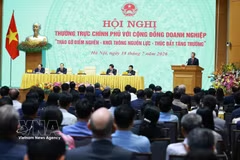
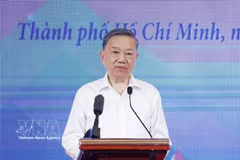
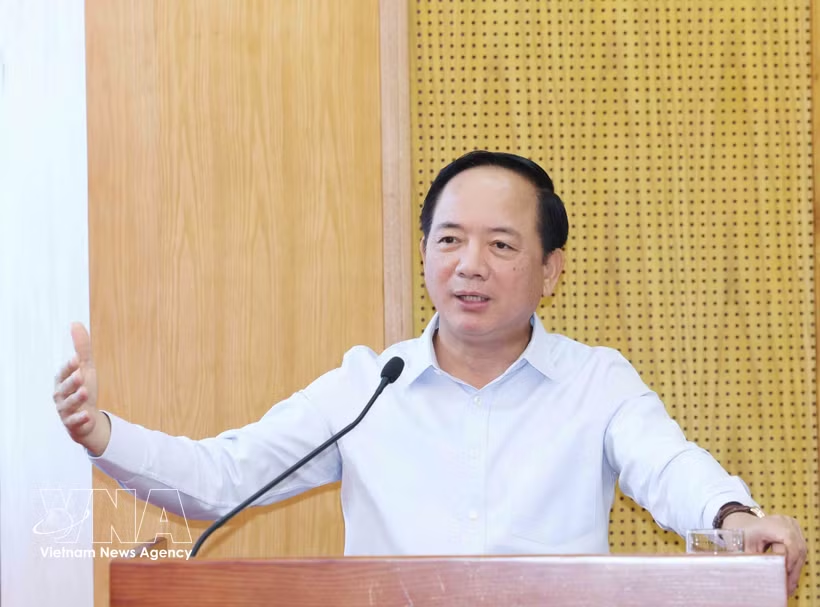
Speaking at a recent conference reviewing information, education and mass mobilisation work in the first half of 2026, Politburo member, Secretary of the Party Central Committee and Chairman of the Party Central Committee's Commission for Information, Education and Mass Mobilisation Trinh Van Quyet said hostile forces are increasingly using AI and digital platforms to wage cognitive warfare targeting the ideological foundation, public confidence and internal unity.
He stressed that the challenge requires continuous innovation in both methods and capabilities.
A new battleground
Associate Prof. Dr Le Thi Thanh Ha, Deputy Director of the Institute of Philosophy under the Ho Chi Minh National Academy of Politics, described cognitive warfare as a form of conflict fought through smartphones, social media, short videos and disinformation rather than conventional weapons.
She said AI, social media algorithms and big data are being used to amplify false information and create an "illusion of truth" through repeated exposure, while increasingly sophisticated tactics extend into culture, education, film and music.
Ha urged Vietnam to develop domestic AI-based monitoring tools, big-data analytics systems and early warning capabilities to detect fake news and coordinated influence campaigns, while training specialists who understand both the defensive and offensive uses of AI.
Associate Prof. Dr Nguyen Thi Thu Ha, Dean of the Faculty of Interdisciplinary Studies, Foreign Languages and Informatics at the National Academy of Public Administration and Governance, said cognitive warfare differs from traditional communications by directly targeting individual perceptions, emotions and behaviour through highly personalised content generated with AI, big data and social media algorithms.
She identified five priority areas for strengthening national resilience - enhancing early warning capability, expanding technological capacity, developing interdisciplinary expertise, improving public resilience against disinformation, and modernising policy communications so that official information is faster, more engaging and more accessible.
The expert argued that protecting the Party's ideological foundation requires not only refuting false information but also proactively providing timely, accurate and transparent information that builds public trust through dialogue and tangible development achievements
From defence to proactive engagement
The experts said the rapid evolution of cognitive warfare means traditional approaches are no longer sufficient.
Thanh Ha called for a shift from reactive defence to proactive engagement by anticipating sensitive issues, preparing authoritative content in advance and adopting multidisciplinary approaches that combine political science, digital technology, psychology and communications.
She also proposed building interdisciplinary teams comprising political officials, journalists, technology experts and social scientists, while expanding collaboration among the Party's Steering Committee 35, media organisations, technology companies and trusted online communities.
On the regulatory front, she recommended legal frameworks that encourage innovation while managing risks, including regulatory sandboxes for emerging technologies, greater support for AI, cybersecurity and big-data enterprises, and stronger standards for data protection and digital security.
Thu Ha similarly argued that the focus should shift from simply responding to false information to creating and leading a trusted information ecosystem.
"When official information becomes the fastest, most reliable and most accessible source for the public, distorted allegations will naturally lose their influence," she said.
Thu Ha also called for a comprehensive legal framework governing AI and data, with clear rules on developer responsibilities, oversight of high-risk AI applications, transparency for AI-generated content and stronger safeguards for personal data and privacy.
The experts held that public trust ultimately depends on the Party's effective leadership, sound governance and visible development outcomes. In the digital era, safeguarding the Party's ideological foundation means not only countering disinformation but also building a rich, credible and compelling information environment that reinforces confidence through Vietnam's achievements, they elaborated./.