Party Central Committee’s third meeting opens in Hanoi

The session is to discuss important issues in implementing the 14th National Party Congress’s Resolution, along with items covering Party building, political system and national development in the new stage.

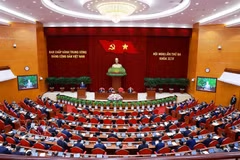
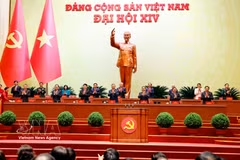
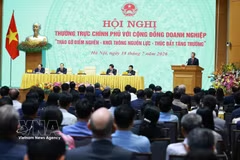
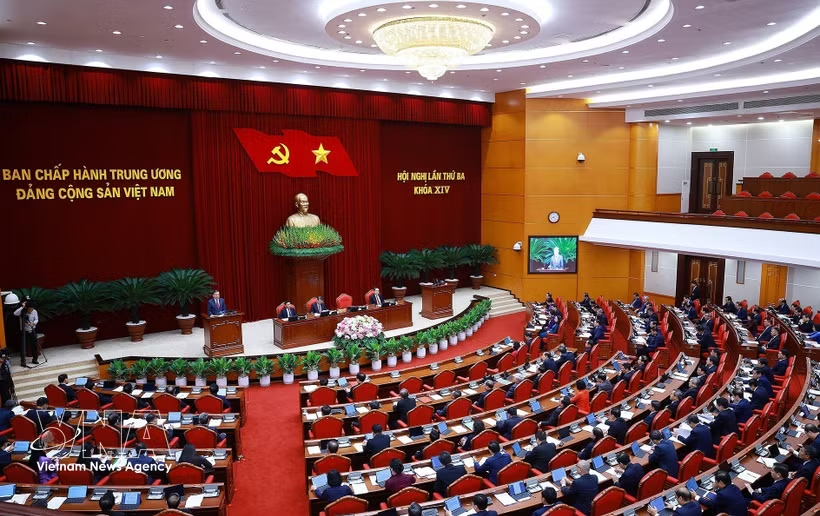
The third meeting of the 14th Party Central Committee opens in Hanoi on July 20. (Photo: VNA)

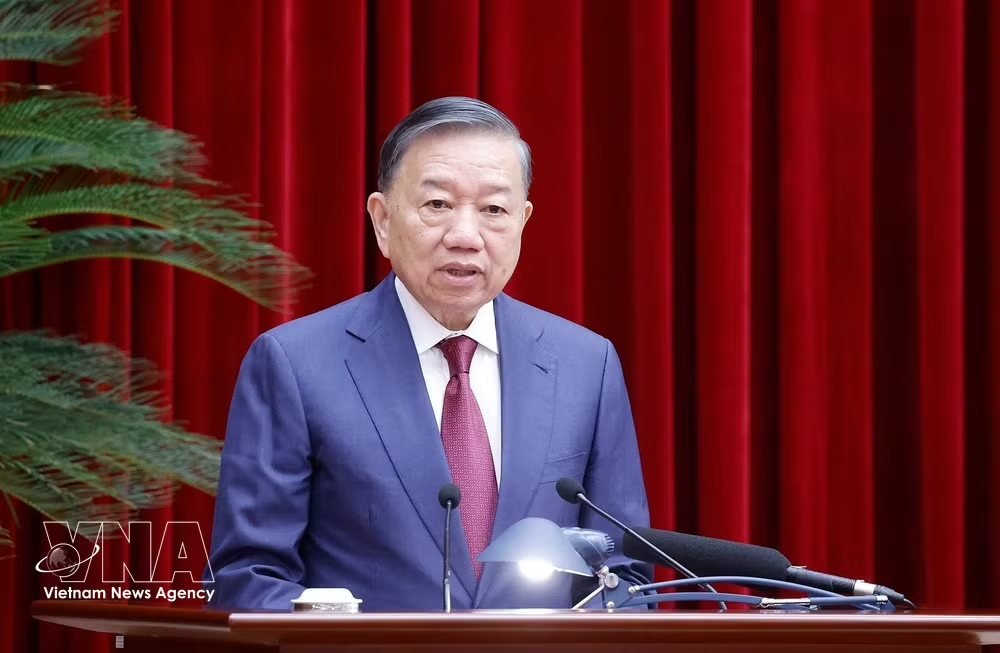
Hanoi (VNA) – The third meeting of the 14th Party Central Committee opened in Hanoi on July 20, under the chair of Party General Secretary and State President To Lam.

The session is to discuss important issues in implementing the 14th National Party Congress’s Resolution, along with items covering Party building, political system and national development in the new stage.

Opening the meeting, General Secretary and State President Lam said the 14th National Party Congress set the country's strategic directions, targets and major orientations, while the second meeting established the organisational framework for the new term. The third meeting must translate those orientations into concrete decisions that remove bottlenecks, unlock resources and create new development momentum, he stressed.

The Party Central Committee is reviewing 13 issues with the aim of strengthening leadership, governance, implementation capacity and national development and defence in the new period, he noted.

The top leader said the decisions adopted at the meeting should deliver four strategic shifts - enhancing the leadership and governance capacity of the Party and State apparatus; establishing unified governance of development space and national resources; advancing a development model driven by productivity, knowledge, technology and people; and strengthening prevention, resilience and national security. He urged delegates to assess how each policy removes bottlenecks, creates new capacity and ensures effective implementation.

The Party and State leader highlighted four priorities for discussion. The first is moving beyond organisational restructuring to improving the quality of Party leadership, State governance and public service delivery. He stressed that a leaner apparatus is only the starting point, with success measured by better policy outcomes, stronger implementation and higher public trust.

The Party Central Committee will also review reports on the one-year operation of the new political system model and the two-tier local administration system, as well as proposals to establish centrally governed cities of Quang Ninh and Bac Ninh as new regional growth poles.
vnanet-potal-khai-mac-hoi-nghi-lan-thu-ba-ban-chap-hanh-trung-uong-dang-khoa-xiv-8898983-1.jpg
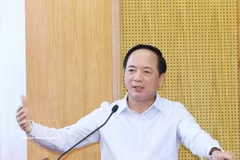
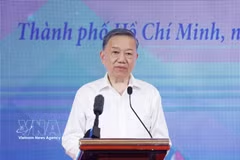
Party General Secretary and State President To Lam addresses the opening of the 14th Party Central Committee’s third meeting. (Photo: VNA)

The second priority focuses on shifting from fragmented management to integrated governance of national development space and resources. Discussions will cover revisions to the Land Law and related laws, the implementation of Party resolutions on land management and maritime-based development, and policies to unlock resources while protecting legitimate rights and preventing speculation, waste and group interests.

The third priority is transitioning from growth driven mainly by expanding inputs to one based on productivity, knowledge, technology and human capital. General Secretary and State President Lam said the six-month socio-economic development report and the proposed new national development model must together answer the question: how will the country create wealth and competitiveness in the long term.

The leader also described the proposal to build a disciplined, safe, civilised and harmonious society as the foundation and goal of the country’s development model, with people at its centre and the rule of law as its foundation.

The fourth priority calls for moving from responding to individual risks towards strengthening national resilience and preventive capacity. The General Secretary and State President said Vietnam must improve strategic forecasting, safeguard critical political, economic and technological systems, and integrate environmental protection and climate resilience into national security and development planning.

He stressed that the four strategic shifts form a unified framework in which organisation and human factors help strengthen implementation capacity, institution and development spaces unlock resources, a new development model generates productivity and higher living standards, and stronger resilience and protective measures ensure continuous and sustainable progress.

General Secretary and State President Lam urged the Party Central Committee's members to engage in focused and substantive discussions, with clear recommendations and practical solutions. He emphasised that all decisions must put national interests, the legitimate rights of the people and the country's long-term development first.

He also called for all resolutions and conclusions adopted at the meeting to be translated immediately into action plans with clearly defined objectives, responsibilities, resources, timelines and expected outcomes, while eliminating delays in institutionalising Party policies and improving implementation.

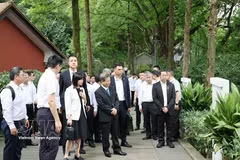
Before the opening session, members of the Party Central Committee laid a wreath in tribute to President Ho Chi Minh at the late leader's mausoleum and paid homage to fallen heroes at the Martyrs' Memorial on Bac Son street.

The third meeting of the 14th Party Central Committee is scheduled to conclude on July 24./.
VNA

See more

President of the National Assembly Tran Thanh Man (right) and Alberto Anaya Gutierrez, General Secretary of the Mexican Labour Party (PT), at their meeting in Hanoi on August 17 (Photo: VNA)

Vietnam, Mexico to enhance exchange of legislative experience

Vietnam and Mexico will strengthen coordination and enhance delegation exchanges between the Vietnamese National Assembly and the Mexican Senate and Chamber of Deputies, while sharing experience in lawmaking and parliamentary activities among committees and promoting the role of the two parliamentary friendship groups.

A view of the fifth session of the National Assembly Standing Committee (Photo: VNA)

NA Standing Committee reviews three revised draft laws

The National Assembly (NA) Standing Committee continued its fifth session on August 17, scrutinising three draft laws concerning administrative procedures, telecommunications, radio frequencies and architecture.

Minister of Justice Hoang Thanh Tung speaks at the discussion (Photo: VNA)

NA Standing Committee reviews draft Law on Urban Development

Speaking at the session, NA President Tran Thanh Man noted that the draft Law on Urban Development was initially designed for Ho Chi Minh City before its scope was expanded to other cities and additional provisions were incorporated. Given the tight timeframe and substantial workload, the NA will make its utmost effort to consider and adopt the contents as scheduled.

A traditional Indian candle-lighting ceremony opens the gathering. (Photo: VNA)

People-to-people diplomacy deepens Vietnam-India ties

Building on this foundation, the city has strengthened ties with Indian localities. In May, Ho Chi Minh City and Mumbai signed a memorandum of understanding on friendship and cooperation, opening up greater opportunities for collaboration in finance, technology, logistics, urban development, innovation, culture, cinema, tourism and people-to-people exchanges.

General Secretary of the Communist Party of Vietnam Central Committee and President To Lam addreses the opening ceremony of the first class of a knowledge update and training programme for members of the 14th Party Central Committee in Hanoi on August 17 (Photo: VNA)

Top leader attends opening of knowledge update programme for 14th Party Central Committee members

General Secretary and President Lam stressed that the programme is being held in the first year of implementing the Resolution of the 14th National Party Congress, which set out the goals and tasks for the entire tenure. The Party Central Committee has adopted measures to remove bottlenecks and unlock resources. The decisive task now is to ensure effective implementation by turning policies into feasible programmes, coordinated action and concrete results, thereby translating the Party's will into national development and a better life for the people.

The delegation meets with progressive friends in the US (Photo: VNA)

Vietnam, US strengthen cooperation to ease suffering of AO/dioxin victims

A delegation from the Vietnam Association for Victims of Agent Orange/dioxin's chapter in Ho Chi Minh City (VAVA HCMC) visited the US directly inform American friends about the long-term consequences of AO/dioxin in Vietnam and seek the support of progressive groups, veterans, legal experts and youth organisations in efforts to care for the victims.

Vietnamese leaders send congratulations to Congo on 66th National Day

Vietnamese leaders send congratulations to Congo on 66th National Day

General Secretary of the Communist Party of Vietnam Central Committee and President To Lam on August 15 sent a congratulatory message to President of the Congolese Party of Labour and President Denis Sassou Nguesso on the occasion of the 66th National Day of the Republic of Congo (August 15, 1960–2026).

A house is damaged after the earthquake in Flores, Indonesia, on August 15. (Photo: Xinhua/VNA)

Vietnamese leaders send condolences over deadly earthquake in Indonesia

General Secretary of the Communist Party of Vietnam Central Committee and President To Lam and Prime Minister Le Minh Hung on August 15 sent messages of condolences to Indonesian President Prabowo Subianto following a powerful earthquake in Indonesia that caused heavy casualties and affected thousands of families.

Participants at the event (Photo: VNA)

ASEAN, Western Australia strengthen connection

Representatives of ASEAN member states highlighted the historic significance of ASEAN Day in reaffirming the bloc's foundational values and promoting solidarity, dialogue, cooperation and consensus in support of regional peace, stability and prosperity.