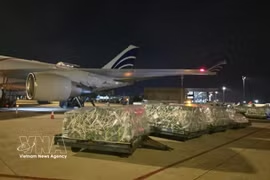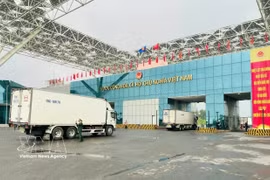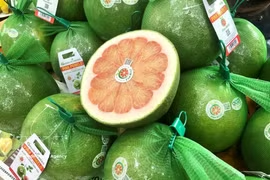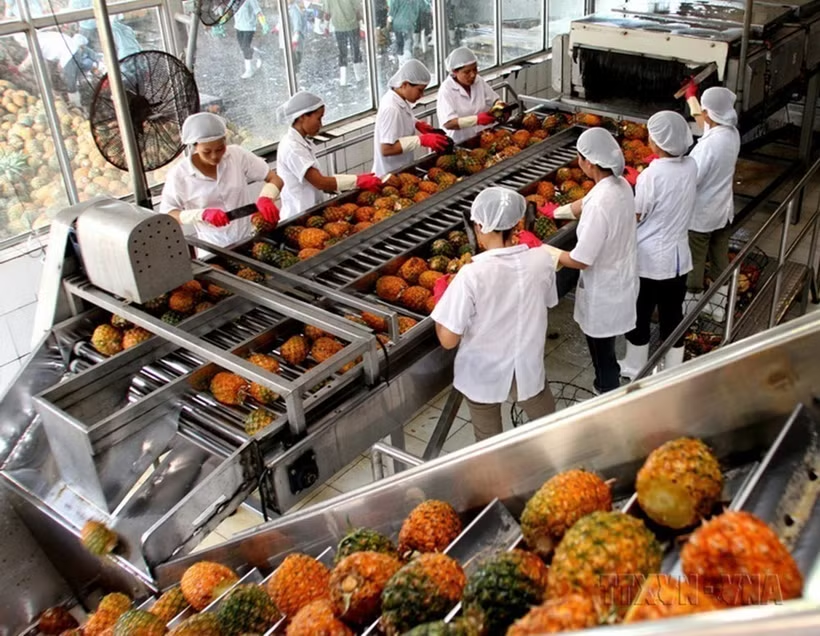
Hanoi (VNA) – Although Vietnam's agricultural product exports to the Middle East slowed in the first half of 2026 amid geopolitical tensions, the region continued to be viewed as a strategic market thanks to robust import demand, strong consumption potential and preferential access under free trade agreements (FTAs).
According to Truong Xuan Trung, who is in charge of the Vietnam Trade Office in the United Arab Emirates (UAE), Vietnam's exports to the UAE fell sharply in the first six months of 2026 compared with the same period last year.
Exports of fruits and vegetables were estimated at nearly 35 million USD, down 41.88% year-on-year, while cashew nut shipments totalled more than 25.1 million USD, down 70.71%. Pepper exports reached nearly 6.2 million USD, a decline of 50.16%, and seafood exports were valued at around 16.1 million USD, down 33.88%.
Trung attributed the decline largely to short-term factors, noting that the UAE produces only around 10–15% of its domestic food requirements and relies heavily on imports. As a result, he said, the market still offers significant opportunities for Vietnamese agricultural exporters.
Israel is also emerging as a promising destination for Vietnamese farm produce.
Le Thai Hoa, Trade Counsellor at the Vietnam Trade Office in Israel, said many of Vietnam's leading agricultural products align well with Israel's import demand, particularly food, beverages and agricultural raw materials for both consumption and processing.
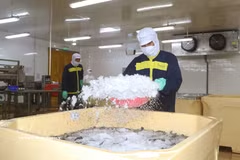
Vietnamese seafood currently accounts for around 11–13% of Israel's seafood imports and still has considerable room for expansion. It is also among the few export categories to post positive growth in the first months of 2026.
Beyond rising consumer demand, FTAs are giving Vietnamese products a stronger competitive edge across the Middle East.
The Vietnam–UAE Comprehensive Economic Partnership Agreement (CEPA), which entered into force on February 3, 2026, is expected to create new opportunities for Vietnamese agricultural product exporters.
Under the agreement, the UAE has liberalised 94.9% of its tariff lines, with 74.2% eliminated immediately upon implementation. Key Vietnamese exports, including seafood, cashew nuts, pepper, timber and wood products, benefit from either immediate or short-term tariff reductions.
Meanwhile, the Vietnam–Israel Free Trade Agreement (VIFTA), which became effective on November 17, 2024, has further improved market access. In 2025, Vietnam's major exports to Israel, including seafood, cashew nuts and coffee, all recorded healthy growth.
Experts recommended exporters to fully comply with technical standards, certification requirements and market regulations to maximise the benefits of these trade agreements.
Le Viet Anh, Secretary General of the Vietnam Pepper and Spice Association (VPSA), said the Middle East is among the world's largest spice-consuming regions. The UAE serves not only as a promising export market but also as a major logistics hub connecting the Middle East with Africa, Central Asia and South Asia, providing Vietnamese products with access to a much broader regional market.
Vietnam is one of the world's leading suppliers of pepper, cinnamon and star anise. In the Middle East, Vietnamese pepper and cinnamon account around 60% and 50% of the market shares, respectively.
However, exporters face mounting challenges as requirements for Halal certification, product traceability and sustainability become increasingly stringent.
At the same time, higher logistics costs and growing competition from suppliers in Brazil, Indonesia and China are pushing Vietnamese businesses to improve product quality, invest in value-added processing and strengthen brand development.
Vu Minh Tam, Head of the General Policy Division under the Ministry of Industry and Trade's Agency of Foreign Trade, said businesses should proactively review product classifications, ensure compliance with rules of origin from the product design stage, integrate both Halal and Kosher standards into production, adopt market-specific strategies and make better use of trade promotion programmes.
He also called on authorities to continue improving the national Halal regulatory framework, promote awareness of commitments under CEPA and VIFTA, enhance logistics support and expand bilateral dialogue on sanitary and phytosanitary (SPS) measures.
With geopolitical uncertainties expected to persist, experts said Vietnam must strengthen exporters' capacity to meet international standards while optimising logistics and distribution networks to safeguard its position in the Middle East.
These efforts will help deepen the presence of Vietnamese agricultural brands across one of the world's most dynamic and promising markets, they added./.