HSBC: Vietnam’s growth, macroeconomic stability to face tougher test in H2

In a recently released report, Vu Binh Minh, CFA, Associate Director, FX Trading, Markets and Securities Services at HSBC Vietnam, said Vietnam’s economy has built a relatively favourable position in the first six months of the year with GDP expanding 8.18% – the highest first-half growth rate in recent years – as key growth drivers have operated in tandem.

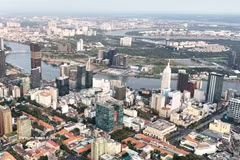
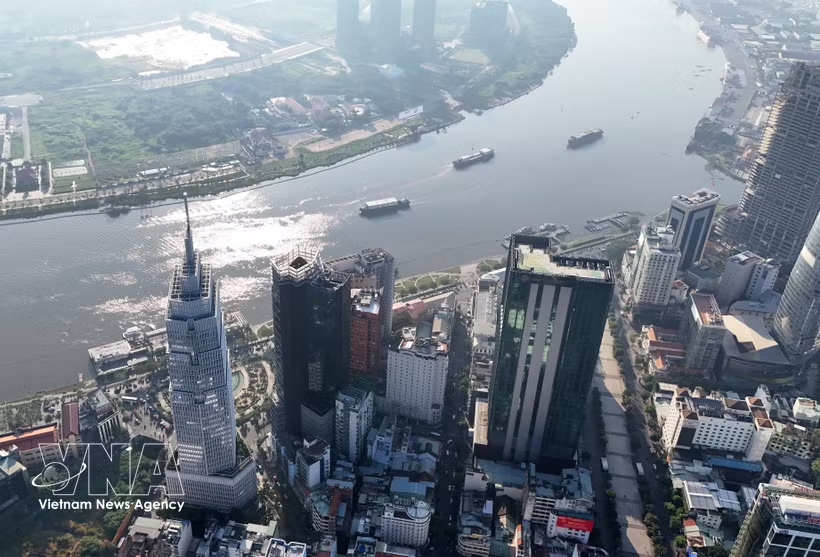
A view of financial buildings in downtown Ho Chi Minh City along the Saigon River. (Photo: VNA)

Ho Chi Minh City (VNA) - After strong growth in the first half of 2026, Vietnam’s economy is forecast to face greater pressure in the months ahead as rising inflation, exchange-rate and interest-rate pressures test its ability to sustain growth and maintain macroeconomic stability.

In a recently released report, Vu Binh Minh, CFA, Associate Director, FX Trading, Markets and Securities Services at HSBC Vietnam, said Vietnam’s economy has built a relatively favourable position in the first six months of the year with GDP expanding 8.18% – the highest first-half growth rate in recent years – as key growth drivers have operated in tandem.

Industrial production, exports, domestic consumption and public investment continued to serve as key pillars, while foreign direct investment (FDI) inflows maintained positive momentum.

Notably, registered FDI reached 34.65 billion USD in the reviewed period, up 61% year-on-year, while disbursed capital totaled 13.03 billion USD, the highest level in five years.

Foreign investors’ capital contributions and share purchases rose by nearly 90%, reflecting confidence in Vietnam’s medium- and long-term prospects and the deepening shift in global supply chains.

However, the rapid pace of growth has also made macroeconomic balances more sensitive. When policy buffers are not as ample as before, policymakers are likely to face greater pressure in the second half as many variables come into play at the same time, the report said.
vnanet-hsbc2.jpg
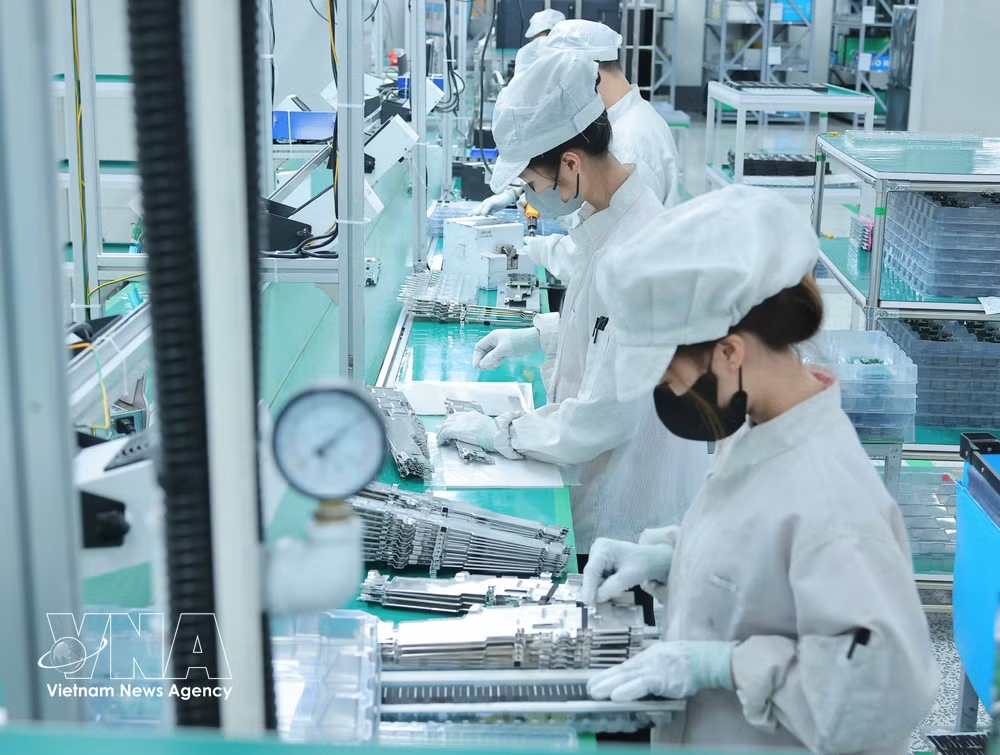
FDI enterprises have invested more than 2 billion USD in industrial parks and economic zones in Quang Ninh province. (Photo: VNA)

One of the key indicators to watch is the trade balance. Vietnam recorded a goods trade deficit of around 16.65 billion USD in the Jan – June period, reversing from a surplus in the same period last year.

According to the expert, most of the rise in imports was concentrated on machinery, equipment and raw materials - categories that support investment and production. In that sense, the current deficit appears to be more about preparing productive capacity for the next phase and is somewhat different in nature from a consumption-driven deficit.

In an economy where production still depends heavily on imported inputs, when imports rise faster than exports, pressure on the external balance and the exchange rate may emerge sooner, the report noted.

Inflation is another variable requiring close monitoring. The average CPI in the first half rose by 4.38%, fairly close to the roughly 4.5% target set by the National Assembly.

HSBC said inflation has been accelerating, especially in the final two months of the second quarter against a backdrop of sharply higher energy prices driven by geopolitical tensions, persistently elevated imported input costs, and some spillover to food prices from global price moves.

The positive point is that six-month core inflation rose 4.12%, still below headline CPI, suggesting price pressures have not yet broadened into a widespread spiral. Even so, the risk of inflation remains something to watch, especially domestic demand is also recovering more strongly.

The exchange rate and interest rates remain key variables for policymakers, with rising foreign-currency demand putting pressure on the Vietnamese dong from late in the first quarter. Proactive measures by the State Bank of Vietnam helped stabilise foreign-currency supply, liquidity and market expectations. At the same time, high interbank and deposit rates reflected strong credit demand, slower deposit mobilisation and the need to maintain a reasonable VND/USD interest-rate differential to support exchange-rate stability.

These developments are a relatively natural consequence of a rapidly growing economy with limited room for further monetary policy easing, and will be among the key factors shaping economic management in the second half.

However, the outlook for the second half is not without positive factors. Seasonal trends could provide additional support towards year-end as exports enter their peak delivery season, tourism and remittance inflows typically improve, and domestic supply conditions may better support price stability.

Another notable driver is the planned upgrading of Vietnam’s stock market. Minh said if the process remains on track in the coming months, its impact would go beyond improving market sentiment to broadening the investor pool able to access Vietnam, improve liquidity, enhance the quality of capital inflows, and strengthen the standing of Vietnamese assets in the global market.

Over the medium and long term, more stable foreign capital inflows could also help generate a more durable supply of foreign currency, potentially easing exchange-rate pressures and creating additional room for policy management, he added.

According to the expert, strong first-half growth has created a favourable foundation for the whole of 2026. However, performance in the remaining months will depend increasingly on the ability to balance growth with macroeconomic stability. Public investment, high-quality FDI and the stock market upgrading process are expected to serve as structural drivers, helping strengthen the foundation for sustainable economic growth./.
VNA

See more

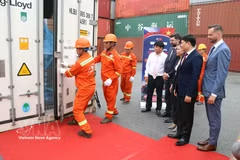
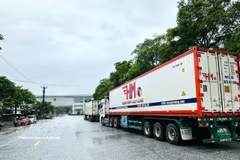
Representatives of relevant parties witness the arrival of the shipment. (Photo: VNA)

First Czech pork shipment officially enters Vietnamese market

A Czech diplomat described the arrival of the first container as the successful outcome of a long and complex market-opening process involving years of negotiations, regulatory approvals and close cooperation between Czech and Vietnamese authorities.

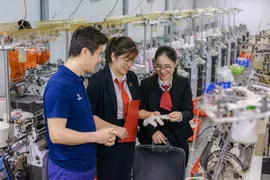
Ha Tay Shoes has secured numerous export orders from the US and European markets. (Photo: VNA)

CPTPP strengthens free trade, expands global economic connectivity

Since taking effect, the CPTPP has significantly expanded Vietnam's access to major markets across North America, the EU, and the Asia-Pacific, contributing to strong export growth in key sectors such as textiles and garments, footwear, and agricultural, forestry and fishery products. The agreement has also encouraged greater investment into Vietnam by promoting regional production networks and clearer rules of origin.

Tan Mingming, Deputy Director of the Foreign Affairs Office of the Dezhou Municipal People’s Government. (Photo: VNA)

Chinese firms put Vietnam on expansion radar

Tan Mingming, Deputy Director of the Foreign Affairs Office of the Dezhou Municipal People’s Government, told Vietnam News Agency reporters that the city has spent years deliberately tightening its links with the Association of Southeast Asian Nations (ASEAN), with Vietnam seen as a key partner.

A perspective of the Viettel Military Industry and Telecoms Group's high-tech semiconductor chip manufacturing plant at Hoa Lac Hi-Tech Park. (Photo: Viettel)

Hanoi builds momentum as Vietnam's semiconductor hub

As Hanoi continues to strengthen its semiconductor ecosystem, the city is creating a new growth driver for both the capital and the country, enhancing Vietnam's technological capabilities and paving the way for deeper integration into the global semiconductor value chain.

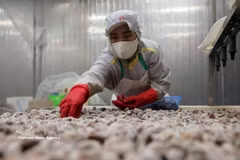
Clams are processed for export at the factory of Thanh Hoa Seafood Import-Export JSC in Thanh Hoa province. (Photo: VNA)

Vietnam steps up export to achieve 550-billion-USD target

Against a backdrop of persistent uncertainty in global commerce, the Government is implementing a broad range of measures to strengthen export growth during the remainder of the year. These include expanding overseas markets through economic diplomacy, maximising the benefits of free trade agreements (FTAs), streamlining administrative procedures, reducing logistics costs, improving access to credit and helping businesses overcome trade barriers. Authorities are also encouraging deeper processing, official cross-border exports and greater market diversification to improve the competitiveness of Vietnamese products.

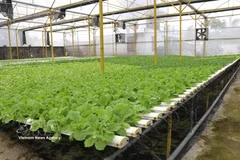
A hydroponic vegetable garden in Nguyet Hoa ward operated by Green Farm Co., Ltd. (Photo: VNA)

Incentive policies for high-tech agricultural zones

Under Decree No. 263/2026/ND-CP, qualified projects are given priority to participate in State support programmes as well as funds and policies on research and development, technological innovation, technology transfer, human resource training, investment promotion and trade promotion.

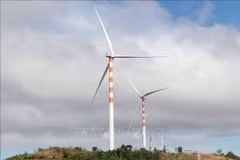
Wind turbines stand fully installed at a wind power project in Gia Lai province. (Photo: VNA)

Gia Lai approves 56-million-USD wind power project

The 42MW wind farm is expected to generate about 123,780.8 MWh of electricity each year. Power generated will be transmitted to the national grid via the 220kV Pleiku 2–Krong Buk transmission line.

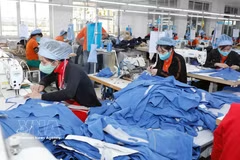
Garments for export to the Japanese market are produced at Hung Viet Garment Company in Hung Yen province. (Photo: VNA)

Vietnam’s garment sector pivots towards value-added growth

Future growth can no longer rely on expanding production capacity alone. Meeting this year's 48 billion USD export target will require greater productivity, higher value addition, stronger domestic sourcing, broader market diversification, and faster digital and green transformation.

Trucks carrying goods wait for customs clearance at the Thanh Thuy International Border Gate in Tuyen Quang province. (Photo: VNA)

Border economy strengthens Tuyen Quang’s growth momentum

While the stronger performance provides momentum for the province's 2026 growth target of 10.17%, officials say the focus must now shift from increasing cargo volumes to expanding services, reducing costs and retaining more value locally.

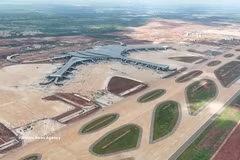
Construction of several key components of Long Thanh International Airport is entering its final stages. (Photo: VNA)

Major works at Long Thanh International Airport gather pace towards completion

The ACV said on July 20 that contractors are deploying additional workers and equipment to speed up construction under Component Project 3, which covers the airport's essential aviation infrastructure. Major facilities, including the first and second runways, taxiways, aircraft aprons, the passenger terminal apron and the aircraft fuel supply system, are approaching completion.