Vietnam better positioned in trade thanks to AI boom: HSBC

Thanks to the AI boom, tech-exposed economies like Vietnam, Singapore, and Malaysia are better positioned in trade, according to a recent report by HSBC.

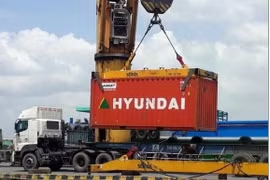
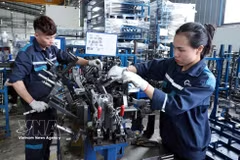
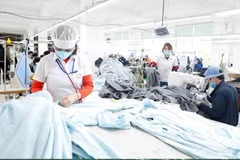
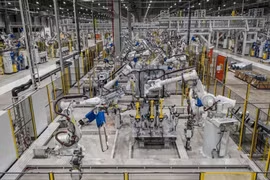
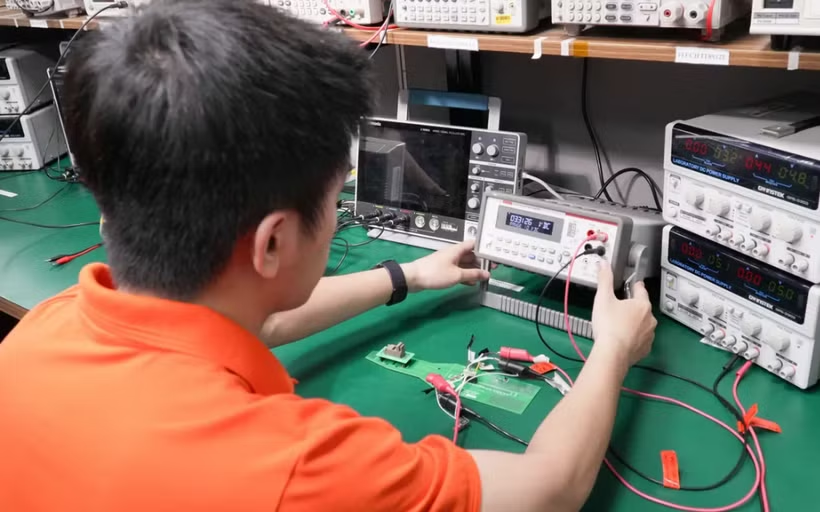
Vietnam is a bright spot in the global electronics supply chain. (Photo: VietnamPlus)

Hanoi (VNA) - Thanks to the AI boom, tech-exposed economies like Vietnam, Singapore, and Malaysia are better positioned in trade, according to a recent report by HSBC.

In its report titled “ASEAN Perspectives: Whoever gets the chips rules the trade,” HSBC Global Investment Research said the Middle East conflict is an acute reminder of how sensitive fast-growing ASEAN is to high energy costs given its reliance on energy imports.

While it is important not to overlook high energy costs, it is also vital not to be distracted by near-term energy volatility and return to ASEAN’s growth fundamentals. One key pocket of resilience is ASEAN’s central position in the global tech supply chain, enabling the regional economies to ride the AI wave. Unsurprisingly, the 2025 regional growth outperformers all have heavy exposure to the tech industry, the research shows.

But not everyone benefits to the same extent. Singapore is in the best position to capture the AI boom, given its prominence in the high-end memory chip space. The next big beneficiary is Malaysia, with its electronics powerhouse in Penang, which has grown its market share in logic chips like processor and amplifier chips.

Vietnam has taken a different path, growing impressively in the consumer electronics segment, but also with an ambition to climb up the value chain further.

Recent US-China trade tensions have pushed the region to embed further into the global tech supply chain, strengthening their positions in this strategic sector.

But not everyone benefits to the same extent: those economies with an extensive tech supply chain are riding on the tech wave. Electronics exports in Malaysia and Vietnam, measured as a percentage of GDP, highlight the weight of tech exports in their respective economies. Elsewhere, electronics non-oil domestic exports (NODX), despite only accounting for 8% of Singapore’s GDP, also benefits the Lion City for related sectors like precision engineering and wholesale trade services.

​The tech beneficiaries – Vietnam, Malaysia and Singapore – stood out in their 2025 GDP performances. While it is not all driven by trade (their domestic resilience cannot be underestimated), the AI-driven tech upcycle has nonetheless been supportive. Growth in all of them in 2025 well exceeded their respective average in the past decade.

When Singapore and Malaysia are leading ASEAN in their semiconductor exports, Vietnam is choosing a different path: it has elevated its importance in final electronics assembly, specialising in finished consumer electronics, thanks to supply chain diversification from tech MNCs like Samsung.

Vietnam’s share of consumer electronics, including smartphone, printers and computers, has seen a notable jump from almost none to 8-15% in 15 years. Besides consumer electronics, Vietnam also strives to climb up the value chain, targeting the IC segment. However, unlike Singapore and Malaysia, it has seen a dwindling share of global processor chips, despite billions of dollars of investment from Intel.

Despite the positive outlook, HSBC experts noted that economies such as Vietnam also face considerable risks.

If high energy prices persist for long, the second-round effect is likely to ultimately affect AI-driven tech demand. In addition, the fate of potential tariffs on semiconductors continues to be the region’s Sword of Damocles, leaving a risk that tech-exposed economies could become the victims of their own success.
See more

Coffee, often referred to as the “brown gem” of Lam Dong, is one of the province’s signature agricultural products. (Photo: VNA)

Lam Dong reshapes coffee industry to elevate export value

Lam Dong plans to strengthen branding and trade promotion efforts, develop coffee-growing regions linked to geographical indications, expand digital traceability systems and make greater use of free trade agreements (FTAs) to diversify export markets.

Cargo handling operations at Berths 3 and 4 of the Hai Phong International Gateway Port. (Photo: VNA)

AI reshapes logistics, raising bar for workforce skills

According to the Vietnam Logistics Business Association (VLA), the logistics sector will require around 2.2 million workers by 2030, including 1.6 million employees for logistics service providers and nearly 600,000 personnel supporting logistics operations in manufacturing and trading enterprises.

The site planned for the Ninh Thuan 1 nuclear power plant in Phuoc Dinh commune of Khanh Hoa province (Photo: VNA)

Nuclear power projects to transform Khanh Hoa coastal communities

Khanh Hoa province aims to hand over fully cleared sites to investors by June 30, 2026. For Ninh Thuan 1, both the plant site and the resettlement zone are scheduled for completion by June 30. For Ninh Thuan 2, the plant site is due on June 15, with the resettlement area following by June 30.

Professor Tao Yitao, Director of the China Centre for Special Economic Zone Research (Photo: VNA)

Stable beginnings, powerful breakthroughs for Vietnam’s private economic sector

Vietnam is now at a critical juncture in pursuing what its leadership has described as a new era of national rise. In the long term, the development of the private economic sector will depend not only on supportive policies but also on a stable, transparent institutional environment that guarantees fair competition, said Professor Tao Yitao, Director of the China Centre for Special Economic Zone Research.

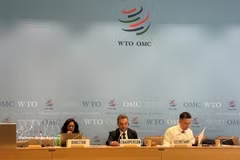
The trade policy review of Uruguay at the WTO headquarters. (Photo: VNA)

Vietnam participates in WTO review of Uruguay's trade policy

Vietnam also welcomed Uruguay's active engagement in the multilateral trading system as a founding member of the WTO. Uruguay has ratified the Agreement on Fisheries Subsidies, joined the Multi-Party Interim Appeal Arbitration Arrangement (MPIA), and contributed to Joint Statement Initiatives (JSIs) on e-commerce and micro, small and medium-sized enterprises (MSMEs).

Experts discuss cooperation opportunities in Vietnam-Germany manufacturing value chains at the forum. (Photo: VNA)

Vietnam-Germany cooperation creates new opportunities for sustainable manufacturing

Germany is an important partner of Vietnam and a global leader in green technology, smart manufacturing, automation and circular economy solutions. The combination of German technological expertise and Vietnam's manufacturing capabilities and strong commitment to transformation would create significant opportunities in green production, supporting industries, digital transformation, supply chain management and eco-industrial park development.

Businesses introduce Halal market products at the workshop. (Photo: VNA)

Da Nang businesses eye growth in booming global Halal market

Huynh Xuan Son, Deputy Director of the Da Nang Department of Industry and Trade, said the Halal market has emerged as a strategic destination for Vietnamese exporters amid persistent global economic uncertainties. Serving more than two billion consumers across over 110 countries and territories, the market offers significant opportunities for business expansion.

Vietnamese bananas are sold at an AEON supermarket in Japan. (Photo: VNA)

Vietnamese products promoted at AEON stores across Japan

Speaking at the opening ceremony, Deputy Minister of Industry and Trade Phan Thi Thang highlighted the significance of 2026, which marks a decade of cooperation between the ministry and AEON in organising Vietnam Week in Japan.