Vietnam’s branded residence segment poised for long-term potential

Branded residences are playing an increasingly prominent role in Vietnam’s premium property market, according to Savills Hotels.

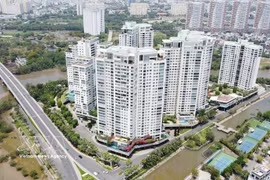
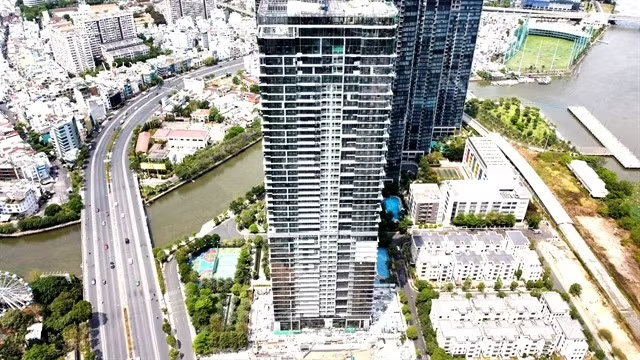
Grand Marina Saigon, an international-standard branded residence by Marriott (Photo: VNA)

Ho Chi Minh City (VNS/VNA) – Branded residences are playing an increasingly prominent role in Vietnam’s premium property market, according to Savills Hotels.

An increasing number of branded residence developments are being launched in partnership with international hospitality operators, including Marriott International, IHG, and Hyatt.

These projects account for 60% of the future development pipeline, compared with just 28% of existing branded residence supply.

This shift highlights the growing influence of global operators within the sector and reflects changing development patterns, with new projects increasingly concentrated in major urban markets such as Ho Chi Minh City, Hanoi, and Da Nang rather than traditional resort destinations.

Alongside established hospitality developers, several local residential developers are also considering branded residences as a new approach to the premium segment.

The market is expected to add 40 branded residence projects to its planning and development pipeline, underscoring the sector’s growing momentum and long-term potential, said Mauro Gasparotti, Senior Director at Savills Hotels Southeast Asia.

While location and capital appreciation were once the primary considerations for buyers, today’s affluent purchasers are placing greater emphasis on amenities, brand affiliation, lifestyle experience and service standards.

This shift reflects the growing maturity of Vietnam’s real estate market and is positioning the country as a leading destination for luxury real estate investment in Asia Pacific’s next growth cycle.

Compared with Thailand, Vietnam’s branded residence market remains at a relatively early stage of development.

However, several structural factors are supporting the sector’s long-term potential, including the expansion of the country’s affluent and ultra-high-net-worth population, the continued recovery of international tourism, and ongoing investment in transport infrastructure.

The market is expected to see a growing number of developments launched in partnership with international brands, particularly across major urban centres and established resort destinations.

At the same time, pricing within the segment is increasingly reflecting the value of brand affiliation, professional management, and service standards.

“Ultra-luxury real estate is no longer defined solely by location, design, or price, but by its ability to preserve wealth, support global mobility, and deliver a highly curated lifestyle,” Gasparotti said.

“Branded residences continue to command premiums through stronger service standards, brand trust, and operational quality, while wellness real estate is increasingly becoming a core value driver.”

In some cases, meaningful wellness integration can support higher added value compared with comparable projects, reinforcing the view that the next generation of luxury projects must seamlessly combine hospitality, wellness, design, services, and global credibility into one complete living experience, he said.

The branded residence market is evolving beyond its traditional hospitality roots, as luxury brands increasingly expand into residential real estate.

Through involvement in design direction, materials selection, finishing specifications, and resident services, lifestyle brands help create distinctive living environments that resonate with affluent buyers seeking both exclusivity and brand-driven experiences./.

VNA

See more

International buyers explore Vietnamese products at Vietnam International Sourcing 2025. (Photo: VNA)

Global buyers turn to Ho Chi Minh City for sourcing

The growing number of international retailers and importers choosing Ho Chi Minh City as a sourcing destination underscores the city's transformation from a trade promotion venue into a regional procurement hub.

An export-oriented apparel factory of the Hung Viet Garment Joint Stock Company (Photo: VNA)

PM’s conclusions set to clear bottlenecks, spur corporate growth

The PM called on the business community, business associations and the Vietnam Chamber of Commerce and Industry (VCCI) to strengthen self-reliance, innovation and competitiveness by improving governance, adopting advanced technologies, enhancing product quality and using capital more efficiently.

According to the State Bank of Vietnam (SBV)’s Region 2 Branch, remittances transferred through credit institutions and economic organisations total 2.03 billion USD in the second quarter, up 1.4% from the first quarter but down 27.9% from the same period last year. (Illustrative photo: VNA)

Remittances to Ho Chi Minh City down 23% in H1

According to the State Bank of Vietnam (SBV)’s Region 2 Branch, remittances transferred through credit institutions and economic organisations totalled 2.03 billion USD in the second quarter, up 1.4% from the first quarter but down 27.9% from the same period last year.

The dialogue and business networking forum between CPTPP senior officials and business leaders is held in Ho Chi Minh City on July 22, as part of the 2026 CPTPP Senior Officials' Meeting (SOM3) hosted by Vietnam. (Photo: VNA)

Public-private dialogue unlocks CPTPP potential

The CPTPP has evolved beyond tariff reductions into a broad framework covering goods, services, investment and digital trade. Its success, however, ultimately depends on businesses' ability to turn commitments into new investment, stronger supply chains and innovative business models.

Tourists on Nha Trang beach in Khanh Hoa province (Photo: VNA)

Promoting integrated governance to advance sea-based economy

Khanh Hoa has positioned itself as the renewable energy industrial and service hub for the south-central and southern regions. Its economic development strategy identifies four key growth drivers, all built on the foundation of the marine economy.

An overview of the seminar entitled "Opportunities and challenges for market development in Turkish market" (Photo: Ministry of Industry and Trade)

Türkiye offers export potential for Vietnamese food producers: seminar

Türkiye’s target of lifting total exports of goods and services to more than 400 billion USD in 2026 could create additional opportunities for Vietnamese agricultural products, food and beverages, said Ta Manh Cuong, director of the Trade and Investment Promotion Support Centre.

SSC Vice Chairman Bui Hoang Hai speaks at the opening of the programme on July 21. (Photo: VNA)

Vietnam boosts crypto market oversight capabilities

Diederik Van Wersch, Chainalysis' ASEAN Regional Director, noted that Vietnam has a high level of crypto asset adoption, offering significant opportunities for innovation while creating greater demands for oversight and risk management.

Vietnam Railways has introduced a range of tourism, heritage and dedicated train services, attracting growing numbers of passengers. (Photo: VNA)

Railways reinvent themselves with tourism, heritage trains

One of the most notable successes is the premium Hoa Phuong Do (Flamboyant Flower) train operating between Hanoi and Hai Phong city. Since entering service in May 2025, the train has completed nearly 3,000 trips and carried around 1.33 million passengers.

Representatives of relevant parties witness the arrival of the shipment. (Photo: VNA)

First Czech pork shipment officially enters Vietnamese market

A Czech diplomat described the arrival of the first container as the successful outcome of a long and complex market-opening process involving years of negotiations, regulatory approvals and close cooperation between Czech and Vietnamese authorities.