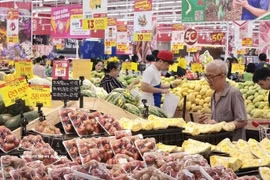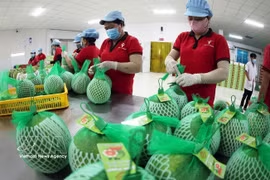
Durian remains king of Vietnam’s fruit exports

Durian remains the sector’s biggest growth driver, accounting for an estimated 35-40% of total fruit and vegetable export revenue so far this year and as much as 55-60% in July.

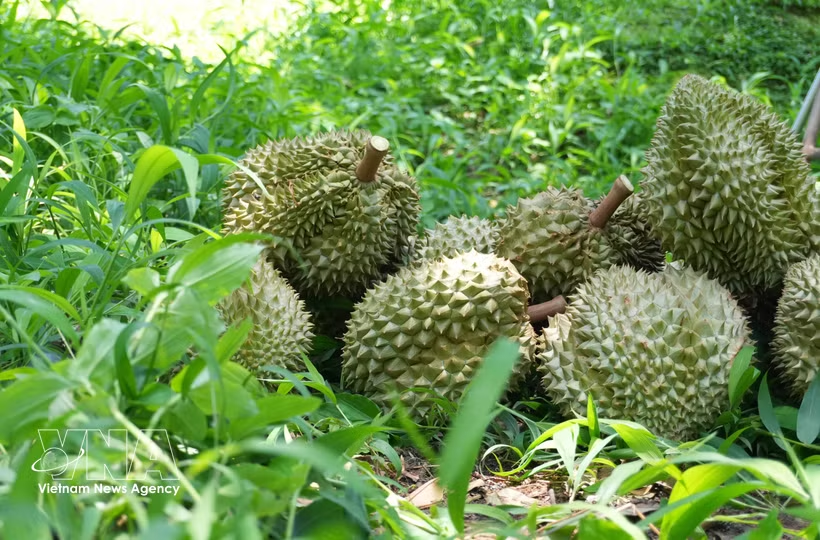
Lam Dong durians are known for their consistent quality and are primarily grown for export. (Photo: VNA)

Hanoi (VNA) – Despite lingering challenges, durian remains the leading contributor to Vietnam’s fruit and vegetable export revenue, with shipments expected to pick up in the coming months as competition from other regional suppliers eases.

According to the Vietnam Fruit and Vegetable Association, the country’s fruit and vegetable exports were estimated at 4.76 billion USD in the first seven months of 2026, up 23% year on year. Export turnover in July alone exceeded 1 billion USD.

Dang Phuc Nguyen, General Secretary of the association, said durian remains the sector’s biggest growth driver, accounting for an estimated 35-40% of total fruit and vegetable export revenue so far this year and as much as 55-60% in July.

Nguyen said that provided product quality remains stable, Vietnamese durian exports are likely to gain momentum in the coming months as competition in the market declines.

Thailand’s main durian harvest typically runs from March to July, with similar seasons in Cambodia, Laos and Malaysia. In contrast, Vietnam’s Central Highlands harvest lasts from July to October, with output expected to rise significantly from last year.

The timing could give Vietnamese exporters a competitive advantage, particularly in China, the key destination for the fruit. Historically, Vietnam’s durian exports have also tended to surge in the third quarter.

Vietnamese businesses are already preparing to increase purchases of fresh durian for export as supplies from competing countries, particularly Thailand, decline in the Chinese market.

Meanwhile, exporters are increasingly turning to processing and freezing as another way to boost the value of durian exports, particularly when fresh fruit prices fall.

Frozen durian is expanding beyond China into markets including the Republic of Korea, Japan and the US. According to Nguyen, Vietnam’s frozen durian export volume in 2025 was 20 times higher than in 2023.

In the first quarter of 2026 alone, frozen durian exports reached nearly 11,600 tonnes, with an average price of around 4,302 USD per tonne, up more than 20% year on year.

Industry experts estimate that, under favourable conditions, Vietnam could export around 1 million tonnes of durian this year. The higher volume could help sustain overall export revenue despite prices being considerably lower than in recent years./.

VNA
See more

Delegates at the meeting between Vietnamese businesses operating in Cambodia and the Council for the Development of Cambodia (CDC) on September 14. (Photo: VNA)

Vietnamese businesses seek to expand investment in Cambodia

Vietnam currently has 223 investment projects in Cambodia with total registered capital of nearly 3.4 billion USD. Vietnamese companies operate in agriculture, particularly large-scale farming, finance and banking, telecommunications, aviation, processing, trade and services.

Children visit President Ho Chi Minh's hometown and learn about his childhood. (Photo: VNA)

Vietnam's tourism sector faces labour shortage

A 2026 survey by Hoteljob.vn found that nearly 90% of tourism businesses planned to recruit. In Ho Chi Minh City alone, 89.7% of businesses were hiring, while 71.8% said recruitment was difficult or very difficult. The biggest shortages were among frontline workers, particularly in housekeeping, engineering, food service, front-office operations, and kitchens.

Octopus processing for export at Huy Nam Company in An Giang province. (Photo: VNA)

New opportunities for Vietnam’s seafood exports

The Vietnam-EFTA Free Trade Agreement brings together two groups of highly complementary economies. EFTA members Switzerland, Norway, Iceland and Liechtenstein have strengths in technology, innovation, finance, clean energy and sustainable development, while Vietnam is one of Asia’s most dynamic economies and is emerging as a major regional manufacturing, trade and investment hub.

The saponin content of Lai Chau ginseng can reach as high as 23.85% in its natural state, a remarkably high level compared to many other ginseng species. (Photo: baolaichau.vn)

Lai Chau ginseng development gains momentum

Blessed with rare and distinctive ecological values, the northern mountainous province of Lai Chau is stepping up efforts to conserve and develop its native ginseng, with the medicinal plant expected to play a growing role in the forest-based economy and local livelihoods.

The Vietnamese delegation poses for a group photo at the third meeting of the Vietnam-Canada Joint Economic Committee (Photo: VNA)

Vietnam, Canada broaden economic cooperation beyond trade

Vietnam is currently Canada’s largest trading partner in ASEAN. Building on the Comprehensive and Progressive Agreement for Trans-Pacific Partnership (CPTPP), the two countries are expanding bilateral economic ties into higher value-added areas such as clean energy, critical minerals, advanced technology, manufacturing and value-chain linkages.

The Index of Industrial Production (IIP) rises 14.4% in August and 11.9% in the first eight months compared to a year earlier. (Photo: VNA)

More momentum needed for economic growth in year-end race

To build momentum for the year-end race, one of the top priorities is to accelerate public investment disbursement, ensuring 100% of the allocated plan is disbursed without allowing funds to be concentrated in the final months of the year.

Vietnamese enterprises showcase products at the Vietnam Pavilion during the Foodist Istanbul 2026 fair. (Photo: Vietrade)

Vietnamese goods gain export opportunities in Türkiye, Spain

Vietrade said the programme helped businesses gain practical market information, identify potential products and partners, and better understand requirements on quality, pricing and distribution. Such direct connections are expected to help companies adapt their products and develop more effective export strategies.