London (VNA) – Vietnam should resist spreading itself too thin as global technology supply chains splinter and instead double down on segments where it holds a genuine competitive edge, Dr. Ho Quoc Tuan, senior lecturer at the UK’s University of Bristol, told the Vietnam News Agency (VNA).
The country’s current talent pool gives it a strong footing to scale up software services, information technology and drone-related industries, Tuan said.
A young army of software engineers, competitive labour costs and deep mathematical skills have already made Vietnam a magnet for IT outsourcing, he said. Companies like FPT Software and VNG have proved they can compete in international markets. These sectors demand relatively modest infrastructure spending while putting existing human capital to work.
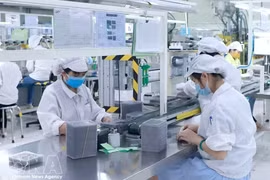
Vietnam also has room to pull in investment in electronic device assembly as well as commercial and civilian drones. The footprint of heavyweights Samsung, LG and Intel could anchor a stronger domestic supplier ecosystem, he added.
According to him, Vietnam can also carve out a place in selected stages of the semiconductor value chain through well-targeted foreign direct investment.
Rather than sinking tens of billions of US dollars into cutting-edge fabrication plants that take years to pay off, Vietnam should prioritise fabless chip design, outsourced semiconductor assembly and test, and printed circuit board manufacturing. Intel’s assembly and test facility in Ho Chi Minh City already validates that model, he noted.
He flagged technology-enabled elderly healthcare services as another promising growth lane as rapid aging across Asia-Pacific fuels surging demand for telehealth, assistive technologies and AI-powered diagnostics.
Vietnam could combine its cost advantage with imported technologies and international partnerships to build competitive healthcare services for regional markets, he said.
With a 100 million-strong domestic market, Vietnam also has a distinct edge in building digital service platforms in e-commerce, fintech, online education and smart logistics, which can create jobs and serve as a bedrock for homegrown innovation, Tuan said.
On how the State should back tech enterprises, Tuan said the focus should be on creating a constructive environment rather than acting as the lead investor in large-scale tech projects.
Public resources should flow into infrastructure, logistics, broadband connectivity and power supply, along with better legal and regulatory frameworks and lower compliance costs for firms. Those are the levers that attract private investment and FDI on a sustainable basis, he said.
He added that public funding should also prioritise social welfare to cushion economic shocks and provide seed capital for essential infrastructure, helping the economy ride out cyclical downturns in key industries.
If state budget is used to support tech enterprises, Tuan said it must be allocated through open and competitive bidding, not steered toward state-owned enterprises. Payouts should be tied to verifiable performance milestones rather than line-by-line spending plans, and recipients should be required to put up a minimum amount of their own capital to ensure only those with real commercial commitment win public backing./.