Growing-area data emerges as key to boosting Vietnam's coffee export value

Experts say verified coffee-growing data is key to helping Vietnamese exporters meet sustainability requirements, secure market access and increase export value.

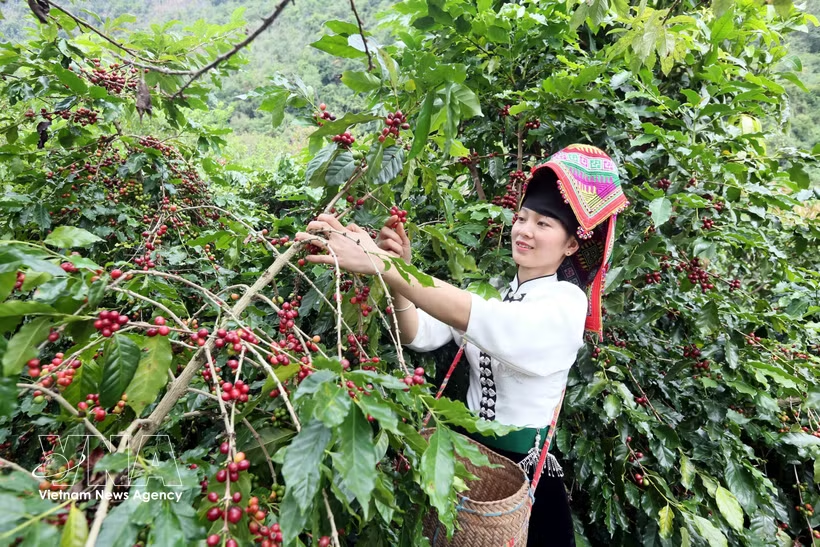
Harvesting coffee in the northern province of Son La. (Photo: VNA)

Hanoi (VNA) – As global coffee markets place growing emphasis on sustainability and traceability, experts say verified data on coffee-growing areas is becoming a critical competitive advantage for Vietnamese exporters, helping them secure market access, strengthen price negotiations and enhance the value of the country's coffee.

Although Vietnam's coffee exports continue to post solid shipment volumes, exporters are facing mounting pressure from lower global prices, tighter supply and increasingly stringent import regulations.

According to the Customs Department, Vietnam exported around 1.1 million tonnes of coffee worth nearly 4.8 billion USD in the first half of 2026. Export volume rose by 7-10% year-on-year, but export value declined by more than 14% as average prices fell.

The figures underscore a growing reality that higher output alone is no longer enough to increase export earnings. Instead, exporters are being required to demonstrate sustainable production practices and transparent supply chains to maintain access to premium markets.

The European Union (EU), which accounts for more than 40% of Vietnam's coffee export value, will fully enforce its Deforestation Regulation (EUDR) from January 1, 2027, following a transition period ending later this year.

Under the regulation, every coffee shipment entering the EU must be traceable to individual plots of land and prove it is not linked to deforestation. As a result, verified growing-area data is increasingly viewed as a "passport" for Vietnamese coffee to enter high-value markets.

Competitive advantage is shifting from production scale and processing capacity to the quality and reliability of production data.
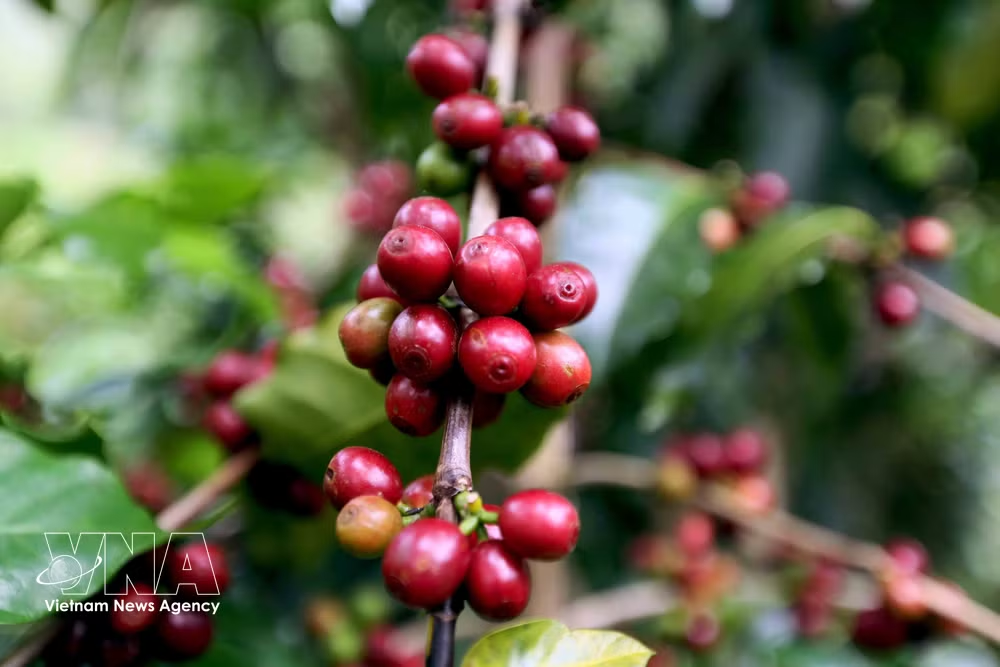
vnanet-potal-ca-phe-son-la-duoc-mua-duoc-gia-nong-dan-phan-khoi-8431668.jpg
Coffee exporters are being required to demonstrate sustainable production practices and transparent supply chains to maintain access to premium markets. (Photo: VNA)

Nestlé Vietnam is among the companies investing heavily in digital mapping through its Nescafé Plan programme. According to Pham Phu Ngoc, Head of Agriculture and the Nescafé Plan in Vietnam, the company expects to complete the collection of more than 40,000 farm polygons – digital map coordinates that accurately define farm boundaries – by the end of 2026.

Beyond meeting international traceability requirements, the database will also support greenhouse gas emissions measurement at farm level, contributing to greener coffee production and adding value to Vietnamese coffee in global markets.

Meanwhile, Vinh Hiep Co. Ltd – one of biggest coffee exporters in Vietnam - has prioritised improving data quality rather than simply expanding its sourcing areas.

The company’s Chairman and General Director Thai Nhu Hiep said the company has conducted field surveys, verified individual production areas, removed duplicate records and updated its database ahead of the new regulations taking effect.

He noted that accurate information on farm locations, growing-area codes and transparent production processes enables exporters to negotiate more effectively with international buyers.

However, experts stressed that the value of production data depends on its accuracy rather than its scale. A single farm may participate in supply chains run by multiple companies, creating overlapping records that could raise compliance risks during import inspections or legal verification.

For that reason, businesses are placing greater emphasis on "cleaning" datasets before expanding them. A digital polygon is considered valuable only when it accurately represents a verified production area, providing trusted information that supports traceability, strengthens compliance and reinforces the long-term competitiveness of Vietnam's coffee exports./.

VNA

See more

Dr. Ho Quoc Tuan, senior lecturer at the UK’s University of Bristol, grants an interview to VNA (Photo: VNA)

Vietnam should focus on competitive niches in global tech value chain: UK-based expert

A young army of software engineers, competitive labour costs and deep mathematical skills have already made Vietnam a magnet for IT outsourcing. Companies like FPT Software and VNG have proved they can compete in international markets. These sectors demand relatively modest infrastructure spending while putting existing human capital to work.

Vietnamese Ambassador to Japan Pham Quang Hieu (R) and Gunma Governor Yamamoto Ichita co-chair the seminar on promoting public-private cooperation in digital transformation. (Photo: VNA)

Vietnam, Japan promote cooperation in digital transformation

The Vietnamese Embassy in Japan reaffirmed its commitment to serving as a trusted bridge connecting Gunma with Vietnamese ministries, localities, universities and businesses to promote concrete cooperation in investment, trade, science and technology, innovation, digital transformation and human resources development.

Minister of Science and Technology Vu Hai Quan delivers a pre-recorded address at the 68th series of meetings of the assemblies of the member states of the World Intellectual Property Organisation (Photo: Permanent Mission of Vietnam in Geneva)

Vietnam strengthens intellectual property system, targets economic value creation

During the recent 68th series of meetings of the assemblies of the member states of the World Intellectual Property Organisation (WIPO), Minister of Science and Technology Vu Hai Quan praised WIPO’s role in developing the global IP system, particularly in strengthening state management capacity, supporting businesses, training human resources, and promoting the commercialisation of intellectual assets.

At a supermarket in the US's Maryland state (Photo: VNA)

USDA to lead agricultural trade mission to Vietnam in November

Luke J. Lindberg, USDA Under Secretary for Trade and Foreign Agricultural Affairs, said the mission will build on the rapid response TRUMP mission that wrapped up in March, and lock in wins for US farmers and agricultural producers in Vietnam.

The signing ceremony of a cooperation agreement among strategic partners for the development of the Da Nang Free Trade Zone on June 13, 2026. (Photo: VNA)

Da Nang completes special administrative framework for free trade zone

The Da Nang Hi-Tech Park and Industrial Zones Authority has now finalised all administrative procedures under its jurisdiction in accordance with the FTZ’s special mechanisms and policies, leaving the system ready for deployment once the zone’s functional areas officially begin operations.

International buyers explore Vietnamese products at Vietnam International Sourcing 2025. (Photo: VNA)

Global buyers turn to Ho Chi Minh City for sourcing

The growing number of international retailers and importers choosing Ho Chi Minh City as a sourcing destination underscores the city's transformation from a trade promotion venue into a regional procurement hub.

An export-oriented apparel factory of the Hung Viet Garment Joint Stock Company (Photo: VNA)

PM’s conclusions set to clear bottlenecks, spur corporate growth

The PM called on the business community, business associations and the Vietnam Chamber of Commerce and Industry (VCCI) to strengthen self-reliance, innovation and competitiveness by improving governance, adopting advanced technologies, enhancing product quality and using capital more efficiently.

According to the State Bank of Vietnam (SBV)’s Region 2 Branch, remittances transferred through credit institutions and economic organisations total 2.03 billion USD in the second quarter, up 1.4% from the first quarter but down 27.9% from the same period last year. (Illustrative photo: VNA)

Remittances to Ho Chi Minh City down 23% in H1

According to the State Bank of Vietnam (SBV)’s Region 2 Branch, remittances transferred through credit institutions and economic organisations totalled 2.03 billion USD in the second quarter, up 1.4% from the first quarter but down 27.9% from the same period last year.

The dialogue and business networking forum between CPTPP senior officials and business leaders is held in Ho Chi Minh City on July 22, as part of the 2026 CPTPP Senior Officials' Meeting (SOM3) hosted by Vietnam. (Photo: VNA)

Public-private dialogue unlocks CPTPP potential

The CPTPP has evolved beyond tariff reductions into a broad framework covering goods, services, investment and digital trade. Its success, however, ultimately depends on businesses' ability to turn commitments into new investment, stronger supply chains and innovative business models.

Tourists on Nha Trang beach in Khanh Hoa province (Photo: VNA)

Promoting integrated governance to advance sea-based economy

Khanh Hoa has positioned itself as the renewable energy industrial and service hub for the south-central and southern regions. Its economic development strategy identifies four key growth drivers, all built on the foundation of the marine economy.