Measures sought to address bottlenecks in sustainable wood material development

The country ranked fifth globally, second in Asia and first in Southeast Asia in wood and wood product exports, providing an important foundation for the industry to pursue modern, sustainable development and generate higher added value.

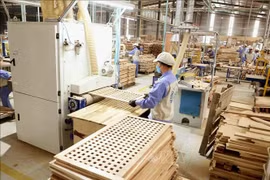
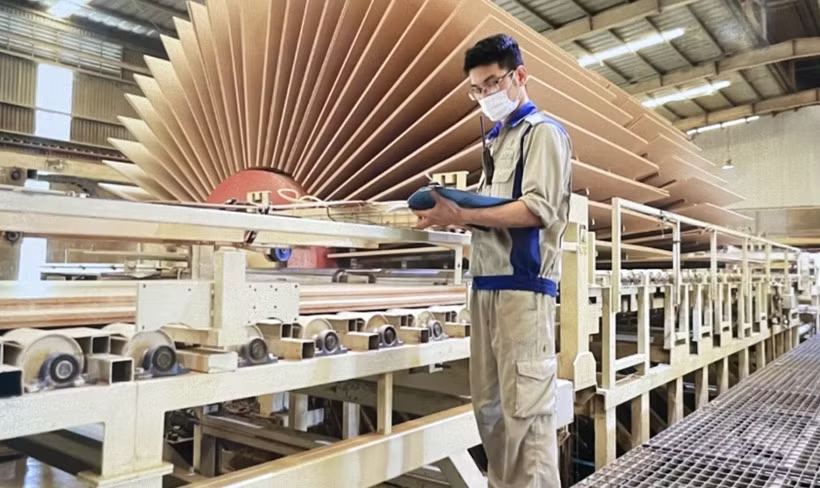
MDF wood production at Quang Tri Wood Company (Photo published by VNA)

Hanoi (VNA) - The Vietnam Chamber of Commerce and Industry (VCCI) hosted a forum in Hanoi on July 23 to discuss solutions to bottlenecks in developing sustainable material sources for deep wood processing, as the sector seeks to shift from growth based on volume to higher quality, added value and sustainability.

VCCI Vice Chairman Bui Trung Nghia said that after nearly three decades of development, Vietnam’s wood processing industry has become a key export sector, recording export revenue of over 17 billion USD in 2025.

The country ranked fifth globally, second in Asia and first in Southeast Asia in wood and wood product exports, providing an important foundation for the industry to pursue modern, sustainable development and generate higher added value.

However, he noted that future growth will no longer come from expanding production scale, but must instead be driven by higher-quality growth, improved productivity and the ability to adapt to new market requirements. Increasingly stringent regulations on deforestation, carbon emissions and traceability, together with the growing trend towards green consumption, are compelling the wood industry to transform its development model.

To achieve the target of 25 billion USD in export revenue by 2030, the industry needs to move towards sustainable forestry, greater material self-sufficiency, upgraded value chains and more efficient use of forest resources, Nghia said.

He noted that a sustainable and transparent material supply chain is not only essential for meeting export market standards, but also helps businesses secure supplies, reduce dependence on imported materials, improve competitiveness and raise the value of deeply processed products.

Ngo Sy Hoai, Vice Chairman and Secretary General of the Vietnam Timber and Forest Products Association (VIFOREST), said that while the forestry sector has successfully expanded planted forest areas over the past 30 years, the next three decades should focus on improving timber quality and the value of raw materials.

The focus should shift from “planting more to harvest more” to creating greater value from the same forest area by developing large-timber plantations, applying science and technology, and improving deep-processing capacity, he said.

Bui Thi Nha Trang, Sustainability Team Manager at Control Union Vietnam, said global forest-product trade was shifting from a “trust-based” to an “evidence-based” model. Businesses must now demonstrate not only the legality of their materials, but also traceability, sustainable forest management and carbon-emission control throughout the supply chain.

Participants said sustainable development of the wood industry required a stronger focus on material quality, technological innovation and transparent and traceable supply chains, rather than simply expanding planted forest areas. The development of large-timber forests, high-yield varieties and smart forestry was identified as key to raising the value and efficiency of forest resources.

They noted that the 25-billion-USD export target by 2030 will require a comprehensive restructuring of the industry towards greener, more sustainable and lower-carbon growth, rather than simply increasing output.

To remove bottlenecks, Doan Van Tinh, Chairman of the Board of Directors of MDF Mekong, called for policy adjustments to encourage deep processing instead of raw-material exports. He also urged measures to address high material costs, improve forestry-related administrative procedures, and increase investment in research and development of high-yield and high-quality forest varieties suited to local conditions and deep processing./.

VNA

See more

A view of the approach road to the Xuan Quang bridge on the side of Thieu Quang commune, Thanh Hoa province. (Photo: VNA)

Public disbursement recovers, accelerates toward double-digit growth

In the first six months of the year, the disbursement of public investment capital nationwide reached over 356 trillion VND (13.52 billion USD), equivalent to 35.5% of the plan assigned by the Prime Minister. Compared to the same period in 2025, the rate reached a similar level, but the volume of disbursed capital rose by 38.4 trillion VND, thanks to the highest ever increase recorded in the total planned public investment capital for 2026 (1.01 quadrillion VND).

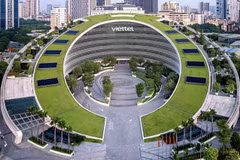
The headquarters of the Viettel Military Industry and Telecoms Group (Photo: Viettel)

Creating runway for Vietnam’s tech "eagles" to take off

Under the national plan for 2026–2030, Vietnam aims to develop at least 10 large strategic technology enterprises by 2030, each generating annual revenue of at least 1 billion USD, employing over 5,000 workers, operating a recognised science and technology organisation, and spending at least 3% of annual revenue on research and development.

Dr. Ho Quoc Tuan, senior lecturer at the UK’s University of Bristol, grants an interview to VNA (Photo: VNA)

Vietnam should focus on competitive niches in global tech value chain: UK-based expert

A young army of software engineers, competitive labour costs and deep mathematical skills have already made Vietnam a magnet for IT outsourcing. Companies like FPT Software and VNG have proved they can compete in international markets. These sectors demand relatively modest infrastructure spending while putting existing human capital to work.

Vietnamese Ambassador to Japan Pham Quang Hieu (R) and Gunma Governor Yamamoto Ichita co-chair the seminar on promoting public-private cooperation in digital transformation. (Photo: VNA)

Vietnam, Japan promote cooperation in digital transformation

The Vietnamese Embassy in Japan reaffirmed its commitment to serving as a trusted bridge connecting Gunma with Vietnamese ministries, localities, universities and businesses to promote concrete cooperation in investment, trade, science and technology, innovation, digital transformation and human resources development.

Minister of Science and Technology Vu Hai Quan delivers a pre-recorded address at the 68th series of meetings of the assemblies of the member states of the World Intellectual Property Organisation (Photo: Permanent Mission of Vietnam in Geneva)

Vietnam strengthens intellectual property system, targets economic value creation

During the recent 68th series of meetings of the assemblies of the member states of the World Intellectual Property Organisation (WIPO), Minister of Science and Technology Vu Hai Quan praised WIPO’s role in developing the global IP system, particularly in strengthening state management capacity, supporting businesses, training human resources, and promoting the commercialisation of intellectual assets.

At a supermarket in the US's Maryland state (Photo: VNA)

USDA to lead agricultural trade mission to Vietnam in November

Luke J. Lindberg, USDA Under Secretary for Trade and Foreign Agricultural Affairs, said the mission will build on the rapid response TRUMP mission that wrapped up in March, and lock in wins for US farmers and agricultural producers in Vietnam.

The signing ceremony of a cooperation agreement among strategic partners for the development of the Da Nang Free Trade Zone on June 13, 2026. (Photo: VNA)

Da Nang completes special administrative framework for free trade zone

The Da Nang Hi-Tech Park and Industrial Zones Authority has now finalised all administrative procedures under its jurisdiction in accordance with the FTZ’s special mechanisms and policies, leaving the system ready for deployment once the zone’s functional areas officially begin operations.

International buyers explore Vietnamese products at Vietnam International Sourcing 2025. (Photo: VNA)

Global buyers turn to Ho Chi Minh City for sourcing

The growing number of international retailers and importers choosing Ho Chi Minh City as a sourcing destination underscores the city's transformation from a trade promotion venue into a regional procurement hub.