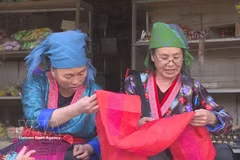
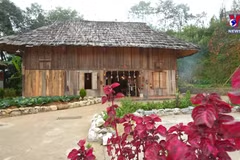
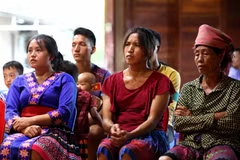
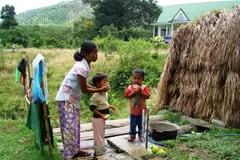
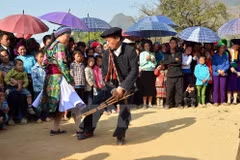
From remote mountain villages to community cultural spaces, ethnic communities in the northwestern province of Dien Bien are keeping their traditional heritage alive. Crafts such as shoemaking by the Xạ Phang people and embroidery by the Mong community continue to be preserved and passed down through generations, reflecting both cultural pride and resilience.
In addition to the majority Mong ethnic group in the resort town of Sa Pa in Lao Cai province are four other groups: Red Dao, Tay, Giay, and Xa Pho. However, as most people only have a short period of time in Sa Pa, it can be a challenge for them to explore the cultures of all five groups.
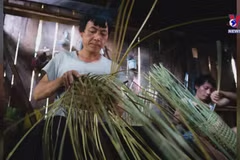
As a key companion of Mong ethnic minority people when they go to work in the fields or head to the market, “Quay tau” (rattan buckets) has become a cultural trait of the group. The weaving of a “quay tau” not only contributes to preserving the ethnic minority’s traditional craft but also creates livelihoods for local people.
Vietnam has proactively increased its engagement in the United Nations’ mechanisms related to human rights. This is in line with the consistent stance of the Party and State that considers ensuring and protecting human rights a cornerstone policy.
Gau Tao Festival is one of the most important festivals of the Mong ethnic minority people in Ta Su Choong commune in Hoang Su Phi district of the northernmost province of Ha Giang. It is held annually in September when paddy fields turn golden ripe, a highlight to attract tourists to the locality.
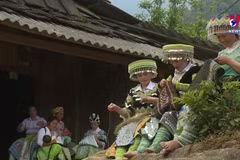
Tram Tau highland district in the northern mountainous province of Yen Bai is home to 11 ethnic groups, with the Mong people making up the majority. The women’s outfits are among the unique features of their culture.
A festival highlighting the culture of the Mong ethnic group is scheduled to be held in September in the Central Highlands city of Lai Chau, with the participation of 14 cities and provinces.
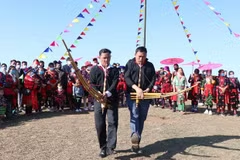
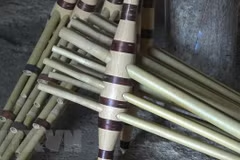
Although modern culture has been present in every corner of mountainous hamlets, the passion for melodies of Khen (panpine) has never ceased among men of the Mong ethnic group.
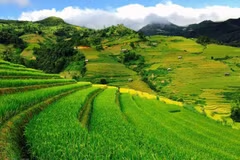
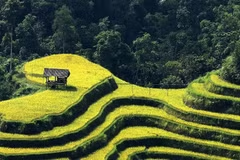
Famous for its most breathtaking rice terraces, Mu Cang Chai in the northern mountainous province of Yen Bai is a reputable name repeated among travel lovers and photographers, especially in late September and early October - the best time for capturing the most beautiful landscapes of terraced fields in the mountainous district.
An ethnic-minority village in the Central Highlands province of Lam Dong has become well-known for its title “village with 3-nos” (no drinking, no smoking and no social evils) thanks to a concerted communal effort that commenced over a dozen years ago.
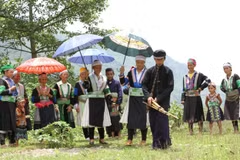
The annual traditional holiday of the Mong ethnic minority group, known as Nao Pe Chau, takes place at the end of the 11th lunar month. The event is held to celebrate the end of the harvest and spend time relaxing together.
A cultural and tourism festival promoting the beauty of Hoang Su Phi’s terraced fields and ethnic culture is due to kick off in the northern mountainous province of Ha Giang on September 28.
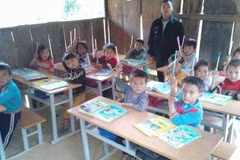
Since 982, no female teacher has worked at a primary school in the central province of Nghe An because the working conditions are very difficult. The dedication of male teachers save the day.
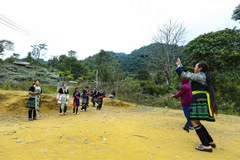
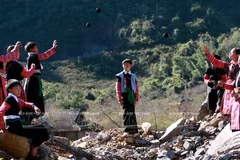
It can be said that the Pao throwing game from Mu Cang Chai’s Mong people is a traditional beauty, highlighting the cultural and characteristic values of the ethnic group.
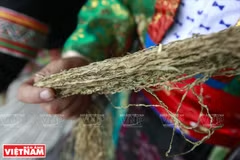
For generations, the Mong ethnic minority group in the Dong Van Karst Plateau, northern Ha Giang province, has woven threads made of flax plant into colourful fabrics.
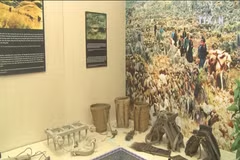
Cultural values of the Mong ethnic group in Ha Giang’s Dong Van Karst Plateau Geopark were the highlight of a festival held in the northern mountainous province’s Meo Vac district from February 13-15.