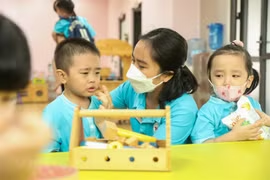
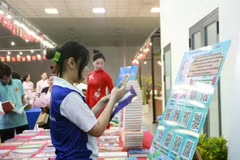
Students learn Vietnamese at Na Bung Pre-school in northern Dien Bien province. (Photo: VNA)
As a result, cultural barriers have gradually been lifted, and thetransmission of knowledge has been more effective.
Ta Ma commune’s pre-school is located approximately 40km from TuanGiao district in Dien Bien province. The school has 462 students, with themajority Mong and Khang whose mother tongue was the only language they’reaccustomed to.
Upon arriving at school, the teachers speak Vietnamese (theofficial language of Vietnamese and is spoken by the majority of Vietnamesepeople), and the educational curriculum is also conducted in Vietnamese.Language differences between the teachers and students have posed significantchallenges.
Ha Thi Men, vice principal of the pre-school, said local childrenwere entirely unfamiliar with Vietnamese language when they entered school.Some couldn't even express their basic needs when they wanted water or use therestroom. The language barrier made children more timid and less confident inclass.
“To ensure quality of teaching and learning, all 29 teachers atthe school registered to learn ethnic language," Men told the onlinenewspaper giaoducthoidai.vn.
"Only through this approach can teachers and students find acommon language.”
Teachers actively engaged in self-learning through practicalexperiences to facilitate communication with parents and students. Theyregularly sought support from parents, not only in communicating with theirchildren at home but also in assisting teachers with translation and enhancingpoems and songs in both languages to make them more memorable andunderstandable for the children.
In addition to the two Vietnamese language classes per week, theschool also integrated Vietnamese language into all classroom activities.
Teacher Tong Thi Lan said she plays traditional folk games withshort and easy-to-remember common language songs, which helped increaseinteraction with students.
"We often teach folk songs and riddles to make learningenjoyable and engaging for the children. Many folk songs have been translated intoboth languages to help children learn faster,” she said.
Previously, Lan was assigned to a preschool in the Phinh Cu village,where all of the students come from the Mong ethnic minority group. She facedchallenges in communicating with the children as well as their parents as noneof them could speak Vietnamese language.
She said: "I had to get acquainted with the children, usingbody language and communicating word by word, repeating each word or phraseuntil the children understood me. I also learned the Mong language from villageelders and parents.
"Thanks to this, by the middle of the first semester, I couldunderstand my students and better communicate with them."
At Toa Tinh commune’s pre-school in Tuan Giao district, allstudents were Mong and communicated in their native language. During lessons,the teachers often used the native language to help children understand themeaning and then translate it into Vietnamese.
Principal Nguyen Huong Diem said: "The school alwaysemphasises to strengthen Vietnamese language for children. We integrateteaching Vietnamese into learning activities, including local language, so thatchildren can read, pronounce, and speak in both languages. This makes childrenmore enthusiastic, understanding, and able to remember their lessons better."
The school placed Vietnamese alphabet letters in the play area sothat children could practise pronunciation anytime and anywhere. The teachersalso encouraged the students to communicate in Vietnamese.
During extracurricular activities, the school required teachers tofocus on improving listening, speaking, reading, and writing skills inVietnamese for the children.
Teacher Cao Thi Nhung said: "The teachers create educationalmaterials and toys related to Vietnamese alphabet letters for the children,such as letter spinning games, alphabet handprints, and alphabet flowerdecorations. We also have a library, play corner, and classrooms with a varietyof books to allow children to access common language materials morefrequently."
Diem said each school might have its own methods and solutions,the goal was to help children understand and communicate effectively inVietnamese language, absorb lessons better, and enhance the quality of teachingand learning./.
VNA