A Virobo staff helps a boy try out a Captain Eye robot (Photo courtesy of Virobo)
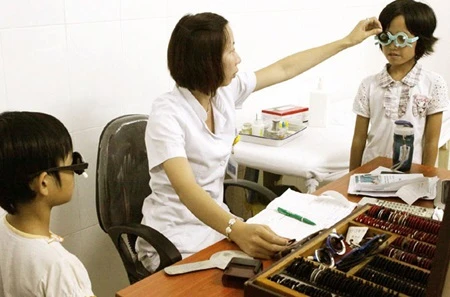
 Hanoi (VNS/VNA) - A Hanoi-based start-up company is trying to help Vietnamese children protect their eyes and spines.
Founded in 2017 by former students from a technology university in the capital city, Virobo produces robots that help prevent myopia and scoliosis in pupils.
Named Captain Eye and small enough to stand on a table, the robots measure the distance between children’s eyes and their desks and make sure they sit in an upright posture so as not to hurt their spines.
“Lots of problems have been born as a result of this era of technology and economic development. Learning through mobile phones and tablets and holding them too close are one of the main reasons that make children become short-sighted and ruin their spines,” said Nguyen Huu Cuong, Virobo’s marketing director.
“With sensors attached, the robots will know when a child is holding a phone or tablet too close and when they are sitting in the wrong position, and utter sounds to remind them to adjust themselves,” he said.
Connected with a mobile application available for both Android and iOS users, the robots also act as a supervisor that reminds children to follow their timetables, which can be planned and stored on the application.
“Parents are often worried they can’t spend time helping their children study and spend money [on extra classes] hoping to equip them with good habits. But that’s not a continuous process, and parents are often not patient enough with their children,” said Cuong.
“The robots will help the children to plan their study and set goals, and share them with their parents through the mobile application so that the whole family can do it together,” he added.
“With this product, we hope to provide a solution that teaches children useful knowledge and help them develop necessary skills. We also hope it will provide an opportunity for family members to spend more time together and get closer to one another.”
As a young, technology-based start-up, Cuong said Virobo has experienced problems unique to the nature of his company.
“Since Vietnam’s supporting industries are still young, companies like us are rare and everything is difficult: human resources planning, financing, hiring manufacturers,” he said.
It’s hard to do sales and marketing since their product is new and few customers have experienced it, he added.
“The problem with having a new product is that we find it difficult to convey a clear key message to customers.
“Think about it like the time when mobile phones didn’t exist – no matter how hard you try you wouldn’t be able to explain to someone who has never seen a mobile phone what a mobile phone is. That’s the type of problems we are having.”
With four out of six founding members technicians graduating from the Hanoi University of Science and Technology – two of them won top prizes at the Asia-Pacific Robot Contest (Robocon) in Vietnam in 2007 – Cuong said it gives the company a solid technical foundation.
But being adept at technology is just a small part of what makes a business flourish, he added.
“Technology is just a constituent element of a business. We need people. A good and large enough body of staff.
“The direction, vision and mission we set for ourselves are also important, as well as the processes of doing marketing, sales, system management and capital management.
“Of course, with start-ups all of those elements will not be available right from the beginning – it is a process that needs fine-tuning. And we can have different solutions in different stages of development.”
Starting technology-based businesses is a trend being supported by the Government and big corporations in Vietnam, Cuong added.
“But technology changes fast. And what most start-ups in Vietnam are doing is using applications already developed by other countries, which is quite a tidy process.
“This is a good opportunity, with lots of elements incorporated, for them to channel their creativity and come up with products that bring benefits to customers.”
Having bought a robot for her seven-year-old, Hanoi resident Le Thi Phuong, 35, said automation is what she likes most about the product.
“I used to get my daughter anti-myopia equipment that can be placed under her chin or worn on her back, but she felt very uncomfortable and often refused to wear it after a few days.
“I find the robot’s schedule and reminder functions useful. My daughter used to have some bad habits, and being a spoiled child as she was, she sometimes failed to do what I set out for her.
“The robot has become a friend that reminds her to follow her timetable.”-VNS/VNA
Founded in 2017 by former students from a technology university in the capital city, Virobo produces robots that help prevent myopia and scoliosis in pupils.
Named Captain Eye and small enough to stand on a table, the robots measure the distance between children’s eyes and their desks and make sure they sit in an upright posture so as not to hurt their spines.
“Lots of problems have been born as a result of this era of technology and economic development. Learning through mobile phones and tablets and holding them too close are one of the main reasons that make children become short-sighted and ruin their spines,” said Nguyen Huu Cuong, Virobo’s marketing director.
“With sensors attached, the robots will know when a child is holding a phone or tablet too close and when they are sitting in the wrong position, and utter sounds to remind them to adjust themselves,” he said.
Connected with a mobile application available for both Android and iOS users, the robots also act as a supervisor that reminds children to follow their timetables, which can be planned and stored on the application.
“Parents are often worried they can’t spend time helping their children study and spend money [on extra classes] hoping to equip them with good habits. But that’s not a continuous process, and parents are often not patient enough with their children,” said Cuong.
“The robots will help the children to plan their study and set goals, and share them with their parents through the mobile application so that the whole family can do it together,” he added.
“With this product, we hope to provide a solution that teaches children useful knowledge and help them develop necessary skills. We also hope it will provide an opportunity for family members to spend more time together and get closer to one another.”
As a young, technology-based start-up, Cuong said Virobo has experienced problems unique to the nature of his company.
“Since Vietnam’s supporting industries are still young, companies like us are rare and everything is difficult: human resources planning, financing, hiring manufacturers,” he said.
It’s hard to do sales and marketing since their product is new and few customers have experienced it, he added.
“The problem with having a new product is that we find it difficult to convey a clear key message to customers.
“Think about it like the time when mobile phones didn’t exist – no matter how hard you try you wouldn’t be able to explain to someone who has never seen a mobile phone what a mobile phone is. That’s the type of problems we are having.”
With four out of six founding members technicians graduating from the Hanoi University of Science and Technology – two of them won top prizes at the Asia-Pacific Robot Contest (Robocon) in Vietnam in 2007 – Cuong said it gives the company a solid technical foundation.
But being adept at technology is just a small part of what makes a business flourish, he added.
“Technology is just a constituent element of a business. We need people. A good and large enough body of staff.
“The direction, vision and mission we set for ourselves are also important, as well as the processes of doing marketing, sales, system management and capital management.
“Of course, with start-ups all of those elements will not be available right from the beginning – it is a process that needs fine-tuning. And we can have different solutions in different stages of development.”
Starting technology-based businesses is a trend being supported by the Government and big corporations in Vietnam, Cuong added.
“But technology changes fast. And what most start-ups in Vietnam are doing is using applications already developed by other countries, which is quite a tidy process.
“This is a good opportunity, with lots of elements incorporated, for them to channel their creativity and come up with products that bring benefits to customers.”
Having bought a robot for her seven-year-old, Hanoi resident Le Thi Phuong, 35, said automation is what she likes most about the product.
“I used to get my daughter anti-myopia equipment that can be placed under her chin or worn on her back, but she felt very uncomfortable and often refused to wear it after a few days.
“I find the robot’s schedule and reminder functions useful. My daughter used to have some bad habits, and being a spoiled child as she was, she sometimes failed to do what I set out for her.
“The robot has become a friend that reminds her to follow her timetable.”-VNS/VNA
VNA