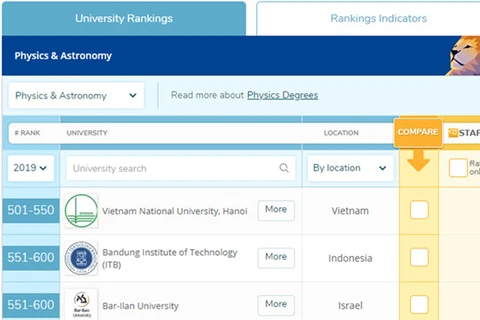
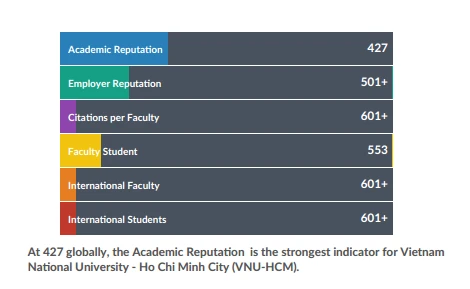
Standings of the Vietnamese universities in the THE World Universities Rankings (Photo: vnu.edu.vn)
 Hanoi (VNA) – Three universities of Vietnam have entered the World University Rankings 2020 of the Times Higher Education (THE) magazine for the first time.
The Vietnam National University (VNU) – Hanoi and the Hanoi University of Science and Technology (HUST) make onto the list of world’s top 800-1000 while the VNU – Ho Chi Minh City is in the 1000+ group.
Among the three Vietnamese educational establishments in the rankings, the VNU – Hanoi takes the lead in scores for teaching, research and international outlook while the VNU – HCM City comes first in scores for industry income. The HUST holds the highest scores for citation.
The University of Oxford for the fourth year in a row leads the rankings. The California Institute of Technology rises three places to second, followed by the University of Cambridge, Stanford University and the Massachusetts Institute of Technology.
Meanwhile, top 1,000 also sees 16 universities in Thailand, 13 in Malaysia, six in Indonesia and two in Singapore. One school in Thailand and two in Malaysia are ranked 801-1,000th.
The THE World University Rankings 2020 includes almost 1,400 universities across 92 countries and territories, standing as the largest and most diverse university rankings ever to date.
The table is based on 13 carefully calibrated performance indicators which are grouped into five areas of Teaching (the learning environment); Research (volume, income and reputation); Citations (research influence); International outlook (staff, students and research); and Industry Income (knowledge transfer)./.
The Vietnam National University (VNU) – Hanoi and the Hanoi University of Science and Technology (HUST) make onto the list of world’s top 800-1000 while the VNU – Ho Chi Minh City is in the 1000+ group.
Among the three Vietnamese educational establishments in the rankings, the VNU – Hanoi takes the lead in scores for teaching, research and international outlook while the VNU – HCM City comes first in scores for industry income. The HUST holds the highest scores for citation.
The University of Oxford for the fourth year in a row leads the rankings. The California Institute of Technology rises three places to second, followed by the University of Cambridge, Stanford University and the Massachusetts Institute of Technology.
Meanwhile, top 1,000 also sees 16 universities in Thailand, 13 in Malaysia, six in Indonesia and two in Singapore. One school in Thailand and two in Malaysia are ranked 801-1,000th.
The THE World University Rankings 2020 includes almost 1,400 universities across 92 countries and territories, standing as the largest and most diverse university rankings ever to date.
The table is based on 13 carefully calibrated performance indicators which are grouped into five areas of Teaching (the learning environment); Research (volume, income and reputation); Citations (research influence); International outlook (staff, students and research); and Industry Income (knowledge transfer)./.
VNA