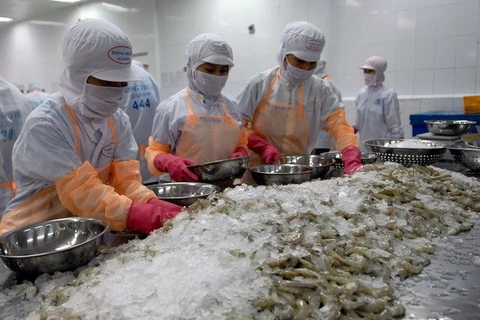
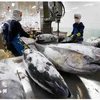
Shrimp processed at Cuu Long Seafood JSC in Trà Vinh province. Vietnam ranks second globally in shrimp exports, with a market share of 14 percent, only behind India (15 percent). (Source: VNA)
 HCM City (VNA) - The seafood industry must envision a long-term strategy to make full use of new trade pacts and prepare for problems that might arise when they take effect, Truong Dinh Hoe, VASEP general secretary, said.
Hoe was speaking at a conference in HCM City on July 17 on the challenges and opportunities faced by the seafood sector under the Comprehensive and Progressive Agreement for Trans-Pacific Partnership (CPTPP), which took effect in January, and the EU-Vietnam Free Trade Agreement (EVFTA), which is expected to be approved by the EU Parliament late this year or early next year.
“Two major trade agreements will result in lower tariffs imposed on Vietnamese goods, but domestic enterprises will also face competition with foreign rivals in addition to stringent regulations on product quality and trace of origin,” he said.
The EVFTA, which was signed by Vietnam in June, will cut tariffs on 99 percent of goods traded between the two sides. Vietnam’s agriculture and seafood exports, as well as other industries in which the country has strengths, are expected to see substantial benefits.
Nguyen Thi Thu Trang, director of the World Trade Organisation (WTO) Integration Centre at the Vietnam Chamber of Commerce and Industry (VCCI), said that EVFTA and CPTPP would offer fishery firms a chance to expand exports, especially to new markets such as Canada, Peru and Mexico.
Vietnam ranks second globally in shrimp exports, with a market share of 14 percent, only behind India (15 percent).
EVFTA is a new-generation FTA that comes with higher standards, and as a result the industry will face strict regulations in terms of the origin of goods, even in textiles and garments, a traditionally strong sector for Vietnam, experts said.
In addition, labour rules under the trade agreement will be stricter, requiring local businesses to adapt to its requirements.
To take full advantage of the EVFTA, local enterprises must adjust their production to meet standards on quality, origin, labour, and environmental protection, among other issues.
Regulatory bodies and firms also need to be prepared to deal with foreign goods that detour into Vietnam to take advantage of the CPTPP and other FTAs that the country has signed.
The CPTPP has provisions for investor-state disputes that allow foreign investors to sue the member state.
To prepare for this, Vietnam needs to comply with all regulations to prevent disputes with foreign investors.
To take advantage of the benefits from the CPTPP, the country will need to build a legal framework to effectively implement the trade pact.
Businesses must also understand the opportunities and challenges that CPTPP offers and ramp up their activities and production, experts said.
The readiness of enterprises is especially critical, they said.
Exporters should also ensure that their products meet requirements on traceability and technical standards, as well as plant and animal safety and hygiene criteria of the EU.
This year the seafood industry has set a target of 10 billion USD worth of exports, a rise of 11.1 percent over last year.
Vietnam’s seafood exports to the other 10 members of CPTPP rose by 15 percent year-on-year to 502 million USD in the first four months since the agreement took effect, according to the ministry.
Overall exports were 2.5 billion USD, an increase of 2.4 percent, the Ministry of Agriculture and Rural Development said. - VNA
VNA