Tram Chim National Park deserves Ramsar title

Located in Tam Nong district of the Mekong Delta province of Dong Thap, Tram Chim National Park boasts a rich biodiversity that turned it into the world’s 2000th Ramsar site in 2012.
Tram Chim National Park deserves Ramsar title ảnh 1Visitors at Tram Chim National Park (Photo: VNA)

Dong Thap (VNA) - Located in Tam Nong district of the Mekong Delta province of Dong Thap, Tram Chim National Park boasts a rich biodiversity that turned it into the world’s 2000th Ramsar site in 2012.

Established in 1985, the 7,313-hectare Tram Chim became a national park in 1998 and then the fourth Ramsar site in Vietnam.

The park’s plentiful green vegetation is inhabited by more than 130 species of higher plants featuring six main types of floristic societies.

Water life in the park is also bustling seeing the presence of over 150 species of freshwater fish, with some listed in Vietnam’s Red Book like clown feather-back fish, common archerfish and giant barbs, nearly 180 algae species, 26 epifauna species, 350 species of plankton and 34 species of amphibian.

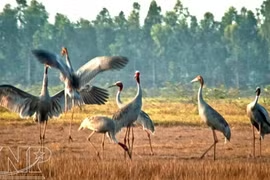
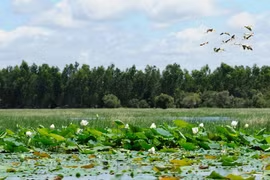
Tram Chim is home to 198 bird species, including 16 rare ones such as red-headed cranes, black-faced spoonbills, black eagles, great-billed herons and spotted-billed pelicans. It was recognised as an important bird sanctuary in Vietnam.

The number of fauna and aquatic species in Tram Chim National Park surpasses those in other wetland reserves in the region, like Tra Su cajeput forest reserve in An Giang province and U Minh Ha National Park in Ca Mau province.

The diversity is largely attributable to the physical feature of the park which lies in the low-lying area of Dong Thap Muoi (Plain of Reeds) and benefits vastly from the flood cycle generated by the Mekong River.

In particular, a well-operating water drainage system has also helped direct a great amount of aquatic species on the Mekong River to reside in the park annually and add to its biodiversity.

Providing a perfect habitat for hundreds of flora and fauna species, the Tram Chim National Park also offers an ideal destination for ecotourism in Dong Thap Muoi.

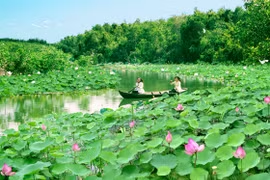
Forming part of the part, the 3,000 hectare forest of cajeput, aged up to 18 years old, is often adorned with tens of thousands of white storks during the flood season. It provides a dozen-hectare ground for various kinds of birds to play and build cosy nests all year round.

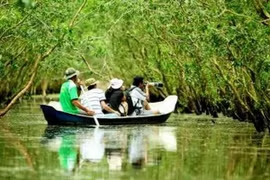
Tours by water taxis to the park are now available for tourists, who are assured to be stunned by a spectacular view of a “green oasis” decorated by flowers and enlivened by bird singing and dances during the flood season.

In the dry season, canoes bring tourists to travel along small canals from which they can spot 1.5-metre-tall cranes, herons with wings of over one metre and long-necked darters seeking food.

A road system has been invested by local authorities to enable tourists to explore the site without harming its ecosystem.

To preserve the park, protective measures have been carried out. A 53-kilometre dyke was built to prevent the park from being flooded entirely during the rainy season and regulate its water level during the dry season.

A number of projects jointly developed by local authorities and state and international agencies have been launched to reduce local residents’ dependence on the park and raise their awareness of protecting its environment.

Local residents have been encouraged to get involved in managing natural resources offered by the park and utilising them in a sustainable manner. These activities have helped Tram Chim National Park live up to its fame as the world’s Ramsar site and contributed to the sustainable development of the Mekong Delta.-VNA
VNA

See more

General Secretary of the Communist Party of Vietnam Central Committee and President To Lam speaks at the groundbreaking ceremony for a project to upgrade the Bac Hung Hai irrigation system. (Photo: VNA)

Hung Yen: Project to modernise Bac Hung Hai irrigation system launched

General Secretary of the Communist Party of Vietnam Central Committee and President To Lam stressed that the development of Bac Hung Hai must be integrated into broader efforts to ensure water security, protect the environment and promote sustainable development in the Red River Delta.

Illustrative image (Source: VNA)

Northern region to experience cold spell

The cold air is forecast to reach northeastern Vietnam from the evening and night of October 4 before spreading to other parts of the north and the area from Thanh Hoa to Hue. Winds will shift to the northeast at levels 2-3 inland and levels 3-4 along coastal areas.

Deputy Minister of Industry and Trade Truong Thanh Hoai and CEO of GWEC Ben Backwell chairs a offshore wind development workshop in Hamburg on September 24, 2026. (Photo: VNA)

Vietnam, Germany promote cooperation in offshore wind development, supply chains

At the discussion session, representatives of the ministry, offshore wind developers, equipment manufacturers and international financial institutions, including CIP, Siemens and KfW, discussed Vietnam’s offshore wind investment potential and the Vietnamese Government’s plans to achieve an offshore wind capacity target of 17GW by 2035, including measures to attract international investment to the country.

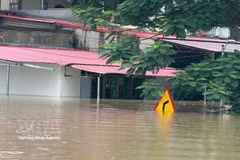
In Kim Tan commune, Thanh Hoa province, flood has submerged more than half of the ground floors of two- and three-storey houses. (Photo: VNA)

Floods affect over 16,000 homes, nearly 25,000ha of crops

The floods submerged and damaged 22,499ha of rice, crops and vegetables, along with 2,172ha of other crops. A further 1,175.62ha of aquaculture areas were affected. Some 1,999 metres of irrigation canals were eroded or damaged, while 15 schools were flooded.

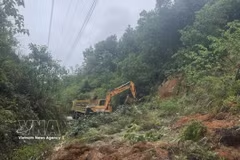
Landslides block roads in mountainous areas of Thanh Hoa (Photo: VNA)

Heavy rains cause widespread damage in Phu Tho, Thanh Hoa

Prolonged heavy rains from September 13–17 have caused flooding and landslides, damaging homes, crops, roads and infrastructure in Phu Tho and Thanh Hoa provinces, with local authorities mobilising forces for emergency response.

White-rumped langurs are rescued and conserved at the Endangered Primate Rescue Centre (EPRC) in Cuc Phuong National Park. (Photo: VNA)

Ninh Binh establishes Kim Bang white-rumped langur conservation area

Covering a total area of 3,182ha, the conservation area comprises 3,016.81ha of natural forest, 64.25ha of plantation forest and 100.94ha of land without forest, with no water surface area. It is located in the Ly Thuong Kiet, Tam Chuc and Nguyen Uy wards of Ninh Binh province.

The forum takes place in Hanoi on August 25, 2026. (Photo: VNA)

Vietnam, RoK promote cooperation to deliver on net-zero commitments

Sectors such as semiconductor manufacturing, nuclear power, science and advanced technologies are playing an increasingly important role in national competitiveness and economic development of each country. They also offer considerable room for Vietnam and the RoK to expand professional exchanges, share experience and promote cooperation, particularly among their energy experts.