User experiences key to digital marketing

As internet users can access a vast pool of information online, one of the challenges facing digital marketing companies is how to create relevant advertising that targets the right customers, experts said at a Vietnam Online Marketing Forum held in HCM City on August 15.
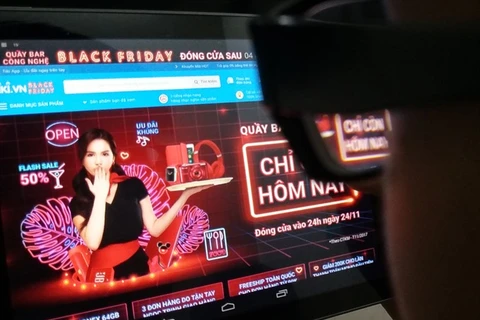
User experiences key to digital marketing ảnh 1One of the challenges facing digital marketing companies is how to provide users with relevant information. (Photo: tapchitaichinh.vn)

HCM City (VNA)
– As internet users can access a vast pool ofinformation online, one of the challenges facing digital marketing companies ishow to create relevant advertising that targets the right customers, expertssaid at a Vietnam Online Marketing Forum held in HCM City on August 15.

Nguyen Phuong Thao, senior manager of Nielsen Vietnam, said that greateraccess to smart devices and massive information online could easily intimidateusers as it would be difficult to filter and verify information.

"Advertisers and marketers are faced with the challenge of providinginformation that is relevant to customer experiences," she said.

“There are already many tools available out there to help businesses boostdigital marketing. What they need to do is to make an intervention byconnecting with users and providing them with relevant user experiences,” shesaid.

For example, when users book an air ticket online, hotel booking advertisementsshould be sent to them immediately.

In order to make that intervention, businesses should be able to collect andprocess a large amount of real-time data using machine learning and artificialintelligence.

Nguyen Ba Ngoc, founder and CEO of NBN Media, a marketing consultancy firm,said to enhance the effectiveness of digital marketing, companies should adoptthe most appropriate model as there is no “one-size-fits-all” model for anybusiness.

"For example, small companies with limited human resources can use acentralised marketing system as it saves costs and is consistent. As companiesgrow, they can apply a decentralised brand management system, which is moresuitable for managing a variety of brands," he added.

Le Hai Binh, founder and chairman of Mat Bao Corp, said that more companieshave been using key opinion leaders (KOL) and influencers to boost marketing onsocial media platforms as every “like”, “view”, and “share” on their personalpages can be seen by the public.

However, companies must know how to verify “real clicks, shares and views” tomeasure the effectiveness of marketing via this channel, he said.

There are three companies on the market that provide a service to helpcompanies measure the real likes, views and shares of each post on social pagesby KOL and influencers, as well as the number of people who have actually beenreached by the post.

Binh recommended that companies use this service in the beginning if theyprefer KOL and influencer marketing.

Thao said that, when using influencers, the most important thing is the messageto customers.

“All of the information posted by influencers should be personalised and shouldnot ‘sound like advertising’,” she said. 

She said people follow influencers because they post content that matches theirinterests or hobbies. Therefore, it is important for companies to find aninfluencer who is more relevant to the value of their brand so they caninteract and connect with the right customers.-VNS/VNA
VNA

See more

A Viettel 5G base station in Dong Hai ward, Khanh Hoa province (Photo: VNA)

Vietnam develops digital infrastructure aligned with demands of AI era

The data centre and cloud computing sector is entering a phase of redefinition. Infrastructure is no longer merely a backbone for data storage and processing, but is evolving into a foundational platform powering complex digital ecosystems—from AI and advanced analytics to real-time applications.

Workers manufacture products at Keystone Electrical Vietnam Co., Ltd. in the Lien Ha Thai industrial park. (Photo: VNA)

Vietnam turning ideas into value, aspirations into reality

Resolution No. 57 of the Politburo on breakthroughs in science-technology development, innovation, and national digital transformation is being vigorously implemented nationwide. Within this framework, innovation is increasingly recognised as a key engine for rapid and sustainable growth.

MK Smart achieves Common Criteria EAL5+ Certification, expanding opportunities in global digital identity

MK Smart achieves Common Criteria EAL5+ Certification, expanding opportunities in global digital identity

As countries accelerate the development of digital governments, electronic identification (eID) and electronic passports (ePassport) are becoming essential infrastructure. At the same time, security requirements are becoming increasingly stringent security requirements, particularly for systems that store sensitive data such as citizens’ identity and biometric information.

Sorting fish prior to transport for distribution. (Photo: VNA)

Fishermen keep pace with digital technology

Across central coastal provinces, authorities have introduced policies to restructure fleets, reduce vessel numbers, and support fishermen in transitioning to more sustainable livelihoods. Provinces such as Dak Lak and Gia Lai have earmarked nearly 1 trillion VND to support occupational changes and decommission inefficient vessels, while others including Nghe An, Quang Tri, Hue, and Quang Ngai are implementing roadmaps to phase out thousands of underqualified boats.

Phuc Loi ward in Hanoi has launched the “Digital Literacy for All” movement, forming support teams to help residents install applications such as iHanoi and eTax. (Photo: VNA)

Hanoi advances technological innovation in key economic sectors

The municipal People's Committee recently issued Plan No. 109/KH-UBND on technological innovation in key economic sectors through 2035, which serves as both a catalyst and a strategic move to systematise, elevate and reinforce the capital’s leading role in the digital era.

General Secretary of the Communist Party of Vietnam (CPV) Central Committee and State President To Lam (first, right, front row) listens to a presentation about the China-ASEAN AI Application Cooperation Centre (Photo: VNA)

Top Vietnamese leader visits China–ASEAN AI Application Cooperation Centre

The China–ASEAN AI Application Cooperation Centre, jointly established by the Guangxi Zhuang Autonomous Region and ASEAN countries, aims to promote inclusive and mutually beneficial development of AI globally. It is regarded as a flagship project in advancing the “Digital Silk Road” initiative in Nanning.

A view of the 224th session of the UNESCO Executive Board in Paris. (Photo: VNA)

UNESCO extends recognition of 2 Category II science centres in Vietnam

The continued operation and enhancement of the two Category II centres under UNESCO’s auspices reflect Vietnam’s policy of positioning science, technology and innovation as key drivers of development, while closely linking scientific advancement with deeper and more substantive international integration in the current context.

China–ASEAN Artificial Intelligence Application Cooperation Centre deeply integrates future technologies with distinctive ASEAN cultural characteristics. (Photo: VNA)

China–ASEAN AI cooperation centre drives regional tech cooperation

With strong policy support and growing participation from businesses and research institutions, the China–ASEAN Artificial Intelligence (AI) Application Cooperation Centre is expected to act as a digital bridge, promoting technological integration and opening new avenues for Vietnam–China cooperation in the digital era.

Politburo member and Chairman of the Party Central Committee’s Organisation Commission Nguyen Duy Ngoc (ninth, left) and the Vietnamese delegation pose for a group photo with leaders of the Zhongguancun Science Park and Beijing city. (Photo: VNA)

Vietnam, China step up cooperation in science, technology, innovation

Politburo member and Chairman of the Party Central Committee’s Organisation Commission Nguyen Duy Ngoc, who also serves as Standing Deputy Head of the Central Steering Committee for the Development of Science, Technology, Innovation and Digital Transformation, toured the park’s exhibition area and was briefed on the formation and development of Zhongguancun, along with Beijing’s achievements in science, technology and innovation.

A technician from Viettel Bac Ninh examines equipment at a 5G base transceiver station. (Photo: VNA)

Bac Ninh accelerates development of 5G, data infrastructure

In the first quarter, Bac Ninh’s telecommunications infrastructure continued to develop in a synchronous manner. All communes have been connected to dedicated data transmission networks, and 100% of the population is covered by mobile services.

Illustrative photo (Photo: VNA)

An Giang identifies key tasks in science-technology development

The priorities focus on four pillars: science and technology, innovation, digital transformation, and real-world applications to boost socio-economic development. These are expected to create breakthroughs in governance, production, and daily life.

Illustrative image (Photo: VNA)

Vietnam Research Excellence Fellowship for 2026-2030 approved

Under the Vietnam Research Excellence Fellowship (VREF) for the 2026–2030 period, PhD students are identified as a core research force directly contributing to breakthroughs in sci-tech and innovation. Investing in top-tier doctoral candidates is more than workforce development, but a high-stakes strategic bet to forge a cohort of world-class scientists and technologists who can power Vietnam’s long-term economic ambitions.