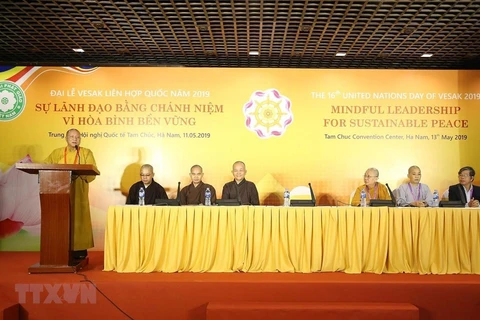
Vice Chairman and Secretary General of the Vietnam Buddhist Sangha (VBS)’s Executive Council, Venerable Thich Duc Thien, who is also Secretary General of the International Committee for Day of Vesak, reads the Ha Nam Declaration (Photo: VNA)
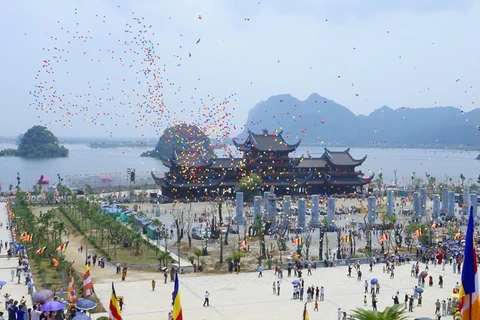
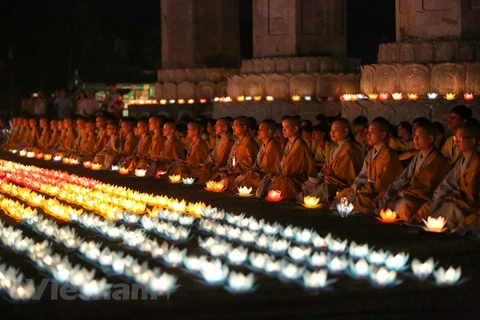
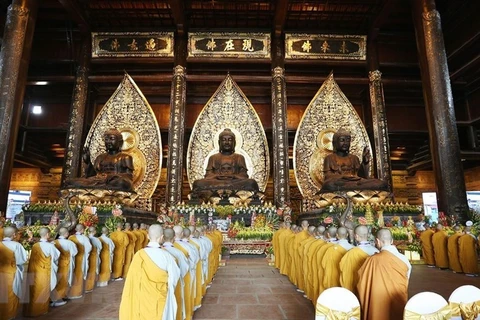
 Ha Nam (VNA) – The 2019 Ha Nam Declaration was issued at end of the 16th United Nations Day of Vesak at the Tam Chuc Convention Centre in the northern province of Ha Nam on May 14.
Following is the full text of the 2019 Ha Nam Declaration.
Whereas, we, the participants, from 112 countries and territories, have come together for the International Buddhist Conference on the United Nations Day of Vesak at Tam Chuc Convention Centre held during May 12-14, 2019;
Whereas, we, came together in this Assembly pursuant to that resolution approved on December 15, 1999 at the General Assembly of the United Nations, Session No. 54, Agenda Item 174, Resolution 54/115. Therein, it was declared that Vesak, which falls on the Full Moon Day in the month of May, will be internationally recognised and observed at the United Nations Headquarters and its Regional Offices from the Year 2000 onwards. The United Nations Day of Vesak is jointly celebrated by all Buddhist traditions as a Thrice Sacred Day. It serves to foster mutual understanding and cooperation amongst all Buddhist traditions, organisations and individuals through ongoing dialogue between Buddhist leaders and scholars addressing those issues of universal concern. As a result of our deliberations we adopt and publish the following message of peace based on the Buddha's teaching of wisdom and compassion:
Whereas, coming together to discuss the issues related to the “Buddhist Approach to Global Leadership and Shared Responsibilities for Sustainable Societies”, we have shared our viewpoints, experiences and research on the latest trends and developments in the various fields and considered deliberately their practical implications; and,
Whereas, we are most grateful and full of deep appreciation for the most wonderful hospitality of the National Vietnam Buddhist Sangha and the support of the Government of Socialist Republic of Vietnam in hosting this most auspicious gathering, on the occasion of the completion of our three-day deliberations featuring meetings, academic presentations, learned discussions, cultural events and Buddhist fellowship.
Now, therefore, at the conclusion of our successful celebrations and meetings we, the assembled delegates, unanimously resolve and adopt this Declaration.
Article 1: General Agreements
In order to better understand and fully implement the UN Sustainable Development Goals, we resolve to:
1.1 Adopt an increasingly active role, both locally and globally, advocating for, working for, and supporting sustainable societies in the current context of profound social, political, economic and cultural crises.
1.2 Invigorate the concept of “Engaged Buddhism” by actively and positively seeking the participation of international institutions.
1.3 Validate the Buddhist approach as a complementary paradigm for achieving peaceful ideals and understanding universal values.
1.4 Advocate Buddhist philosophy for exploring the changing character and context and as spiritual guidance for global governance.
1.5 Recognise the Buddhist-based framework of international actions as a set of feasible, agreeable, arrangements for the overall well-being, development and progress of all sentient beings.
1.6 Avow the greatness of Buddhism in contemporary times.
Article 2: Buddhist Response to Shared Responsibilities
In order to promote the notion of shared responsibilities, we resolve to:
2.1 Build a proactive and well-weaved foundation for interactions by identifying the significant roles of Buddhist Communities around the World.
2.2 Support each one’s expertise on the basis of Buddhist principles for the benefit of each other.
2.3 Extend the idea of compassion, considerate action and support to help the people beyond Buddhist communities without any discrimination on the basis race, creed, religion and gender.
2.4 Emphasise the important individual responsibility in the shared collective.
2.5 Collaborate with international agencies at different levels of responsibility for the attainment of Buddhism’s ultimate goal to end sufferings.
2.6 Propagate the Buddhist’s five ethical precepts and promote the active participation of local communities to transform them into sustainable goals as a basis of shared responsibilities toward better living conditions worldwide.
Article 3: Buddhist Approach to Sustainable Societies
In order to create sustainable societies, we resolve to:
3.1 Utilise the Four Noble Truths and the Eightfold Path as the foundational approach to sustainable societies.
3.2 Create interdependence among several communities by recognising the teachings of Buddha for promoting maximum human potential in a sustainable manner.
3.3 Revitalise the integration of three Buddhist pillars of development, namely, environmental protection, economic prosperity, and social justice.
Article 4: Mindful Leadership for Sustainable Peace
In order to make peace in the light of mindful leadership, we resolve to:
4.1 Emphasise dialogue and non-violent approaches for peace-building contrary to the old paradigm that the physically stronger always wins over the weaker
4.2 Encourage the notions of wisdom and compassion as the basis for any conflict avoidance and resolution.
4.3 Acknowledge the fundamental importance of mindful leadership relating to instruction in individual and societal ethics in contributing to peace making. (Specifically, seeking the settlement of conflicts, respect for life, ending of violence and practice of loving kindness, non-violence through dialogue and cooperation.)
Article 5: Buddhist Approach to Harmonious Families, Healthcare and Sustainable Societies
In order to create sustainable societies, we resolve to:
5.1 Acknowledge the contemporary transformations in family structures and social systems and promote Buddhist principles of harmonious communication to achieve harmonious families, better healthcare service and sustainable societies.
5.2 Evaluate the effects of healthy living and facilitate the Buddhist healthy living programme by applying Buddhist meditation techniques.
5.3 Teach the Buddhist’s five ethical precepts as part of the school curriculum, from K to 12 grade, to advocate for the concept of healthy living and harmonious families.
5.4 Promote the spirit of the five ethical precepts in the justice system as the basis for rehabilitation of incarcerated individuals.
Article 6: Buddhist Approach to Global Education in Ethics
In order to improve the global system of education, we resolve to:
6.1 Reaffirm that the ultimate goal of Buddhist education in ethics is to liberate a person from its own ego and suffering.
6.2 Propagate the Buddhist concept of impermanence and non-self in global education for betterment of the World to fight against greed, anger, and ignorance.
6.3 Combine the tenets of Buddhism with Psychology and Philosophy in education as a way to examine the issues of Ethics and Ethics itself.
6.4 Incorporate Buddhist ethical principles into national systems of education at all levels.
6.5 Encourage the integration of wisdom and compassion in caring for the environment, cultivating synergetic effects among individuals, schools and communities.
Article 7: Buddhism and the Fourth Industrial Revolution
With the help of digital platforms, we resolve to:
7.1 Urge Dharma teachers to take advantage of the fourth industrial revolution to modernize Buddhist science of mind studies for human healing and transformation by using robotics, artificial intelligence, sensors, and vision.
7.2 Integrate Buddhist practices with technology like mindfulness-based computer and phone applications for meditation.
7.3 Advocate for continued research in the field of artificial intelligence as a tool to allow humans more free time to perform higher-level and meaningful tasks but not to replace human interaction, innovation and critical decision-making.
7.4 Apply Buddhist philosophy in furthering the understanding of a world run by algorithms.
Article 8: Buddhist Approach to Responsible Consumption and Sustainable Development
With renewed awareness of the fundamental importance of Buddhist approach in enabling growth, we resolve to:
8.1 Propagate the life story of the Buddha as one who spent most of his life in harmony with nature, with more of a need-based than greed-based engagement for the betterment of the environment.
8.2 Utilise Buddhist attitude, emphasising dependent origination for co-existence to ensure ecological stability and the harmony between human beings and the natural world.
8.3. Promote energy transition, replacing large emissions of energy that pollute or deplete natural resources with clean and safe energies.
8.4 Collaborate with business leaders in developing alternative and sustainable food sources without relying on animal protein.
Article 9: Policy Implications and Conclusion
In conclusion and cognisant of the need for fundamental shifts in policy among numerous and diverse stakeholders, we resolve to:
9.1 Request that these well considered findings be incorporated into the new programme of the UN Sustainable Development Goals.
9.2 Herald that it is time for the World community to begin an honest reflection about the Buddhist solution and its utilisation in today´s rapidly changing world.
9.3 Proclaim that Buddhist ethics have cultural value to contribute to the development of a more compassionate society and are capable of building sustainable, equitable and caring political systems, economies, and societies.
9.4 Advocate that the Buddhist community can become valuable partnership for achieving the UN Sustainable Development Goals.
9.5 Request that World leaders collaborate with Buddhists to develop systems that universally encourage the attainment of full socio-economy and compassionate potentials and thereby create a World in which we all want to live.
9.6 Insist that state governments, civil societies, businesses, families and individuals, regardless of faith or tradition, adopt moral and ethical virtues.
9.7 Declare that instrumental to the practice of Buddhism at all levels, individually and collectively, is Social Engagement wherein the insights from meditation practice and teachings are brought to bear in physical and meaningful ways to address situations of social, political, and economic injustice.
9.8 Encourage the expansion of Buddhist NGOs which actively and substantively engage in disaster relief, social welfare and the attainment of the UN Sustainable Development Goals. - VNA
Following is the full text of the 2019 Ha Nam Declaration.
Whereas, we, the participants, from 112 countries and territories, have come together for the International Buddhist Conference on the United Nations Day of Vesak at Tam Chuc Convention Centre held during May 12-14, 2019;
Whereas, we, came together in this Assembly pursuant to that resolution approved on December 15, 1999 at the General Assembly of the United Nations, Session No. 54, Agenda Item 174, Resolution 54/115. Therein, it was declared that Vesak, which falls on the Full Moon Day in the month of May, will be internationally recognised and observed at the United Nations Headquarters and its Regional Offices from the Year 2000 onwards. The United Nations Day of Vesak is jointly celebrated by all Buddhist traditions as a Thrice Sacred Day. It serves to foster mutual understanding and cooperation amongst all Buddhist traditions, organisations and individuals through ongoing dialogue between Buddhist leaders and scholars addressing those issues of universal concern. As a result of our deliberations we adopt and publish the following message of peace based on the Buddha's teaching of wisdom and compassion:
Whereas, coming together to discuss the issues related to the “Buddhist Approach to Global Leadership and Shared Responsibilities for Sustainable Societies”, we have shared our viewpoints, experiences and research on the latest trends and developments in the various fields and considered deliberately their practical implications; and,
Whereas, we are most grateful and full of deep appreciation for the most wonderful hospitality of the National Vietnam Buddhist Sangha and the support of the Government of Socialist Republic of Vietnam in hosting this most auspicious gathering, on the occasion of the completion of our three-day deliberations featuring meetings, academic presentations, learned discussions, cultural events and Buddhist fellowship.
Now, therefore, at the conclusion of our successful celebrations and meetings we, the assembled delegates, unanimously resolve and adopt this Declaration.
Article 1: General Agreements
In order to better understand and fully implement the UN Sustainable Development Goals, we resolve to:
1.1 Adopt an increasingly active role, both locally and globally, advocating for, working for, and supporting sustainable societies in the current context of profound social, political, economic and cultural crises.
1.2 Invigorate the concept of “Engaged Buddhism” by actively and positively seeking the participation of international institutions.
1.3 Validate the Buddhist approach as a complementary paradigm for achieving peaceful ideals and understanding universal values.
1.4 Advocate Buddhist philosophy for exploring the changing character and context and as spiritual guidance for global governance.
1.5 Recognise the Buddhist-based framework of international actions as a set of feasible, agreeable, arrangements for the overall well-being, development and progress of all sentient beings.
1.6 Avow the greatness of Buddhism in contemporary times.
Article 2: Buddhist Response to Shared Responsibilities
In order to promote the notion of shared responsibilities, we resolve to:
2.1 Build a proactive and well-weaved foundation for interactions by identifying the significant roles of Buddhist Communities around the World.
2.2 Support each one’s expertise on the basis of Buddhist principles for the benefit of each other.
2.3 Extend the idea of compassion, considerate action and support to help the people beyond Buddhist communities without any discrimination on the basis race, creed, religion and gender.
2.4 Emphasise the important individual responsibility in the shared collective.
2.5 Collaborate with international agencies at different levels of responsibility for the attainment of Buddhism’s ultimate goal to end sufferings.
2.6 Propagate the Buddhist’s five ethical precepts and promote the active participation of local communities to transform them into sustainable goals as a basis of shared responsibilities toward better living conditions worldwide.
Article 3: Buddhist Approach to Sustainable Societies
In order to create sustainable societies, we resolve to:
3.1 Utilise the Four Noble Truths and the Eightfold Path as the foundational approach to sustainable societies.
3.2 Create interdependence among several communities by recognising the teachings of Buddha for promoting maximum human potential in a sustainable manner.
3.3 Revitalise the integration of three Buddhist pillars of development, namely, environmental protection, economic prosperity, and social justice.
Article 4: Mindful Leadership for Sustainable Peace
In order to make peace in the light of mindful leadership, we resolve to:
4.1 Emphasise dialogue and non-violent approaches for peace-building contrary to the old paradigm that the physically stronger always wins over the weaker
4.2 Encourage the notions of wisdom and compassion as the basis for any conflict avoidance and resolution.
4.3 Acknowledge the fundamental importance of mindful leadership relating to instruction in individual and societal ethics in contributing to peace making. (Specifically, seeking the settlement of conflicts, respect for life, ending of violence and practice of loving kindness, non-violence through dialogue and cooperation.)
Article 5: Buddhist Approach to Harmonious Families, Healthcare and Sustainable Societies
In order to create sustainable societies, we resolve to:
5.1 Acknowledge the contemporary transformations in family structures and social systems and promote Buddhist principles of harmonious communication to achieve harmonious families, better healthcare service and sustainable societies.
5.2 Evaluate the effects of healthy living and facilitate the Buddhist healthy living programme by applying Buddhist meditation techniques.
5.3 Teach the Buddhist’s five ethical precepts as part of the school curriculum, from K to 12 grade, to advocate for the concept of healthy living and harmonious families.
5.4 Promote the spirit of the five ethical precepts in the justice system as the basis for rehabilitation of incarcerated individuals.
Article 6: Buddhist Approach to Global Education in Ethics
In order to improve the global system of education, we resolve to:
6.1 Reaffirm that the ultimate goal of Buddhist education in ethics is to liberate a person from its own ego and suffering.
6.2 Propagate the Buddhist concept of impermanence and non-self in global education for betterment of the World to fight against greed, anger, and ignorance.
6.3 Combine the tenets of Buddhism with Psychology and Philosophy in education as a way to examine the issues of Ethics and Ethics itself.
6.4 Incorporate Buddhist ethical principles into national systems of education at all levels.
6.5 Encourage the integration of wisdom and compassion in caring for the environment, cultivating synergetic effects among individuals, schools and communities.
Article 7: Buddhism and the Fourth Industrial Revolution
With the help of digital platforms, we resolve to:
7.1 Urge Dharma teachers to take advantage of the fourth industrial revolution to modernize Buddhist science of mind studies for human healing and transformation by using robotics, artificial intelligence, sensors, and vision.
7.2 Integrate Buddhist practices with technology like mindfulness-based computer and phone applications for meditation.
7.3 Advocate for continued research in the field of artificial intelligence as a tool to allow humans more free time to perform higher-level and meaningful tasks but not to replace human interaction, innovation and critical decision-making.
7.4 Apply Buddhist philosophy in furthering the understanding of a world run by algorithms.
Article 8: Buddhist Approach to Responsible Consumption and Sustainable Development
With renewed awareness of the fundamental importance of Buddhist approach in enabling growth, we resolve to:
8.1 Propagate the life story of the Buddha as one who spent most of his life in harmony with nature, with more of a need-based than greed-based engagement for the betterment of the environment.
8.2 Utilise Buddhist attitude, emphasising dependent origination for co-existence to ensure ecological stability and the harmony between human beings and the natural world.
8.3. Promote energy transition, replacing large emissions of energy that pollute or deplete natural resources with clean and safe energies.
8.4 Collaborate with business leaders in developing alternative and sustainable food sources without relying on animal protein.
Article 9: Policy Implications and Conclusion
In conclusion and cognisant of the need for fundamental shifts in policy among numerous and diverse stakeholders, we resolve to:
9.1 Request that these well considered findings be incorporated into the new programme of the UN Sustainable Development Goals.
9.2 Herald that it is time for the World community to begin an honest reflection about the Buddhist solution and its utilisation in today´s rapidly changing world.
9.3 Proclaim that Buddhist ethics have cultural value to contribute to the development of a more compassionate society and are capable of building sustainable, equitable and caring political systems, economies, and societies.
9.4 Advocate that the Buddhist community can become valuable partnership for achieving the UN Sustainable Development Goals.
9.5 Request that World leaders collaborate with Buddhists to develop systems that universally encourage the attainment of full socio-economy and compassionate potentials and thereby create a World in which we all want to live.
9.6 Insist that state governments, civil societies, businesses, families and individuals, regardless of faith or tradition, adopt moral and ethical virtues.
9.7 Declare that instrumental to the practice of Buddhism at all levels, individually and collectively, is Social Engagement wherein the insights from meditation practice and teachings are brought to bear in physical and meaningful ways to address situations of social, political, and economic injustice.
9.8 Encourage the expansion of Buddhist NGOs which actively and substantively engage in disaster relief, social welfare and the attainment of the UN Sustainable Development Goals. - VNA
VNA