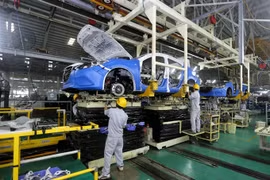
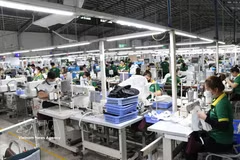
Hyundai trucks at the Truong Hai Auto Corporation’s manufacturing plant in Quang Nam province (Source: VNA)
Hanoi (VNA) - Most of the domestic auto industry went into a tizzywhen Decree 116 tightening controls over the import and assembly of cars wasissued in October, and days away from its official implementation, the worriesand divisions remain.
Though Decree116 took immediate effect when it was issued on October 17, it wasannounced that implementation will begin on January 1, 2018 to give all firmstime to meet the new requirements.
At a recent meeting held by the Ministry of Transport (MoT), the Truong HaiAuto Corporation (Thaco), a leader in the domestic market, reiterated itscomplete support for the decree, saying its provisions were appropriate andfeasible.
Thaco representative Nguyen Hung Minh said that since the company was fullydomestic, importing wholly assembled vehicles straight from Japan, it wouldhave no problem complying with the new requirements.
Also speaking in concord with Thaco was Hyundai Thanh Cong (HTC), officialdistributor of Hyundai vehicles in Vietnam.
HTC representatives said at the meeting that the decree’s provisions on qualitycertification, which has generated a lot of complaints from importers andassemblers, should be seen as the basis for restricting imports of poor qualitycars into Vietnam, protect consumers and make the market more equitable.
They also said, in contradiction to complaints of it being a redundant,expensive provision, that the inspection of a sample vehicle from each importedbatch of cars was needed to ensure genuine warranty and maintenance facilities.
The rationale behind the support of these two firms was the belief that the newdecree would enable Vietnamese importers to act on behalf of foreignmanufacturers in recalling orders or assuring customers of product quality andafter-sales services.
However, the Japan Business Association in Vietnam said that some automobileassembly and importing joint ventures have been asking that implementation ofDecree 116 be postponed for at least six months so that they can arrange thenecessary paperwork.
Representatives of Suzuki Vietnam said at the meeting that importers in thesouth would have to transport their vehicles to Hanoi for inspection, whileFord Vietnam complained that the random sampling of imported vehicle batcheswould complicate procedures, increase costs as well as time taken to clear thevehicles.
In response, Dang Viet Ha, Deputy General Director of the Vietnam Register,said that the random sampling and inspection process will be objective andtransparent, and carried out in a swift and accurate manner.
According to Decree 116, in order to obtain an operating and selling license,enterprises are required to legally own, contractually lease or authorisevehicle servicing premises that conform to prescribed requirements.
Importers must also have documents showing that they are authorised to act onbehalf of foreign automotive manufacturing and assembling enterprises recallingimported vehicles.
After the decree was issued, the Vietnam Automobile Manufacturers Association(VAMA) sent four recommendations to the Prime Minister’s Office and relatedministries, said the Hanoi People’s Committee’s official news site Kinh te& Do thi.
The association argued that several of the decree’s requirements would wastethe firms’ time and resources.
Speaking at the meeting, Tran Thanh Hai, Deputy Director General ofthe Trade Ministry’s Import-Export Department, said that despite theirincessant complaints, importers have been scrambling to obtain the neededlicences.
He also said that Decree 116 was a supportive measure for domestic companies toset up a number of technical barriers to limit the number of imported cars.
Though import tariffs for vehicles from ASEAN countries will be set to zero,the decree would ensure there was no “wave of cheap cars,” that would hit thedomestic market, he said.
Imported car prices could go up in the first few months of 2018 due to a supplyshortage as some importing firms struggle to meet the new requirements, Haisaid.
Responding to the firms, representatives from the Ministry of Industry andTrade (MoIT) and the MoT said that application of the regulations was still inprogress.
Tran Quang Ha, Deputy Director of the MoT’s Department of Science andTechnology, said that the firms’ opinions on Decree 116 will be taken intoconsideration for future adjustments, like allowing batch test results to bevalid for a period of six months.
According the General Department of Vietnam Customs, as of December 15, 2017,90,611 vehicles worth 2.1 billion USD were imported into the country.-VNA
VNA