Vietnam acts to combat white pollution

The Vietnamese Government has issued a lot of policies, participated in various forums, and promoted international cooperation, demonstrating its activeness and affirming its determination to reduce plastic waste and join global efforts toward a planet without white pollution.
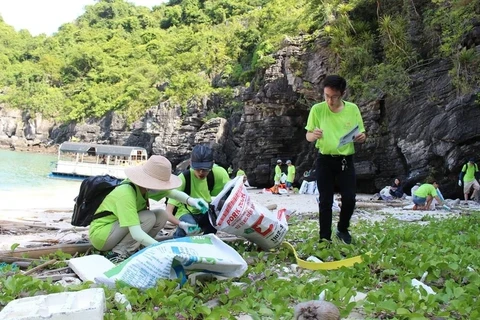
Vietnam acts to combat white pollution ảnh 1Hue people exchange trash for gifts at Plastic Reduction Day in Thua Thien-Hue province in 2024. (Photo: VNA).
Hanoi (VNA) - The Vietnamese Government has issued a lot of policies,participated in various forums, and promoted international cooperation,demonstrating its activeness and affirming its determination to reduce plasticwaste and join global efforts toward a planet without white pollution.

According to the Ministry of NaturalResources and Environment, Vietnam's per capita plastic use has increasedrapidly, from 3.8kg a year in 1990 to 41kg in 2015 and about 54kg currently. Theincreasing consumption will lead to rises in plastic waste, the risk of whitepollution, as well as the pressure on the environmental management system, unlesseffective and scientific management is conducted.

On December 4, 2019, the Prime Ministerissued a decision announcing the National Action Plan on Ocean Plastic WasteManagement by 2030.

It aims to reduce 75% of plastic waste inseas and oceans; collect 100% of lost or abandoned fishing gears and put anend to the disposal of fishing tools directly into the sea; ensure 100% of touristareas, attractions, accommodation establishments and other coastal tourismservices suppliers do not use single-use plastic products and non-biodegradableplastic bags; and 100% of marine protected areas are free of plastic waste.

Following the plan, the ministry officiallyapproved a project on reducing ocean plastic waste in Vietnam. The project,funded by the German Ministry of Environment, Nature Conservation and NuclearSafety through the World Wide Fund for Nature (WWF), has been implemented in 10areas of Da Nang city and eight provinces.

At the World Economic Forum (WEF) Annual Meetingin Davos, Switzerland, in 2019, the Minister of Natural Resources andEnvironment and a WEF representative signed a Letter of Intent related to plasticwaste treatment and the building of a circular economy, aiming to help Vietnamparticipate in the Global Plastic Action Partnership (GPAP). To implement theGPAP, a project on strengthening plastic waste management in Vietnam wasapproved by the Prime Minister in 2021. On November 19, 2021, the Minister ofNatural Resources and Environment issued a decision on the establishment of a working group to implement the National Plastic Action Partnership (NPAP)programme in Vietnam.

On March 7, 2024, Deputy Minister ofNatural Resources and Environment Le Cong Thanh signed a decision publising aplan to implement NPAP activities and participate in international forums onplastic waste in 2024.

The plan aims to support and enhance theoperation effectiveness of technical groups established within the framework ofthe NPAP based on main pillars of innovation, finance, policy, gender equality and inclusive development, and communications and awareness improvement.

In addition, the Institute of Strategy andPolicy on Natural Resources and Environment under the Ministry of NaturalResources and Environment is coordinating with the United Nations EnvironmentProgramme to build steps to implement a project on enhancing the capacity ofplastic pollution management in Vietnam.

It includes two component projects onstrengthening plastic pollution control through promoting monitoring activitiesin Vietnam to provide information for the management and policy making process,and on intensifying plastic waste value chain management in target provinceswith river basins through promoting circular economic models and innovativesolutions to prevent plastic waste at source./.
VNA

See more

BUYO Bioplastics' biodegradable plastic products are made from brewer's grains and sugarcane bagasse. (Photo: nhandan.vn)

Vietnam urged to shift from plastic waste treatment to full life-cycle management

For years, efforts to tackle plastic pollution in Vietnam have focused mainly on waste collection, recycling and disposal. However, as sustainable development and green trade standards become increasingly important, specialists argued that a broader approach is needed, covering everything from product design and material selection to production, consumption and recycling.

Bang Mo volcano in Lam Dong province (Photo published by VNA)

Lam Dong optimises value of UNESCO Dak Nong Global Geopark

Alongside conservation, Lam Dong aims to tap the geopark's tourism potential through geological, ecological and community-based tourism. Infrastructure and tourism development projects must ensure that heritage values, landscapes and the natural environment are preserved.

Dr. Dang Trung Phuoc (left) is introducing the history and origin of the Pinhey sand dunes (Photo: VNA)

Vietnamese Canadian scientist revives forgotten ecosystems

From restoring an ancient sand dune ecosystem in Canada to promoting the conservation of Vietnam's coastal dunes, native forests and ecological corridors, Vietnamese-born scientist Dang Trung Phuoc has remained committed to using science to revive ecosystems long misunderstood or neglected. His quiet but sustained efforts reflect both a scientist's responsibility to the communities he serves and the enduring commitment of a Vietnamese expatriate to his homeland.

Police and military forces work together to rescue people and assist local residents in affected areas. (Photo: VNA)

PM orders proactive response to heavy rainfall in northern mountainous region

To minimise casualties and damage to public and private property, the PM instructed ministries, sectors and local authorities to strictly implement directions issued by Party General Secretary and State President To Lam, as well as the Government's directives on strengthening disaster prevention and response in 2026.

A view of the Ea So Nature Reserve in Dak Lak province (Photo: VNA)

Rare wild animals released into natural habitat in Dak Lak

Among them are two species classified under Group IB of Vietnam's protected wildlife list, namely the Bengal slow loris (Nycticebus bengalensis) and the Sunda pangolin (Manis javanica). Both are endangered forest species protected under Vietnamese law and are prohibited from commercial exploitation or use.

A large-timber plantation model in Gia Lai province (Photo: VNA)

96-million-USD project promotes agroforestry to cut emissions

The Reduction of Emissions in the Central Highlands and South Central Coast of Vietnam (RECAF) project will run from 2026 to 2031 across the provinces of Dak Lak, Gia Lai, Lam Dong, and Khanh Hoa covering about 145,000ha, according to the International Fund for Agricultural Development (IFAD).

Crested goshawks are handed over by the People's Committee of Dong Le commune, Quang Tri province. (Photo: VNA)

Quang Tri rescues six rare wild animals

The animals are now receiving quarantine, treatment and specialised care. Once recovering their physical condition and wild behaviour, they will be reassessed for release back into the wild.

The Ministry of Industry and Trade has reported initial signs that the fuel is helping reduce emissions and protect the environment. (Photo: VNA)

E10 biofuel shows initial environmental benefits: Ministry

An official said the initial results indicate the nationwide rollout has begun to achieve its intended objectives, but more comprehensive monitoring over a longer period, with a wider observation network and more frequent measurement, is needed for a precise and objective assessment.

Forest development in Phan Son commune, Lam Dong province. (Photo: nhandan.vn)

Vietnam lays groundwork for transparent carbon market

Experts say the launch of the trading platform is only the first step. The long-term success of the market will depend on a transparent system backed by robust measurement, reporting and verification (MRV) standards to ensure every transaction reflects genuine emissions reductions.

A rubber plantation are in Dong Nai province. Vietnam has more than 900,000 ha of rubber plantations, with over 60% operated by smallholders. (Photo: VNA)

Rubber traceability accelerated as EU deforestation regulation deadline nears

Speaking at a conference held recently in Ho Chi Minh City to gather feedback on draft EUDR compliance guidelines for the rubber sector, Nguyen Quoc Manh, Deputy Director of the Plant Production and Protection Department under the Ministry of Agriculture and Environment, said that Vietnam had spent the past three years preparing for the regulation through awareness campaigns, training programmes and coordination with ministries, local authorities and businesses.