Vietnam affirms efforts to use atomic energy for sustainable development

Vietnamese officials affirmed the country’s consistent efforts to guarantee nuclear safety and security and to apply atomic energy in service of sustainable development during a recent meeting with representatives of the International Atomic Energy Agency (IAEA).
Vietnam affirms efforts to use atomic energy for sustainable development ảnh 1The nuclear reactor in Da Lat city (Source: vinatom.com.vn)

Hanoi (VNA) –Vietnamese officials affirmed the country’s consistent efforts to guaranteenuclear safety and security and to apply atomic energy in service of sustainabledevelopment during a recent meeting with representatives of the InternationalAtomic Energy Agency (IAEA).

The meeting took place on thesidelines of the IAEA Board of Governors’ regular meeting held in Vienna on June 6 - 10, according to the Chemicals Arm underVietnam’s Ministry of National Defence.

The Vietnamese officials,including Ambassador Nguyen Trung Kien, Governor - Permanent Representative ofVietnam to the IAEA, and Col. Nguyen Dinh Hien, Deputy Commander and Chief of theStaff of the Chemicals Arm, appreciated the IAEA’s assistance to its member states, including Vietnam, to apply nuclear technology to responding toglobal issues and serving sustainable development, especially in the COVID-19combat.

They stressed the need forpromoting personnel training as well as bilateral and multilateral cooperationin dealing with radiation and nuclear incidents.

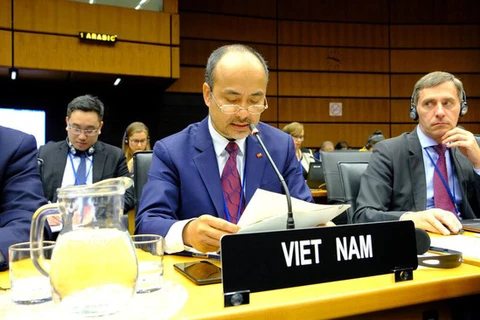
Vietnam affirms efforts to use atomic energy for sustainable development ảnh 2Ambassador Nguyen Trung Kien, Permanent Representative of Vietnam to the IAEA, addresses the regular meeting of the IAEA Board of Governors in Vienna. (Source: VNA)

Vietnam expressed itsattention to the application of nuclear energy and technology to such areas ashealth care, biology, agriculture, industry, and environment so as to boostsocio-economic development and improve people’s living standards.

It noted that developingnuclear energy will help ensure energy security, particularly amid soaringfossil fuel prices, and realise the international agreements on climate changeresponse and environmental protection to which Vietnam is a party.

The Vietnamese side proposedthe IAEA continue helping the country perfect the relevant legal framework anddevelop nuclear technology to achieve sustainable development, build responseplans for nuclear incidents, and train high-quality manpower in this field.

They also called on theagency to step up discussion of the amendment and supplementation ofstandards for nuclear security, safety, and incident response as nucleartechnology is developing strongly at present.

For their part, IAEAofficials, including Deputy Director General Lydie Evrard, said the agency willalways support Vietnam to apply nuclear technology for peaceful purposes.

The cooperation with Vietnamin some areas like agriculture and pandemic response has proved successful andis a model for the IAEA’s partnerships with other member countries, they went on.

The IAEA said it will sendVietnam’s proposals to its relevant units for consideration, adding that itwill organise more cooperation activities to help its members, includingVietnam, improve their readiness for and response to radiation and nuclearincidents in the time ahead, when the COVID-19 pandemic is basically broughtunder control./.

VNA

See more

Deputy Minister of Foreign Affairs Le Thi Thu Hang and non-resident foreign ambassadors at the meeting (Photo: VNA)

Deputy FM hosts non-resident ambassadors attending 14th National Party Congress

The 14th National Party Congress is a milestone in Vietnam’s development, as it not only reviews and assesses 40 years of Doi moi (Renewal), but also sets out orientations for national development in the 2026–2030 period, with a vision to 2045, through strong and right decisions to guide the country into a new era of development.

Professor Zhu Chenming, Honorary Director of the South Asia–Southeast Asia Research Institute under the Yunnan Academy of Social Sciences. (Photo: VNA)

14th National Party Congress: Bridging the past and the future

Zhu said the congress plays a crucial role in shaping Vietnam’s future development, as it discusses development pathways and policy directions to achieve targets set for 2030 and realise the long-term vision towards 2045. The convening of the congress is truly a major political event in the life of the Vietnamese people.

Dr. Kin Phea, Director of the International Relations Institute under the Royal Academy of Cambodia (RAC). (Photo: VNA)

Vietnam’s progress tied to Communist Party of Vietnam leadership: Cambodian expert

In his presentation at a recent seminar hosted by the Vietnamese Embassy in Cambodia, Dr. Kin Phea described the the 14th National Congress of the CPV as a historic and momentous event, saying that with three strategic breakthroughs and six key tasks set for the country’s new revolutionary period, the Congress is seen as a landmark ushering in a new era - the era of the nation’s rise.

General Secretary of the Communist Party of India (CPI) Doraisamy Raja (Photo: VNA)

Vietnam advances creative, adaptive socialism for new era: Indian Communist Party leader

The 14th National Congress of the CPV comes at a critical juncture, as the world faces profound upheavals marked by escalating geopolitical tensions, economic instability, and deep structural crises within global capitalism. Against this backdrop, Vietnam’s decision to pursue a new growth model driven by science, innovation, and digital transformation reflects strategic vision, confidence, and a clear grasp of the requirements of the times.

Deputy Minister of Foreign Affairs Le Thi Thu Hang welcomes journalists and updates them on a number of achievements Vietnam has attained in recent years. (Photo: Ministry of Foreign Affairs)

Deputy Foreign Minister meets int’l journalists covering 14th National Party Congress

Deputy Minister of Foreign Affairs Le Thi Thu Hang said the 14th Congress holds special historical significance, marking a major turning point in the country’s development, as it not only reviews and assesses the achievements of 40 years of Doi moi (Renewal), but also defines goals, vision, and major policy decisions to lead Vietnam into a new era of development.

Professor Carl Thayer from the Australian Defence Force Academy, University of New South Wales (Photo: VNA)

Australian expert shows expectations on Vietnamese Party’s groundbreaking decisions

The 14th congress takes place in a context in which Vietnam recognises the need to adjust its “Doi moi” economic development model. Accordingly, one of the key tasks of the coming period is the use of science and technology, innovation, and digital transformation as the main driving forces for the country’s rapid and sustainable development.