Vietnam Airlines – 20 years on the wing

The national flag carrier Vietnam Airlines is celebrating its 20th anniversary this year (1995-2015), a major milestone in its journey to be a prominent airline both regionally and globally.
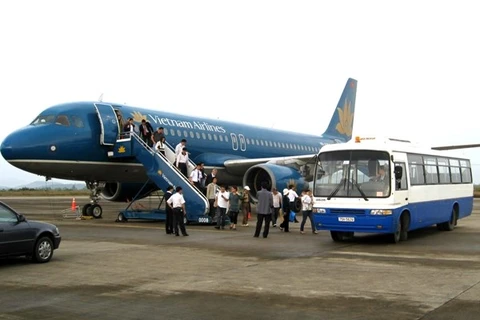
Vietnam Airlines – 20 years on the wing ảnh 1Vietnam Airlines aircraft. (Photo: VNA)

The national flag carrier Vietnam Airlines is celebrating its 20th anniversary this year (1995-2015), a major milestone in its journey to be a prominent airline both regionally and globally.

Vietnam Airlines has expanded its international partnership network by joining SkyTeam, the world’s second largest global airline alliance, in 2010 and signing code-share agreements with 21 airlines and a French national railway firm as well as special prorate agreements with 92 others by the end of last year, said Pham Viet Thanh, Chairman of the airline’s Director Board said.

Beginning with 25 international and 18 domestic routes in 1995, Vietnam Airlines now operates 57 international routes to 29 destinations alongside 37 domestic routes to 21 destinations.

The airline has served 1.39 million flights for about 160 million passengers, earning around 662 trillion VND (30.35 billion USD) in revenue thus far and paying over 30 trillion VND (1.37 billion USD) in taxes.

It expects to carry 17 million passengers this year, an eight-fold increase from 1995.

Joining the International Air Transport Association (IATA) as an official member in 2006, Vietnam Airlines has been awarded the IATA Operational Safety Audit (IOSA) certificate, a strict safety standard set by the Aviation Quality Services (AQS) that it has maintained since then.

The carrier was ranked as a three-star airline by Skytrax—a United Kingdom-based research consultancy firm—in 2014 and event met more than 80 percent of 972 criteria for four-star or above.

According to Vietnam Airlines General Director Pham Ngoc Minh, the national flag carrier currently has 700 pilots, 1,100 qualified technicians and a fleet of 84 aircraft, compared to 25 jets back in 1995.

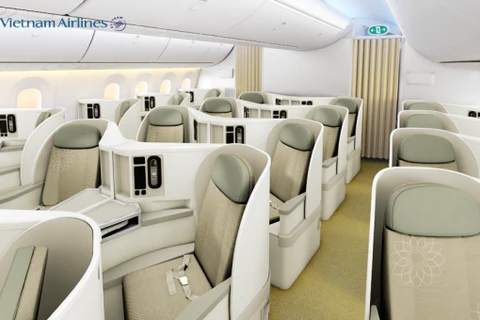
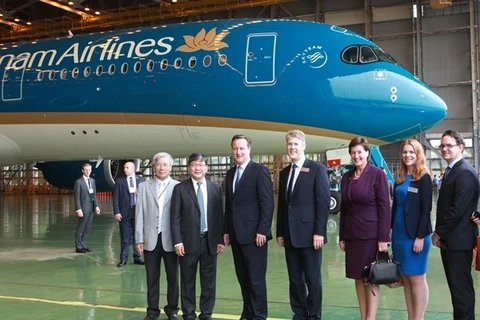
Vietnam Airlines welcomed Airbus A350-900 XWB, the newest member of Airbus’s wide-body family, and Boeing 787-9 aircraft on board in early July this year, making it the second airline in the world, after Qatar Airways, to own an Airbus A350-900 XWB and the first in the Pacific Asia to operate the two new generation jets at the same time.

The acquisitions are part of a plan to replace its old wide-body fleet, including 19 Boeing 787 and 14 Airbus A350 airliners, with the new models for long-haul services by mid-2019.

Coinciding with the roll out of brand new jets was the official launch of a brand-new corporate identity and four-star service upgrade, which extends to new uniforms, lounges, ticket offices, check-in counters, first-class foods and comfort kits among others.

Vietnam Airlines – 20 years on the wing ảnh 2New uniforms launched as part of the carrier's four-star service upgrade. (Photo: Vietnam Airlines)

New services will also be introduced in the near future, including in-flight Wi-fi access.-VNA

See more

The proportion of Vietnamese goods remains high at supermarkets. (Photo: VNA)

Vietnamese brands win over domestic consumers to go global

Amid increasingly fierce global competition, the goal is no longer simply to increase domestic consumption of Vietnamese goods, but to develop strong Vietnamese brands capable of winning consumers through quality, innovation and added value, thereby creating a stepping stone for expansion into international markets.

Illustrative image (Photo: VNA)

Automated VAT refunds to be rolled out from December

As of August 11, VAT refunds rose 32% from a year earlier, reaching 64.4% of the full-year estimate. Tax authorities issued 11,627 refund decisions totaling 111.726 trillion VND (4.26 billion USD), up 9% by volume. The payouts improved cash flow for companies and supported production, trade and exports.

ST25 rice is the centrepiece of the Vietnam Goods Week at Selgros. (Photo: VNA)

ST25 rice officially enters Selgros wholesale supermarket chain in Germany

The placement of ST25 rice on Selgros shelves not only creates an additional opportunity for German consumers to access Vietnamese rice products, but also contributes to efforts to increase the added value of Vietnamese agricultural products by shifting the focus from volume to quality, branding and value.

Trains on the elevated section of the Cau Giay – Nhon route in Hanoi provide convenient transportation for local residents. (Photo: VNA)

Multimodal connectivity to drive Vietnam’s transport infrastructure

Under the proposed approach, roads would serve mainly as connectors and for first- and last-mile transport; railways would handle large volumes over long distances; maritime transport would serve import and export cargo; inland waterways would carry large volumes at low cost; and air transport would focus on fast delivery and high-value goods.

Amata Industrial Park in Dong Nai city (Photo: VNA)

Green shift powers investment in southeast Vietnam

The Amata Industrial Park in Dong Nai City, established 32 years ago and covering more than 500ha, is home to over 160 domestic and foreign businesses. Selected in 2020 as one of three national pilot sites for conversion into an eco-industrial park, Amata has raised its compliance with the international eco-industrial park framework from 41% to 86% in 2024, and is working towards becoming Dong Nai's first certified eco-industrial park.

At a port in Ho Chi Minh City (Photo: VNA)

Multi-channel capital mobilisation needed to achieve double-digit growth

The Ministry of Finance estimates development investment for 2026-2030 at a minimum of 38.5 quadrillion VND (1.48 trillion USD), or about 40% of GDP. The state budget is expected to provide only about 20%, or more than 7.7 quadrillion VND, leaving over 80%, or more than 30 quadrillion VND, to be raised from the broader economy. That makes expanding capital mobilisation channels beyond bank credit essential.

An aerial view of the Nhieu Loc – Thi Nghe area in Ho Chi Minh City. The southern metropolis is home to the Vietnam International Financial Centre. (Photo: VNA)

Vietnam International Financial Centre launches membership registration system

Integrated into the official Vietnam International Financial Centre portal at vifc.gov.vn, the online system for registering and recognising members provides a unified online service channel through which investors, organisations and businesses can complete procedures related to membership, from new registration and recognition to information updates and termination of membership.

At a tax office in Hung Yen province (Photo: VNA)

Finance ministry moves to cut business costs, spur growth

Tax policy is among the solutions with the most direct impact on companies. Rather than prioritising near-term revenue collection, fiscal policy is being run to help them preserve cash flow, expand production and build more sustainable revenue sources.

In the Kim Long Motor Hue factory (Photo: VNA)

Hue courts capital to turn industrial zones into growth engine

The economic and industrial zones in Hue city host more than 200 active investment projects worth over 152 trillion VND (5.84 billion USD), with 139 already operational. Since the start of 2026, they have generated about 32 trillion VND, contributed 4.2 trillion VND to the state budget and brought in 730 million USD in exports, while employing more than 46,000 workers.